Toyota plant turns to solar power
28 May 2008
Power Electronics / Power Management
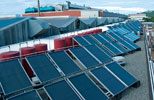
Companies with large industrial plants will benefit from finding alternative energy resources in the face of Eskom's major power shortage. The electricity service provider has requested a reduction in power usage of 10% over all business sectors in order to reduce demand by 3000 Megawatts. Toyota's manufacturing plant in Durban is one of the first to install solar panels.
South Africa's growing economy has put huge strain on electricity usage. South Africa's electricity demand has been increasing at 15% a year, placing considerable strain on existing infrastructure. "We would like to work together with Eskom's new task team to aid in load reduction. This will ensure that our economy does not suffer loss from unnecessary load shedding," says Ferdi de Vos, Toyota spokesperson.
Renewable energy is a reliable alternative to the traditional kind. In 2006, over 18% of global final energy came from renewable sources. By the end of 2008, Toyota will have installed 270 solar panels into its Durban plant. The company's decision to install solar panels will enable it to operate at full capacity while also reducing demand on Eskom.
Where previously Toyota's Prospecton plant in Durban used electricity and gas to heat water, it will now use energy converted from the sun as a source of heat. Solar panels collect and convert energy from the sun into energy and heat that is then used by nearby buildings.
Toyota's renewable energy project began in 2006 with the installation of 44 x 2,5 m² panels and the second phase was completed in June 2007 when 150 panels were installed. In the third phase of this project, Toyota will install a further 120 panels. While the project has cost Toyota R3,5 million, the company expects to save R95 000 per month on energy costs when the project is completed in the next few months.
The car manufacturer will also reduce carbon dioxide released to the atmosphere by approximately 1350 tons per annum. Environmental impact of electricity use in South Africa is a concern which big electricity users like Toyota need to help address.
Further reading:
Setting a new benchmark for high-power DC load testing
Conical Technologies
Test & Measurement Power Electronics / Power Management
The new ITECH IT8900G/L high-speed, high-power DC electronic load offers a powerful combination of speed, scalability, precision and high-power density.
Read more...
Quality batteries are critical for IIoT
Uniross Batteries
Power Electronics / Power Management
Batteries intended for use in industrial operations must indeed offer complete reliability under extreme environmental conditions, resistance to vibration and harsh environments.
Read more...
12 kW hybrid inverter
Power Electronics / Power Management
Sungrow recently unveiled its next-generation residential energy storage solution, expanding its power range from 5 kW to 12 kW with the introduction of the new MG12RL hybrid inverter.
Read more...
40 W and 75 W railway DC/DC converter
Brabek
Power Electronics / Power Management
RECOM has announced two new cost-efficient DC/DC converters for the rail market with an ultra-wide 11:1 input range to cover all nominal input voltages from 24 to 110 V DC.
Read more...
Power modules for solid-state transformers
RS South Africa
Power Electronics / Power Management
Microchip’s new 3,3 kV silicon carbide modules deliver the required thermal performance and efficiency for SSTs to increase power available for token generation.
Read more...
Solving South African power problems with locally built intelligence
Editor's Choice Power Electronics / Power Management
Smart metering infrastructure in South Africa remains patchy. The rollout has been slow, coverage is inconsistent, and for the most part, granular per-unit measurement simply does not exist.
Read more...
Wide range power module
Power Electronics / Power Management
The latest DC-DC modules from Würth Elektronik are characterised by high resilience to voltage transients on the 24 V bus and an extremely wide input-voltage range from 3,5 V to 38 V.
Read more...
Selecting primary batteries for maximum service life
Uniross Batteries
Power Electronics / Power Management
Primary batteries play an important role in IoT applications. Designed for longevity, they have a high-energy capacity and are often used in standalone applications where charging is impractical or impossible.
Read more...
4 kW e-mobility DC-DC converter
Brabek
Power Electronics / Power Management
The RECOM RMOD4000 series of compact, plug-and-play DC-DC converters is a cost-effective solution to provide isolated 14 V, 28 V, or 56 V DC network rails from a high input voltage between 180 and 950 V DC.
Read more...
Aluminium case upgrade boosts performance
Vepac Electronics
Power Electronics / Power Management
The SQBF Quarter Brick 300 W DC to DC Converter is now available in a newly upgraded metal case designed to deliver improved durability and superior electrical performance across demanding applications.
Read more...









 printer friendly version