SMD placement machine for small and mid-sized production
13 May 2009
Manufacturing / Production Technology, Hardware & Services
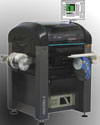
The Pantera–XV SMD placement machine from Essemtec directly addresses prototyping and production runs in mid-sized quantities.
The system provides high placement accuracy and speed, a broad application range, high reliability and low maintenance costs, as well as very short changeover times and excellent cost-performance ratio.
The placement machine handles the entire SMD range from 0201s to 50 x 50 mm QFPs with a fine pitch of 0,4 mm. Designed for the assembly of complex printed boards and fast changeover, the machine offers a large number of feeder slots (up to 108) in a small footprint of less than 1 square metre. All intelligent tape and stick feeders will be recognised automatically, regardless of the feeder slot being used, providing for a fast and error-free changeover process. The tape feeders are motorised and the transport speed is programmable. Also, 0201 chips can be reliably placed at a placement speed rated up to 4500 components per hour.
A further highlight of the system is increased precision, provided by the application of more accurate measuring systems. The resolution of the magnetic linear measuring system is 1 micron; the mechanism is not prone to dirt particles and dust and, therefore, provides high reliability and accuracy. For alignment, an integrated laser system measures small ICs and chip components ‘on the fly,’ and a bottom-up vision system is used for fine-pitch ICs or BGAs. Additionally, another vision system is installed for the automated correction of PCB positions as well as for the teach-in of component locations.
The Pantera–XV can be customised to match the assembly task by a multitude of options. One example is the optional dispensing system for solder paste and adhesive that reduces the cost for stencils in prototyping and also allows for higher flexibility. A further example of the optional flexibility is the exchange of the universal standard magnetic PCB holder system.
The graphic-based software concept supports easy machine operation so that usage and programming can be quickly learned. The programming interface allows for CAD data of layout software to be directly converted in an appropriate assembly program. In the case that such a data set is not available, the components can be placed manually (ie, virtually) by means of an integrated camera.
The SMD placement machine is designed for the flexible assembly of small and mid-sized production volumes. With its solid construction and high reliability, the equipment can also be used efficiently for larger production quantities.
Further reading:
High precision in-line conformal coating inspection system
MyKay Tronics
Manufacturing / Production Technology, Hardware & Services
Conformal coating is widely used to protect electronics from moisture or other environmental hazards. It is critical to know if coatings are properly applied; covering what is meant to be covered and not covering what should be exposed.
Read more...
Soldering day highlights
Manufacturing / Production Technology, Hardware & Services
JAPAN UNIX has published a new event report and highlight video from their UNIX SOLDERING DAY 2026 in Hungary. This event reflects on their commitment to supporting manufacturers not only through soldering automation systems, but also through technical education, live demonstrations, hands-on training, and practical engineering know-how.
Read more...
Clearing the Static: Electrostatic Discharge
Actum
Manufacturing / Production Technology, Hardware & Services
A cordless ESD (Electrostatic Discharge) wrist strap does not work by grounding the person in the same way as a traditional wired wrist strap. Instead, it works by reducing or balancing the static charge on your body so that you are less likely to discharge electricity into sensitive electronic components.
Read more...
Engineering trust in South Africa’s SMT sector
ZETECH ONE
Manufacturing / Production Technology, Hardware & Services
From a small Johannesburg start-up to a trusted SMT technology partner, Zetech One has spent four decades helping South African electronics manufacturers improve production quality, efficiency and reliability.
Read more...
The new reality of PCB material supply
Jemstech
Editor's Choice Manufacturing / Production Technology, Hardware & Services
How resilient manufacturing strategies are helping OEMs navigate a changing global supply chain.
Read more...
Streamlining Device Programming with the AutoBee-D1
Vepac Electronics
Manufacturing / Production Technology, Hardware & Services
The AutoBee-D1 desktop automated programmer is designed to simplify the programming of devices, while delivering consistent accuracy, high throughput and reduced manual intervention.
Read more...
Zero PFAS die attach paste
Testerion
Manufacturing / Production Technology, Hardware & Services
With silver price volatility increasing and sustainability requirements accelerating across semiconductor assembly, MacDermid Alpha Electronics Solutions introduces ATROX CD 560-1, a zero per- and polyfluoroalkyl substance (PFAS) alternate silver filler die attach paste.
Read more...
Precision jet printing for advanced PCB designs
MyKay Tronics
Manufacturing / Production Technology, Hardware & Services
Mycronic’s BA 01 small dot ejector delivers unmatched precision in solder paste jet printing for advanced PCB designs.
Read more...
Strengthening local electronics manufacturing through investment and innovation
Microtronix Manufacturing
Editor's Choice Manufacturing / Production Technology, Hardware & Services
Microtronix South Africa cements its commitment to local manufacturing with ongoing investments in production capacity, skills development, and job creation.
Read more...
Polypropylene pole-top boxes support smarter, more secure electricity networks
Manufacturing / Production Technology, Hardware & Services Enclosures, Racks, Cabinets & Panel Products
As South Africa accelerates the rollout of smart prepaid electricity metering, innovative enclosure technology from Power Process Systems (PPS) is helping utilities improve network security, reduce electricity theft and protect critical electrical infrastructure.
Read more...









 printer friendly version