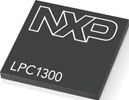
The new LPC1300 microcontroller series from NXP Semiconductors employs the 32-bit ARM Cortex-M3 architecture and achieves performance of 70 MHz while consuming just 200 μA/MHz. This power-performance ratio makes them suitable for applications in battery-powered systems, e-metering, consumer peripherals and remote sensors.
The new MCUs feature a nested vector interrupt controller for fast deterministic interrupts, while the wakeup interrupt controller allows automatic wake. Three reduced-power modes – sleep, deep-sleep and deep power-down – are included to give designer flexibility of control over power consumption.
Communications peripherals include a USB 2.0 full-speed device controller with on-chip PHY, UART, SSP/SPI controller and I²C bus interface. Among the integrated I/O peripherals are 10-bit ADCs with eight channels and conversion rates up to 250 KSps, up to 42 GPIO pins and four general-purpose counter/timers. Also featured are a programmable watchdog timer with lock-out and a system tick timer.
Built around a Cortex-M3 Rev2 processor core, the LPC1300 is equipped with up to 32 KB of Flash and up to 8 KB of SRAM, uses a single 3,3 V power supply (for operation between 1,8 and 3,6 V), and is available in LQFP48 and HVQFN 33 packages. The LPC1300 series is pin-to-pin compatible with the LPC1100 series, NXP’s new family of Cortex-M0 MCUs, giving designers a migration path to the lower-power features of the Cortex-M0 architecture.
In keeping with NXP’s existing line of more than 50 USB-equipped ARM MCUs, the LPC134x offers support for USB full-speed operation. HID and mass storage USB driver software is included in a dedicated on-chip ROM, maximising the amount of Flash memory available for user code. Through third-party suppliers, a range of development and evaluation tools is also available.
1 GHz crossover MCU with Arm Cortex Cores Future Electronics
DSP, Micros & Memory
i.MX RT1170 Crossover MCUs, from NXP Semiconductor, are dual-core devices featuring an Arm Cortex-M7 and Arm Cortex-M4 for real-time microcontroller (MCU) performance and high integration for automotive, industrial and IoT applications.
Read more...NECTO studio update 7.5.0
DSP, Micros & Memory
MIKROE have continued their collaboration with Renesas by introducing support for the RL78 architecture in NECTO Studio, expanding the IDE beyond its existing MCU platforms.
Read more...UFS 5.0 flash for on-device AI EBV Electrolink
DSP, Micros & Memory
UFS 5.0 embedded flash memory solutions, designed to deliver the performance, efficiency and capacity required for the next generation of AI-enabled mobile and edge devices.
Read more...Accelerate development of physical AI deployments Altron Arrow
DSP, Micros & Memory
With Avocado OS now available on the HummingBoard RZ-V2N-
AIoT and SolidSense AIoT V2N from SolidRun, teams can move from prototype to deployed fleet in weeks.
Read more...AI-ready edge MPU for HMIs Future Electronics
DSP, Micros & Memory
The Renesas RZ/G3E MPU is a high-performance microprocessor designed to enable advanced HMI systems with integrated artificial intelligence capabilities at the edge.
Read more...Industrial-grade ESP32-S3 controller
DSP, Micros & Memory
Erqos Technologies has introduced the EQSP32CE, a CE-certified, industrial-grade ESP32-S3 controller designed for developers who want the flexibility of the ESP32 ecosystem in hardware that can be deployed directly into real-world automation.
Read more...Universal NFC device Altron Arrow
DSP, Micros & Memory
Delivering high-end performance in a compact 4 x 4 mm package, the multipurpose NFC reader from ST Microelectronics, enables the convenience of contactless interaction and features for various end applications.
Read more...Java Card-based solution Future Electronics
Analogue, Mixed Signal, LSI
The SECORA ID Key S USB, from Infineon Technologies, is a Java Card-based solution with USB and NFC connectivity for secured authentication and digital signatures.
Read more...Compact low-power 32-bit platform EBV Electrolink
DSP, Micros & Memory
Microchip’s PIC32CM PL10 microcontroller family expands the company’s Arm Cortex-M0+ portfolio, delivering a compact, low-power 32-bit platform designed for cost-sensitive embedded applications.
Read more...Bridging the gap between prototype and production
DSP, Micros & Memory
Choosing between the FRDM i.MX 93, FRDM i.MX 91 and FRDM i.MX 91S development platforms can be intimidating, but once designers understand how each platform aligns with their application’s requirements, the decision becomes straightforward.
While every effort has been made to ensure the accuracy of the information contained herein, the publisher and its agents cannot be held responsible for any errors contained, or any loss incurred as a result. Articles published do not necessarily reflect the views of the publishers. The editor reserves the right to alter or cut copy. Articles submitted are deemed to have been cleared for publication. Advertisements and company contact details are published as provided by the advertiser. Technews Publishing (Pty) Ltd cannot be held responsible for the accuracy or veracity of supplied material.









 printer friendly version