Convection reflow oven
28 October 2009
Manufacturing / Production Technology, Hardware & Services
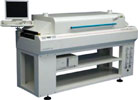
Essemtec’s RO300FC-C is a full convection oven that allows fast and homogenous heating, as well as high-temperature soldering of sensitive electronics. The integrated convection technology offers an innovative and efficient way of heating – with a vertical hot air stream that evenly heats the complete PCB. Both standard and lead-free pastes can be used.
As an innovative new feature, the oven features RO-CONTROL software for increased process simulation and control. RO-CONTROL combines all the important functions for the process evaluation and process control for reflow ovens. This advanced software offers many of the same features as thermal profilers, but for a lower price.
The high air volume of the RO300FC-C guarantees equal heating rates in all the components and the substrate, which leads to a minimum delta-T and guarantees a perfect soldering process at every location on the PCB. This 2 metre long oven offers many of the same options – including chain conveyor for double-sided boards, computer control and an N2 option – as those available on far more expensive ovens.
The temperature of the pre-heat and peak zones, along with the conveyor speed, are programmable to obtain the required soldering profile. Measuring the zone temperatures directly in the convection airflow guarantees reproducible results with low delta-T values (±2°C). Different profiles for solder and glue are already integrated in the microprocessor control. The RO300FC-C can be used for prototypes, small batches and production runs up to 700 boards in an eight-hour shift.
RO-CONTROL software enables the simulation of soldering profiles at different settings and the comparison with a solder paste library. The number of profiles managed with the software is unlimited. The software also controls and supervises the reflow oven, ensuring safe operation. A saved parameter set can be selected from the profile library and can be transmitted to the reflow oven. RO-CONTROL steers and supervises the oven, and the actual status is displayed on the screen. Additionally, the paste editor allows the design and saving of profile references for different solder pastes. These references can be used by the profile simulator for comparison. The software also has the capability to save the process changeover to a lead-free process.
Further reading:
200 W of power in a space-saving design
Vepac Electronics
Manufacturing / Production Technology, Hardware & Services
The Hakko FX-972 Soldering Station delivers high-performance soldering in a compact package, making it suitable for a wide range of soldering applications.
Read more...
FineX: Makes shielding clear
Avnet Abacus
Manufacturing / Production Technology, Hardware & Services
Panasonic Industry launches high-transparency, low-resistance, flexible transparent conductive film for electromagnetic wave shield with pre-applied OCA.
Read more...
Collaboration is now critical
RS South Africa
Manufacturing / Production Technology, Hardware & Services
The message emerging from RS Connect is clear: Organisations can no longer rely on internal optimisation alone to secure performance. Competitive advantage is increasingly being determined by the strength of external relationships, shared capability and coordinated action across value chains.
Read more...
Disruption is the new normal. Effortless is the new competitive advantage.
Seven Labs Technology
Manufacturing / Production Technology, Hardware & Services
Global supply chains have been under pressure for years. The manufacturers still standing are the ones who stopped waiting for normal to return, and started building something better.
Read more...
World-first 016008 mm component placement
Manufacturing / Production Technology, Hardware & Services
Fuji has achieved the world’s first placement of 016008 mm (0,16 x 0,08 mm or 006 x 003 inches) size components on printed circuit boards with its SMT pick and place machine, NXTR.
Read more...
Lifecycle and obsolescence: Protecting electronics through process
Production Logix
Manufacturing / Production Technology, Hardware & Services
At Production Logix, we believe longevity is not accidental. It is engineered through early visibility, structured response, and disciplined execution, in partnership with our OEM customers.
Read more...
Maximising squeegee quality and durability
Testerion
Manufacturing / Production Technology, Hardware & Services
Transition Automation has announced two new product advancements designed to improve SMT printing performance and extend squeegee life: laser-enhanced Permalex bonding and integrated edge protectors.
Read more...
NeoDen ND2 PCB screen printer
ZETECH ONE
Manufacturing / Production Technology, Hardware & Services
The NeoDen ND2 PCB screen printing machine is a fully automatic stencil printer designed to deliver precise and consistent solder paste application in modern SMT production environments.
Read more...
Understanding the BGA rework process
Techmet
Manufacturing / Production Technology, Hardware & Services
BGA rework is a highly technical process that involves removing the faulty component, preparing the circuit board, and installing a new or repaired device, while maintaining the integrity of the printed circuit board.
Read more...
Flexible three-process reflow soldering system
Truth Electronic Manufacturing
Manufacturing / Production Technology, Hardware & Services
By combining multiple soldering technologies within a single system, the Vision TripleX system enables manufacturers to adapt easily to different assembly requirements, board designs, and production volumes.
Read more...









 printer friendly version