


Making the right decision in choosing a contract manufacturing partner is as important as having a good design. Besides the design process, into which much energy and commitment is invariably poured, manufacturing is the most crucial stage of bringing a product to market. Making a poor decision at this point can destroy a product’s chances in the market just as surely as a poor design would.
Manufacturing is a highly complex undertaking with many variables – some of which are outlined below. According to Murison Kotzé, who heads up Tellumat Electronic Manufacturing, it is important to choose a partner, not merely a ‘service provider,’ that can produce a product cost-effectively, to the highest standards and in accordance with the designer’s unique requirements, while providing expert guidance and advice.
All round qualities
Kotzé feels strongly that a partner with a full turnkey offering (ranging from design, prototyping and sourcing to manufacturing, testing and even logistic services) is first prize. “Our partners also benefit from Tellumat’s ability to accommodate production runs of any volume, ranging from a few prototypes to high-volume production runs. These two qualities, namely full turnkey offering and volume scalability, combine to accommodate every aspect of manufacturing assistance a customer may ever need,” he says.
As regards the choice between a full turnkey manufacturer and one that only offers limited services (ie, assembly only), Kotzé points out that market conditions and company strategies are subject to change, and one’s requirements with it. One should therefore ascertain whether their choice of manufacturer will still be able to accommodate them when they decide to outsource another step in the process tomorrow.
As an example of the need for a manufacturer to accommodate variable volumes, he explains that a product’s pre-production phase typically involves low volumes, whereas full production escalates that requirement. It would be exceedingly disruptive to switch from one manufacturer to another halfway through production. It may also be that the product is comprised of both high-volume as well as low-volume components and again, making the right choice in contract manufacturer would mean that these requirements are well catered for.
New products
“At Tellumat we encourage our customers to engage with us during the initial stages of the design process. This enables us to give vital input with regards to design for manufacturability of the product.” Kotzé says. “Engineers who design in isolation are often only concerned about the functionality of the product, forgetting about ‘manufacturability’. Engaging with the appropriate manufacturer during the design phase will help customers design with efficient manufacturing in mind. This will ensure that a high ‘first-pass yield’ (low failure rate) is achieved with no need for costly redesigns, as well as a reduction of manufacturing costs and time to market.”
Of course, this means selecting a manufacturer with engineering expertise and experience. “A good question to ask your prospective manufacturer is ‘how many engineers do you have?’” Kotzé advises. He also notes a few other questions to consider when choosing a manufacturer to take a product from concept to production:
* Do they have a track record of ‘incubating’ new products?
* Are they geared for efficient datapack transfer, configuration management and procurement?
* Can they handle production in prototype, pre-production and high volumes?
* Do they have the ability to design test fixtures and software?
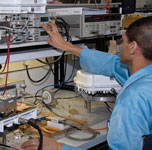
* Would they be able to assist with design qualification, including environmental considerations?
* Do they have experience in obtaining product type approvals and certifications?
Mature products
If a product is not likely to undergo any further design changes, it may be easier to change manufacturers or even split manufacturing between two manufacturers, Kotzé points out. Still, there are strict criteria for a good mature-product manufacturer:
* The ability to produce cost effectively, and keep on engineering the production process to improve efficiencies.
* The capability to produce in the required volume within the required time.
* A full turnkey portfolio handling engineering, testing, procurement and logistics.
* Adherence to internationally accepted standards (ie, ISO9001:2008 certification and adherence to the IPC workmanship standards).
* After-sales support including in- and out-of-warranty returns and repairs, product maintenance and continued product support.


Specialised industries
Kotzé maintains that contract manufacturers do not generally need an in-depth knowledge of every one of the diverse industries they manufacture for. “What is important is that they are experts in electronic manufacturing, and that they adhere to best practices that result in a high first-pass yield.”
However, there are cases where specialist knowledge is essential. “If your product requires specialised testing, you should confirm that your manufacturer has the right equipment and technical expertise for that,” he says. “As an example, Tellumat has vast experience and knowledge in the field of radio frequency products. This allows us to cater for customers who require this specialist production capability that they may not find elsewhere. Also, industries like defence, automotive, medical and aerospace have strict conformance specifications. Successfully manufacturing for these industries requires a certain amount of experience and industry specific knowledge.”
What about the east?
According to Kotzé, it is vital to revisit perceptions about cost. “Cost is often cited as a major reason why some customers opt for ‘low cost’ Eastern manufacturers, but the truth is that South African manufacturers can today provide similar or even better service at a comparable cost.
“It is still possible to achieve manufacturing cost savings in some cases, but these will often be eroded by the additional resources required to manage production in the East – often necessitating on-site personnel, researching production sites, and the logistics involved in shipping finished product back to South Africa. There is also the very real possibility of having intellectual property compromised, and one cannot always be sure that only original, quality components are used in making their product,” he adds. “In addition, while local manufacturers have in the past struggled to source components at competitive prices, the SA components distribution industry is improving constantly.”
Additional considerations
Proximity
“There are times when close proximity to one’s manufacturer is useful (in the Far East, for example, logistics, language and time zone all play a role), but proximity in and of itself is not a proper basis for selecting a manufacturer,” Kotzé says.
“Companies sometimes base their decision almost solely on proximity, as this allows them to be able to spend time at the manufacturer to sort out problems when they occur. This reasoning is, however, flawed. Firstly, if there are many issues that the manufacturer cannot resolve without the customer’s assistance, it probably means that they do not have the appropriately skilled people and may mean that the wrong partner was chosen. Secondly, outsourcing entails relinquishing a non-core business process. If one has to spend an excessive amount of time at their manufacturer then they are not really outsourcing this business process, they have just moved their manufacturing premises.”
Empowerment
“In South Africa, Black Economic Empowerment (BEE) is an increasingly important aspect of any business and the choice of manufacturer should not overlook this very important factor. “As Tellumat is rated a level 4 contributor to BEE, our customers can claim 100% of their production costs as preferential procurement,” Kotzé points out.
After-sales support
Lastly, it is important to consider whether the manufacturer in question offers comprehensive after-sales support. “Tellumat’s customer service centre allows us to effectively handle any requirement for in- and out-of-warranty repairs, upgrades or refurbishments,” says Kotzé. “There are definite benefits in having a product maintained by the same company that manufactured it.”
Bottom line
One’s choice of contract manufacturer is a weighty issue that ultimately comes down to being able to check the boxes next to some key factors. Even in a country with good manufacturing credentials like South Africa, it is important to ask the right questions.
For more information contact Murison Kotzé, Tellumat Electronic Manufacturing, +27 (0)21 710 2241, mkotze@tellumat.com, www.tellumat.com






© Technews Publishing (Pty) Ltd | All Rights Reserved
 printer friendly version