


Power supply provision for complex systems has made remarkable progress in recent years, accurately delivering an ever-increasing range of power rails, with constantly-improving efficiency, while occupying less and less circuit board area.
To further this trend, power systems architects have developed a number of configurations, notably – in large-system installations such as networking and communications infrastructure – DPA (distributed power architecture) and IBA (intermediate bus architecture).
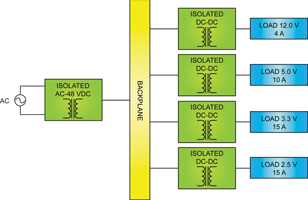
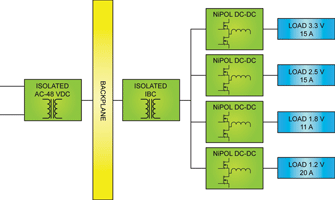
In DPA, incoming AC is converted to a DC voltage backplane which is either 36 V–75 V or a narrower range of 36 V–60 V; individual isolated DC-DC converters are then used to convert down to each required voltage directly from the input bus. IBA converts AC to the same DC backplane ranges as DPA; for the wide range requirements a regulated or semi-regulated, isolated bus converter (IBC) is employed to decrease the high voltage down to a level selected to match the needs of downstream narrow-range, non-isolated point-of-load converters (NiPOLs), that produce a regulated output voltage for each load.
In general, DPA yields the best figures for efficiency due to the lower number of ‘serial’ conversion stages and lower distribution losses of the input bus, but tends to be more expensive and to occupy more board area (or cabinet volume). IBA evolved in an effort to reduce the board area and cost of the DPA but does so at the potential expense of lower overall efficiency.
Best of DPA and IBA combined
Further progress would be enabled if component- and module-level technology permitted the efficiency of DPA, with the size benefits of IBA. That technology is now a reality in the shape of Picor’s Cool-Power PI3101 isolated DC-DC converter (Figure 1).
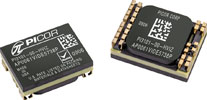
The PI3101 is a 3,3 V output, 60 W converter which yields a power density of 24,4 W/cm³ and 16,28 W/cm² while operating across a wide input voltage range of 36 V–75 V. The efficient, soft-switching power architecture, combined with an innovative integrated power-system-in-package (PSiP) packaging concept – the module looks, and can be handled, more like an IC than a power supply – allows the power of an isolated 1/16th brick to be produced in a package that is less than half the size, at just 22 x 16,5 x 6,7 mm. The PI3101 contains all of the necessary circuitry for a completely isolated and regulated power supply, with external trimming, soft-start capability and full protection.
Reducing size is a worthwhile ambition in any power supply, but in the context of today’s high-performance systems the benefit is increased because of the throughput of the host system. Every square millimetre of PCB area devoted to ancillary systems has a higher cost in terms of the greater system throughput that might have been achieved if that board area had been used to enhance functionality.
PCB area saving
Consider the DPA configuration shown in Figure 2. The likely approach before the PI3101’s availability would consist of four 1/16th bricks to produce the regulated output power. With the proper complement of product variants of the PI310x Cool-Power family, the total system size could be reduced in half.
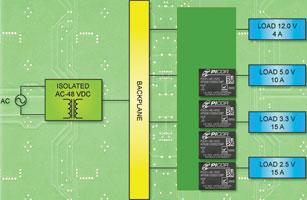
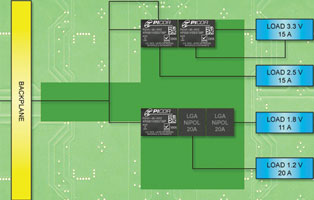
Now, consider the IBA solution shown in Figure 3. If the input bus is a wide-range 36–75 V and a fixed bus IBA is used, and for the level of input power to the board, the isolated converter will probably need to be an 1/8th brick followed by independent surface-mount of vertical-mount NiPOL’s to step down to each load voltage. The resulting system could be reduced in size using a PI310x Cool-Power based solution for the 2,5 V and 3,3 V rails and a further PI3101 that provides a 3,3 V input into high density NiPOLs for the 1,x V rails. Depending on whether the implementation is via surface-mount or a vertical-mount assembly, the space savings can be between 40% to over 75%. Figure 4a and Figure 4b illustrate the savings when using Cool-Power based solutions versus traditional DPA and IBA schemes.
The fully isolated PI3101 is only 5,6 mm longer than state-of-the art, high-density, non-isolated DC-DC converters, and in terms of height it is also thinner than typical DOSA DC-DC converters, making iPOL (isolated point-of-load) conversion a reality. The PI3101 allows 48 V bussing of isolated power to be applied right to the low-voltage point-of-load for enhanced flexibility.
Finding the space for a discrete design
An alternative strategy that is open to engineers is to design a custom converter. To meet power demands in the class of application outlined above, a starting point would be to select a synchronous flyback converter IC which does not require optical feedback. A typical state-of-the-art example from today’s market comes with a reference design for 40 W, or 12 A at 3,3 V, output. The parts count – promoted as low, compared to other devices in the same class – is around 45 components, possibly including two custom-wound inductive parts. The specified transformer alone is larger than the PI1301 and – even after placing and routing all 45 parts – the design delivers only 2/3 that of the Cool-Power module.
Other applications
The PI310x family is well suited for the new high-power standard of power-over-Ethernet (PoE). The smallest implementation of Ethernet power supply can be supported by a single Cool-Power solution up to the maximum allowed power supported by the standard. The light weight of the PI3101 also makes it very attractive to weight-sensitive applications such as aircraft and man-mobile equipment. The PI3101 can also be adapted to support remote sensing for those applications requiring very tight regulation.






© Technews Publishing (Pty) Ltd | All Rights Reserved
 printer friendly version