


The growing use of micro-grids is reshaping how electrical power is produced and managed. Instead of relying solely on large, centralised generation, micro-grids combine distributed energy resources such as solar PV, wind turbines, battery energy storage systems, and controllable loads. The result is a system that can operate more efficiently, ride through disturbances, and in some cases function independently of the main utility supply.
At the same time, the rapid expansion of electric vehicle charging infrastructure is adding a new layer of complexity. Modern EV chargers are built around fast-switching power electronics, and their demand can change almost instantly. In vehicle-to-grid applications, they can even send power back into the network. For engineers responsible for micro-grid design and validation, this creates a challenging test environment.
To replicate these real-world conditions in a controlled manner, specialised grid simulation equipment is required. The IT7900EP series high-performance regenerative grid simulator from ITECH is designed specifically for this purpose. It is a full four-quadrant AC grid simulator capable of both sourcing and sinking power.
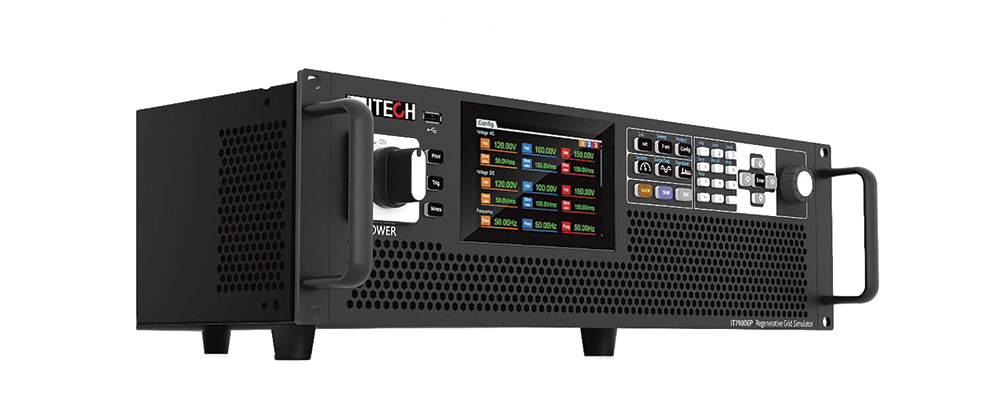
In simple terms, four-quadrant operation means the simulator can handle all combinations of voltage and current polarity. It can deliver active power to a device under test, absorb power returned from it, and independently control both active and reactive power. This is essential in micro-grids, where inverters, storage systems, and chargers frequently switch between importing and exporting energy, sometimes within milliseconds. The IT7900EP maintains tight control of voltage, frequency, and phase during these transitions.
One of its key advantages is regenerative operation. When a connected device feeds energy back, for example during V2G operation, that energy is returned to the utility rather than dissipated as heat in load banks. For high-power, long-duration testing at tens of kilowatts, or even into the megawatt range, this approach reduces wasted energy, lowers cooling requirements, and cuts operating costs.
Four-quadrant capability is particularly important when validating grid-forming and grid-following inverters, droop control strategies, virtual inertia functions, and advanced micro-grid controllers. It also enables accurate testing of reactive power support and power factor control under both inductive and capacitive conditions, as well as simulation of weak grids with limited short-circuit capacity.
EV chargers deserve special attention. Fast DC chargers can ramp from zero to full output in milliseconds, and bidirectional chargers can reverse power flow just as quickly. A simulator such as the IT7900EP allows engineers to observe how voltage and frequency respond during these events without exposing live infrastructure to risk. Reactive power injection and absorption can be tested independently, ensuring compliance with grid codes and micro-grid control strategies.
Power quality is another concern. EV chargers introduce harmonic currents that interact with other distributed resources. With low intrinsic total harmonic distortion and programmable waveform distortion, the simulator makes it possible to study harmonic behaviour under controlled importing and exporting conditions.
For system-level development, the IT7900EP can be integrated into power hardware-in-the-loop setups, acting as the physical interface between real equipment and a real-time digital model. This enables realistic validation of load, generation, and reactive support scenarios that are difficult to capture in software-only simulations.
As micro-grids become more dynamic and bidirectional, accurate four-quadrant grid simulation is no longer optional. Equipment such as the IT7900EP provides the level of control and realism needed to validate performance under demanding, real-world conditions, including the growing influence of EV charging and V2G operation.
For more information contact Conical Technologies,
| Tel: | +27 87 265 2544 |
| Email: | info@conical.co.za |
| www: | www.conical.co.za |
| Articles: | More information and articles about Conical Technologies |






© Technews Publishing (Pty) Ltd | All Rights Reserved
 printer friendly version