27 October 2010Manufacturing / Production Technology, Hardware & Services
UV curing is a technology that arose from the areas of adhesive bonding, printing and lacquering. Based on the principle of polymerisation, adhesive, paint and lacquer that harden when exposed to UV radiation are used. Curing happens in a matter of seconds, which means fast process times combined with superior quality.
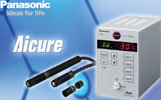
The UJ30 is Panasonic’s latest UV curing product and represents a further development of the successful UJ20 model. Commissioning is possible in just three steps: choose the LED head and necessary lenses; set the UV irradiation intensity; and set the curing time. Moreover, one controller can control up to four different curing processes. By combining four LED heads with wavelengths of 365 nm and 385 nm with 12 different lenses, almost any application involving UV curable resin or lacquer can be realised.
The UV LEDs for the UJ30 series were developed for time-critical applications that require immediate power output yet absolute stability. The heads are available for two wavelengths: 365 nm for standard applications with short cycle times and large distances, or the 385 nm type for curing resins at high volumes or thicknesses. Since the systems work with extremely narrow wavelengths, the entire intensity of up to 9200 mW/cm² can be used for curing, ie, loss of energy in the form of heat is avoided. In this way, the materials meant for bonding are protected from thermal destruction in addition to saving energy. Fans and other cooling elements are not necessary.
Temperature feedback control by way of the sensor heads enables stable irradiation intensity for long-term applications. At the same time, an external signal can be used to activate and deactivate UV irradiation needed only temporarily. In contrast to conventional curing lamps, LED models can be used at 100% intensity immediately after startup.
Weller limited Black Edition soldering station Testerion
Manufacturing / Production Technology, Hardware & Services
Weller’s WE1010 Black Edition Soldering Station is a premium limited-edition soldering station.
Read more...High-voltage X-Ray generators for advanced imaging Vepac Electronics
Opto-Electronics
X-ray has developed a high-performance range of HV generators designed for accuracy, long-term durability, and seamless integration into OEM environments.
Read more...Quick and easy shielding Würth Electronics South Africa
Electronics Technology Manufacturing / Production Technology, Hardware & Services
Würth Elektronik expands its EMC product portfolio with nanocrystalline WE-FNCS sheets.
Read more...Smarter local buying could reboot South Africa’s manufacturing sector
Manufacturing / Production Technology, Hardware & Services
With smarter localisation, clearer procurement rules and a more deliberate industrial strategy, public spending could again become a powerful engine for rebuilding factories, expanding supply chains and restoring confidence in South Africa as a place that makes things.
Read more...Understanding EMI Filters and their applications Vepac Electronics
Passive Components
Electromagnetic Interference (EMI) Filters are essential for maintaining electromagnetic compatibility (EMC), allowing multiple devices to function together without interference.
Read more...Next-Gen Min-ITX motherboard Vepac Electronics
Computer/Embedded Technology
Adding to AAEON’s extensive industrial motherboard portfolio, the Next-Gen MIX-Q870A1 is the company’s most advanced Mini-ITX board to date.
Read more...The effect of seasonal changes on ESD performance in South Africa Actum
Editor's Choice Circuit & System Protection Manufacturing / Production Technology, Hardware & Services
Electrostatic discharge performance is influenced by several environmental factors, with relative humidity being one of the most important. This is particularly relevant in South Africa, where seasonal changes can result in significant differences in humidity levels.
Read more...High precision in-line conformal coating inspection system MyKay Tronics
Manufacturing / Production Technology, Hardware & Services
Conformal coating is widely used to protect electronics from moisture or other environmental hazards. It is critical to know if coatings are properly applied; covering what is meant to be covered and not covering what should be exposed.
Read more...Rugged spectrum analyser Vepac Electronics
Test & Measurement
The HAROGIC PXR Series is designed for maximum durability and performance in the most demanding environments.
Read more...Soldering day highlights
Manufacturing / Production Technology, Hardware & Services
JAPAN UNIX has published a new event report and highlight video from their UNIX SOLDERING DAY 2026 in Hungary. This event reflects on their commitment to supporting manufacturers not only through soldering automation systems, but also through technical education, live demonstrations, hands-on training, and practical engineering know-how.
While every effort has been made to ensure the accuracy of the information contained herein, the publisher and its agents cannot be held responsible for any errors contained, or any loss incurred as a result. Articles published do not necessarily reflect the views of the publishers. The editor reserves the right to alter or cut copy. Articles submitted are deemed to have been cleared for publication. Advertisements and company contact details are published as provided by the advertiser. Technews Publishing (Pty) Ltd cannot be held responsible for the accuracy or veracity of supplied material.









 printer friendly version