Heatsink analysis system
10 November 2010
Circuit & System Protection
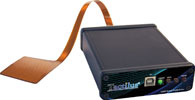
The new Tactilus heatsink analysis system by Sensor Products enables research and design engineers to test and correct the surface contact and pressure distribution between a heatsink and semiconductor.
Even a slight warping of the heat exchange structure or reduction in surface contact area can have a profound effect on cooling efficacy. If the pressure distribution is not uniform, heat conduction will be low, and the electronics may overheat.
With Tactilus, engineers can visualise actual contact forces and pressure distribution data on circuit board components. As the mounting screws between the component and the heatsink are torqued, Tactilus maps and measures the changing pressure distribution between the mating surfaces and displays it through its software. The heatsink interface can be tested, manipulated and repositioned in real time, speeding the trial and error process and eliminating the need for additional assembly. Tactilus also provides the pressure data needed for FEA simulation predictions.
The Tactilus sensor is flexible and only 0,38 mm thick, allowing it to be placed between a device and heatsink without affecting the assembly. The sensor pad has 625 resistive sensing points arrayed on a 25 x 25 grid for a total sensing area of 50 x 50 mm. The scan speed is up to 1000 Hertz and the operating pressure range is 0 to 100 psi (0 to 7 kg/cm²).
The system collects and processes sensor data using Windows-based software that creates pressure vs. time graphs and histograms; performs 2D, 3D and 360° image rendering and region of interest scaling; displays maximum, minimum and average pressures and does force integrations; and prepares reports through export to Excel, ASCII or Access formats. In addition, Dynamic Link Library (DLL) files and the graphical user interface can be tailored to the customer’s request.
The Tactilus sensor system will endure hundreds of diagnostic uses on different heatsinks with consistent repeatability. It is highly resistant to electromagnetic noise, temperature and humidity fluctuations. Accuracy is ±10%; repeatability is ±2%; hysteresis is ±5%; and non-linearity is ±1,5%.
For more information visit www.sensorprod.com/dynamic/heatsink
Further reading:
EMC limits and levels
Altron Arrow
Editor's Choice Circuit & System Protection
As soon as electronics and electrical systems started interfering with each other, the world had to come to some consensus. Considering physics is universal and does not care about what country electrical/electronic products are used in, it should be the same everywhere, right? It is nearly there, but not quite.
Read more...
Clearing the Static: The importance of cleaning in ESD control
Circuit & System Protection
The proper cleaning of ESD-safe areas and equipment such as workstations, floors, mats, trays, and tools using specialised antistatic cleaners is vital to prevent ESD damage.
Read more...
Safety relay for explosive areas
IOT Electronics
Circuit & System Protection
Phoenix Contact has expanded its safety portfolio with the new PSR-MC35-EXI safety relay module, specifically engineered for use in potentially explosive environments.
Read more...
Clearing the Static: Ensuring effective ESD control
Actum
Circuit & System Protection
To maintain reliable electrostatic discharge control, regular testing and accurate measurement are essential, with grounding products and ESD testing equipment being vital.
Read more...
Clearing the Static: The importance of ESD audits
Actum
Circuit & System Protection
An ESD audit is the first step in establishing an effective static control programme in the workplace, and will help identify vulnerable areas and potentially hazardous static zones that require improvement.
Read more...
EMI shielding materials application guide
Circuit & System Protection
TE Connectivity’s shielding solutions include electrically conductive elastomers, gaskets, knitted wire mesh, oriented wire, EMI shielding ventilation panels, shielded window, cable shielding and shielding components.
Read more...
Clearing the Static: ESD containers and packaging
Actum
Circuit & System Protection
Vacuum forming ESD
Electronic components can be damaged by electrostatic discharges. To protect against such damage, electronic assembly parts are often transported or stored in vacuum formed component
...
Read more...
Electrostatic discharge chairs
Actum
Circuit & System Protection
An ESD chair forms an integral part of grounding within the electrostatic discharge protected area to prevent potential damage to products.
Read more...
Conductive ESD footwear
Actum
Circuit & System Protection
Conductive ESD footwear is used in conjunction with other grounding devices, such as a wrist strap, cord, and ESD surface mats, to provide a continuous path to ground.
Read more...
Clearing the Static: The importance of cleaning in ESD control
Actum
Circuit & System Protection
To prevent Electrostatic Discharge (ESD) damage to sensitive electronic assemblies and components, all production, handling, packaging, and storage must take place in an ESD-protected environment.
Read more...









 printer friendly version