


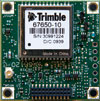
With their high sensitivity, performance and fast startup times, the modules enable system integrators to add GPS capability to a mobile device with little impact on its size or battery life.
The GPS modules are complete, ready-to-go receivers that provide position, velocity and time data with fast acquisition times. Compatible with active or passive antennas, they can be used in portable handheld, battery-powered applications such as sport accessories, PNDs, cameras, computer and communication peripherals as well as vehicle tracking, navigation and security products.
The Condor GPS family includes modules with different form factors and interface options:
The C1011 is packaged in a 10 x 11 x 2,01 mm module, and is aimed at portable navigation products. It features a 36-ball surface-mount interface land grid array (LGA) that can be electrically connected to a PCB by using a socket or soldering it directly to the PCB. The C1919 is a 19 x 19 x 2,5 mm surface-mount format common with the Trimble Copernicus II GPS modules. As a surface-mount module with 28 reflow-solderable edge castellations, the C1919 requires no costly I/O and RF connectors.
The Condor C1722 is a full featured module in the 17 x 22,4 x 2,13 mm form factor. It offers a USB interface, antenna open and short detection, and support for both passive and active antennas. The C1216 supports the same full feature set as the C1722 in a smaller 12,2 x 16 x 2,13 mm form factor. Finally, the C2626 module measuring 26 x 26 x 6 mm leverages the popular Lassen iQ form factor. It features a single 8-pin (2x4) male header connector for power and data I/O.
The Condor modules can generate position fixes with high accuracy in challenging environments and under poor signal conditions (down to -160 dBm). The receiver consumes typically 37 mA at 3,3 V with continuous tracking. In addition, the receivers provide a configurable 1 PPS synchronised to GPS/UTC, typically within 25 nanoseconds (one sigma) and an update rate up to 5 Hz.
Condor GPS modules are capable of receiving Satellite Based Augmentation System (SBAS) corrections, including the US Wide Area Augmentation System (WAAS) and the European Geostationary Overlay Service (EGNOS). They also support GPS assistance (aGPS).
A starter kit is available which includes all the tools necessary to test and evaluate the Condor GPS receiver, including a GPS receiver in a rugged enclosure suitable for testing and data collection; a GPS antenna; PC-based analysis tools; and documentation.
Also available are Antenna Companion Modules (ACM) that combine a GPS receiver and a matched antenna in an easy to integrate module – the Silvana ACM, Anapala ACM, and Zelia ACM. Silvana and Anapala are compatible with both Trimble’s Copernicus II and Condor GPS solutions. Zelia includes a compact Condor C1011.
The Silvana ACM offers an onboard antenna as well as a connector for an external antenna. An antenna detection circuit automatically switches to the external antenna, when connected. Like the Silvana, the Anapala ACM also supports multiple GPS solutions, but instead of an external antenna option, it relies solely on the internal matched antenna.
The smaller Zelia ACM integrates the Condor C1011 with a linearly polarised printed monopole antenna element. It is an omnidirectional antenna ideal for portable device applications. The printed monopole takes up less space than a patch antenna, giving Zelia a smaller size than the other ACMs.
For more information contact Michelle Parreira, CST Electronics, +27 (0)11 608 0070, [email protected], www.cstelectronics.co.za
| Tel: | +27 11 608 0070 |
| Email: | [email protected] |
| www: | www.cstelectronics.co.za |
| Articles: | More information and articles about CST Electronics |






© Technews Publishing (Pty) Ltd | All Rights Reserved
 printer friendly version