


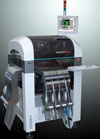
Essemtec’s FLX2011 is an SMT pick-and-place machine aimed at electronics production environments with high product variety and featuring tools and solutions that enable SMT production to react flexibly to unplanned surprises.
The machine is designed to handle emergency or ‘rush’ jobs, where PCB ‘B’ must suddenly be fitted while PCB ‘A’ is running. While the production of product A continues, the operator sets up feeders with the additional components required by product B and installs these feeders on the machine. They can then use the offline programming station to convert the CAD layout data of the PCB into a placement program. Then the operator interrupts the production of product A, inserts a circuit B, loads the assembly program from the network and starts the production. When product B is finished, product A continues. During this time, the machine is standing still only while exchanging PCBs.
Changeover without standstill time is possible thanks to the high feeder count of the FLX2011. Up to 190 components (or 310 in the L version) can be installed simultaneously. The intelligent FLX feeders can be exchanged during operation and they are recognised by the pick-and-place machine automatically. The magnetic PCB holder can be adapted to different PCB formats without requiring any tooling.
For prototype runs, the machine features helpful functions such as the Virtual PCB View, the Pick-Anywhere feature and the Component Verification Unit (CVU).
Virtual PCB View is a software technology which allows the pick-and-place program to be superimposed onto the real PCB. Thus, it is possible to verify before placement if placement coordinates are correct, if IC and diodes are aligned correctly, if the correct component size is used, and if all required components are available on the machine.
The Pick-Anywhere feature enables components to be picked from any location, even without feeders. Any coordinate within the pick-and-place area can be defined as a pick-up location. This feature allows singular components to be handled without feeders or to pick components from small pieces of tape presented on tape strip feeders. It also allows the implementation of customer-specific feeding systems such as vibration or label feeders.
The CVU has been developed for PCB manufacturing in the medical and aerospace industries. Small series of highly-complex PCBs are common in these industries and the production must be fully documented. With CVU, the value and the polarity of each component can be measured and documented prior to assembly. The measurement system is suitable for resistors, capacitors, inductors and diodes.
The FLX2011 is a dispensing machine as well. The assembly head is expandable with two metering valves and can dispense two different liquids. This option most often is used for solder paste and adhesive dispensing, for example, if a stencil is not available or for double-sided PCB assembly. The dispensing program is automatically created from the pick-and-place and the component date – no additional programming is necessary. The sequence of dispensing and placement is free to choose; therefore, special constructions can be manufactured such as component stacks. Different dispensing valves can be installed, such as micro-jet valves, screw valves and time-pressure valves.
FLX software and the magnetic PCB holder allow different PCBs to be combined into a cluster and assembled as one PCB, a useful feature for electronic devices consisting of multiple PCBs.
An MIS (management information system) software package can be installed that provides features such as update of the component stock based on real consumption data from the pick-and-place; identification of each component package (reel, tray, stick); feeder setup control with bar code reader; production and consumption planning; and traceability of the SMD production. The MIS knows the content stock of each component package and the planning module delivers information about availability and possible bottlenecks in the planned production. These values also can be provided to external ERP systems.
Because the MIS identifies each component package individually and requests feeder setup verification with a barcode reader, production data of each PCB can be documented precisely. If required, the MIS delivers all data necessary for tracing a PCB or about the usage of a specific component series.
The FLX2011 placement system is available in a standalone or inline version. Multiple machines can be combined to a line for more placement speed and feeder capacity. But even when inline, each module can either produce as a single machine or in combination with others. Depending on current needs, PCBs can be loaded from left or right. For example, module 1 and 2 are loaded from the left and assemble product A together. Simultaneously, module 3 is loaded from the right and assembles prototype B. If one module fails, the remaining two can still produce with 2/3 of the productivity and production does not stand still.






© Technews Publishing (Pty) Ltd | All Rights Reserved
 printer friendly version