Low dropout regulators deliver more power to the portable world
4 July 2001
Power Electronics / Power Management

Today's increasingly portable world is calling for new ways to regulate voltage while meeting space and high-volume cost demands. The answer, says Analog Devices, lies in its line of anyCAP low dropout regulators (LDOs), that deliver high accuracy, low dropout and stability with any type of output capacitor, including MLCC.
The anyCAP range allows maximum design flexibility, minimum footprint and true system-level benefits that include longer battery life, increased time between charges and the opportunity to use a smaller battery stack. Housed in one of the smallest thermally-enhanced package sizes available - incorporating proprietary leadframe design - these LDOs dissipate up to 30% more power, while considerably shrinking system size.
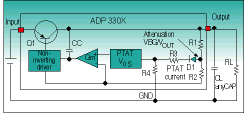
Figure 1. The anyCAP control loop
New topology
The anyCAP uses a patented, new topology - a single loop for regulation and reference functions. This single loop is controlled by a very high gain error amplifier. A unique noninverting driver between the error amplifier and the pass transistor is designed specifically to enable the frequency compensation to include the load capacitor in a pole-splitting arrangement, achieving reduced sensitivity to the value, type and ESR of the load capacitance.
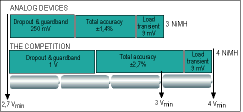
Figure 2. In a cellular phone that operates off three fully discharged NiMH batteries, anyCAP LDOs provide an accurate output of 2,7 V from a 3,0 V ±10% input. Industry standard devices require a fourth NiMH battery to obtain the same minimum output voltage
As low as Zero ESR
Most LDOs place strict requirements on the range of ESR values for the output capacitor because they are difficult to stabilise due to the uncertainty of load capacitance and resistance. Moreover, the ESR value required to keep conventional LDOs stable changes depending on load and temperature. These ESR limitations make designing with other LDOs more risky and more difficult due to unclear specifications based on typical ESR values.
The anyCAP LDOs have no restraints on minimum ESR. The innovative design enables stability even with an MLCC and capacitor values as low as 0,47 mF. The very high regulator gain also leads to excellent line and load regulation with ±1,4% overall accuracy - one of the best in the industry.
Advanced features
With additional features such as a dropout detector, optional noise reduction, current and thermal limiting and a low shutdown current, designers have more ways to improve their portable designs. The anyCAP LDOs come in a variety of output voltages - as well as output current options.
For further information, contact CST Electronics, (011) 452 0706.
Further reading:
40 W and 75 W railway DC/DC converter
Brabek
Power Electronics / Power Management
RECOM has announced two new cost-efficient DC/DC converters for the rail market with an ultra-wide 11:1 input range to cover all nominal input voltages from 24 to 110 V DC.
Read more...
High-precision current transducer
Power Electronics / Power Management
Danisense announces its new high-precision DP12IP current transducer designed for isolated DC and AC current measurement in demanding PCB-mounted power electronics applications.
Read more...
Secure holder for protected 18650 batteries
Power Electronics / Power Management
Designed for protected 18650 batteries up to 70 mm long, the holder offers secure retention for portable, industrial, and embedded applications.
Read more...
More room to scale
Altron Arrow
Power Electronics / Power Management
With the latest STM32H5 lines from STMicroelectronics, you can now scale within the same platform, from a compact 1 Mbyte device to higher-memory MCUs for graphics-rich and feature-heavy designs.
Read more...
Surface mount power amplifier for high-power applications
RF Design
Power Electronics / Power Management
The GNA-63-5W+, from Mini-Circuits, is a GaN MMIC Power Amplifier (PA) designed for demanding RF applications requiring high efficiency, excellent linearity, and a compact footprint.
Read more...
1200 V QSiC modules
Power Electronics / Power Management
SemiQ Inc has launched the QSiC Dual3, a family of 1200 V half-bridge MOSFET modules for motor drives in data centre cooling systems, grid converters in energy storage systems, and industrial drivers.
Read more...
MCOTS transient filter for military applications
RFiber Solutions
Power Electronics / Power Management
SynQor has announced the new MCOTS-F-28-T-HE transient half-brick filter, the latest addition to its MCOTS product family.
Read more...
Expanded range of high-thermal-performance QSiC modules
Power Electronics / Power Management
SemiQ’s half-bridge series for data centre power converters and industrial motor drives features low RDSON SiC MOSFETs and parallel SBD diodes for best-in-class power density and conversion efficiency.
Read more...
Transporting lithium batteries and IoT devices
Power Electronics / Power Management
With billions of rechargeable and non-rechargeable lithium cells and batteries powering most of the world’s consumer and industrial electronic devices, shipping them to customers through vast global logistics chains is often an overlooked topic.
Read more...
Setting a new benchmark for high-power DC load testing
Conical Technologies
Test & Measurement Power Electronics / Power Management
The new ITECH IT8900G/L high-speed, high-power DC electronic load offers a powerful combination of speed, scalability, precision and high-power density.
Read more...









 printer friendly version