


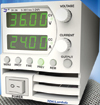
New from TDK-Lambda is the Z+ series of programmable DC power supplies. These high-density, 2U format benchtop and rack mounted units are designed to meet the demands of a wide variety of ATE and OEM applications, such as test and measurement, semiconductor burn-in, component test, laser diodes, heater supplies, RF amplifiers and electromagnets.
The first model to be introduced is the Z+400; providing 400 W of output power, models are available with output voltages up to 100 V d.c. and output current up to 75 A. The standard models are only 70 mm wide, so up to six units can be accommodated in a 19” rack. Options for front panel output terminals and a dual unit housing are available for bench use.
The power supply has comprehensive front panel controls with individual rotary encoders for output current and voltage, and access to power supply settings such as OVP level, startup modes and remote control and monitoring parameters. Separate 4-digit volt and current displays are provided along with function/status LEDs, pushbuttons for output preview, output on/off, fine/coarse and other features. The air intake is also on the front panel with the exit at the rear to allow zero stacking in order to maximise system flexibility and power density.
The Z+ series offers arbitrary function generation and up to six pre-programmed functions can be stored. They also boast a fast command processing time, output sequencing and two programmable output pins (that could be used to control isolation relays, for example).
All models within the series operate in constant current and constant voltage modes from an 85 to 265 V a.c. input. They feature active power factor correction, variable speed fans and extensive safety features, including user-selectable safe-start and auto-restart. With safe-start, the power supply returns to the last used settings after a power interruption, but with the output disabled. With auto-restart, it resumes normal operation without intervention after a power interruption, thereby meeting typical requirements for unattended use.
Common to all Z+400 models are the built-in USB, RS232 and RS485 interfaces. Using the standard serial RS485 interface between units enables daisy chain control of up to 31 power supplies on the same bus. Analog remote programming and monitoring is user selectable from 0–5 V or 0–10 V. Other digital and isolated analog interfaces are optional: the GPIB interface is IEEE-488.2 SCPI compliant and multidrop (only one unit needs the IEEE interface, which can then feed the commands to others via RS485). LabView and LabWindows drivers are also available. Isolated analog programming and monitoring options include either 0–5 V or 0–10 V, and 4–20 mA control. An LXI-C compliant LAN interface is also available.
Higher-power systems can be realised by connecting up to six identical units in parallel with active current sharing. In advanced parallel configuration, the master unit reports total system output current, which means that up to six units appear as a single power supply, increasing flexibility for system designers. Up to two units may be connected in series to increase the output voltage or to provide a bipolar output.
| Tel: | +27 11 782 8728 |
| Email: | info@accutronics.co.za |
| www: | www.accutronics.co.za |
| Articles: | More information and articles about Accutronics |






© Technews Publishing (Pty) Ltd | All Rights Reserved
 printer friendly version