


Widely seen as a panacea for solving noise-related issues, capacitors deserve more respect.
Designers often think that adding a few capacitors will solve most noise problems, but give little thought to parameters other than capacitance and voltage rating.
Like all electronic components, however, capacitors are not perfect. Instead, they possess parasitic effective series resistance (ESR) and inductance (ESL); their capacitance varies with temperature and voltage, and they are sensitive to mechanical effects.
Designers must consider these factors when selecting bypass capacitors – as well as for use in filters, integrators, timing circuits and other applications where the actual capacitance value is important. An inappropriate choice can lead to circuit instability, excessive noise and power dissipation, shortened product life and unpredictable circuit behaviour.
Capacitor technologies
Capacitors are available in a wide variety of form factors, voltage ratings and other properties to meet the requirements of diverse applications. Commonly used dielectric materials include oil, paper, glass, air, mica, polymer films and metal oxides. Each dielectric has specific properties that affect its suitability for a particular application.
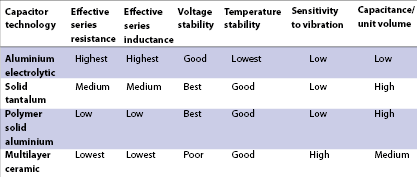
In voltage regulators, three major classes of capacitors are commonly used as voltage input and output bypass capacitors: multilayer ceramic, solid tantalum electrolytic and aluminium electrolytic. Table 1 provides a comparison.
Multilayer ceramic
Multilayer ceramic capacitors (MLCCs) combine small size, low ESR, low ESL and wide operating temperature range, making them the first choice for bypass capacitors. They are not without faults, however. Depending on the dielectric material, the capacitance can vary dramatically with temperature, DC bias and AC signal level.
In addition, the piezoelectric nature of the dielectric material can transform vibration or mechanical shock into an AC noise voltage. In most cases, this noise tends to be on the order of microvolts, but in extreme cases, mechanical forces can generate noise in the millivolt range.
Voltage-controlled oscillators (VCOs), phase-locked loops (PLLs), RF power amplifiers (PAs) and other analog circuits are sensitive to noise on their power supply rails. This noise manifests itself as phase noise in VCOs and PLLs, amplitude modulation in RF PAs and display artefacts in ultrasound, CT scans and other applications that process low-level analog signals.
Despite these imperfections, virtually every electronic device uses ceramic capacitors due to their small footprint and low cost. For regulators used in noise sensitive applications, however, designers must carefully evaluate their side effects.
Solid tantalum electrolytic
Solid tantalum capacitors are less sensitive to the effects of temperature, bias and vibration than ceramic capacitors. A recent variation uses a conductive polymer electrolyte instead of the usual manganese dioxide electrolyte, providing improved surge current capability and eliminating the need for a current limiting resistor.
Lower ESR is an additional benefit of this technology. Solid tantalum capacitors have a stable capacitance with temperature and bias voltage, so the selection criteria need only account for the tolerance, voltage derating at the operating temperature and maximum ESR.
Conductive polymer tantalum capacitors with low ESR cost more and are somewhat larger than ceramic capacitors, but may be the only choice for applications that cannot tolerate noise due to piezoelectric effects. The leakage current of tantalum capacitors is much larger than for equal value ceramic capacitors, however, rendering them unsuitable for some low-current applications.
A drawback of the solid polymer electrolyte technology is that this type of tantalum capacitor is more sensitive to the high temperatures encountered in the lead-free soldering process, with manufacturers typically specifying that the capacitors not be exposed to more than three soldering cycles. Ignoring this requirement in the assembly process can cause long-term reliability issues.
Aluminium electrolytic
Conventional aluminium electrolytic capacitors tend to be large and have high ESR and ESL, relatively high leakage current and limited service lifetimes – measured in thousands of hours.
OS-CON capacitors employ an organic semiconductor electrolyte and an aluminium foil cathode to achieve low ESR. Although related to solid polymer tantalum capacitors, they actually preceded tantalum capacitors by 10 years or more. With no liquid electrolyte to dry out, the service lifetime of OS-CON type capacitors is better than that of conventional aluminium electrolytic capacitors. Most are limited to 105°C, but OS-CON type capacitors capable of 125°C operation are now available.
Although the performance of the OS-CON type capacitor is better than that of conventional aluminium electrolytic capacitors, they tend to be larger and have higher ESR than ceramic or solid polymer tantalum capacitors. Like solid polymer tantalum capacitors, they do not suffer from the piezoelectric effect, so they are suitable for use in low-noise applications.
Selecting capacitors for LDO circuits
Output capacitor. Low-dropout regulators (LDOs) from Analog Devices can operate with small, space-saving ceramic capacitors as long as they have low effective series resistance (ESR); the ESR of the output capacitor affects the stability of the LDO control loop. A minimum capacitance of 1 μF with a maximum ESR of 1 Ω is recommended to ensure stability.
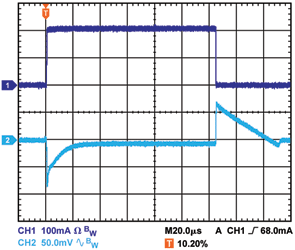
The output capacitance also affects the regulator’s response to changes in load current. The control loop has finite large-signal bandwidth, so the output capacitor must supply most of the load current for very fast transients. When the load current switches from 1 mA to 200 mA at 500 mA/μs, a 1 μF capacitor, unable to supply enough current, produces a load transient of about 80 mV, as shown in Figure 1.
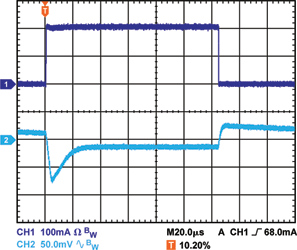
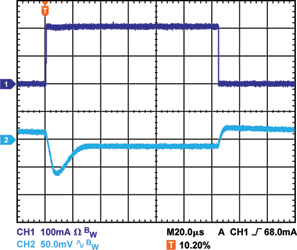
Increasing the capacitance to 10 μF reduces the load transient to about 70 mV, as shown in Figure 2. Increasing the output capacitance further, to 20 μF, allows the regulator control loop to track, actively reducing the load transient as shown in Figure 3. These examples use the ADP151 linear regulator with a 5 V input and a 3,3 V output.
Input bypass capacitor. Connecting a 1 μF capacitor from VIN to GND reduces the circuit’s sensitivity to printed circuit board (PCB) layout, especially when long input traces or high source impedance are encountered. The input capacitance should be increased to match the output capacitance when more than 1 μF is required on the output.
Input and output capacitor properties. The input and output capacitors must meet the minimum capacitance requirement at the intended operating temperature and working voltage. Ceramic capacitors are available with a variety of dielectrics, each with different behaviour vs. temperature and voltage. X5R or X7R dielectrics with a 6,3 V to 10 V voltage rating are recommended for 5 V applications. Y5V and Z5U dielectrics have poor characteristics vs. temperature and DC bias, so they are not suitable for use with LDOs.
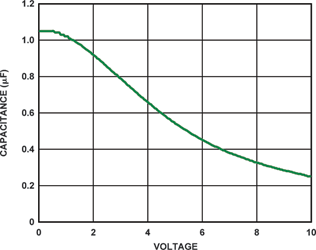
Figure 4 shows the capacitance vs. bias voltage characteristic of a 1 μF, 10 V X5R capacitor in a 0402 package. The capacitor’s package size and voltage rating strongly influence its voltage stability. In general, a larger package or higher voltage rating will provide better voltage stability. The temperature variation of the X5R dielectric is ±15% over the -40°C to +85°C temperature range and is not a function of package or voltage rating.
To determine the worst-case capacitance over temperature, component tolerance and voltage, the nominal capacitance must be scaled by the temperature variation and tolerance, as shown in the following equation:
CEFF = CBIAS X (1 – TVAR) × (1 – TOL)
Where CBIAS is the nominal capacitance at the operating voltage; TVAR is the worst-case capacitance variation over temperature (as a fraction of 1), and TOL is the worst-case component tolerance (as a fraction of 1).
In this example, TVAR is 15% from -40°C to +85°C for an X5R dielectric; TOL is 10%; CBIAS is 0,94 μF at 1,8 V, as shown in Figure 4. Using these values in the above equation yields:
CEFF = 0,94 μF X (1 – 0,15) X (1 – 0,1) = 0,719 μF
The ADP151 specifies a minimum output bypass capacitance of 0,70 μF over the operating voltage and temperature range, so this capacitor meets this requirement.
Conclusion
To guarantee the performance of an LDO, the effects of DC bias, temperature variation and tolerance of the bypass capacitor must be understood and evaluated. In applications that require low noise, low drift or high signal integrity, the capacitor technology must also be considered. All capacitors suffer from the effects of non-ideal behaviour, so the capacitor technology chosen must match the needs of the application.
For more information contact Andrew Athanasiou, Arrow Altech Distribution, +27 (0)21 555 1884, [email protected], www.arrow.altech.co.za
| Tel: | +27 11 923 9600 |
| Email: | [email protected] |
| www: | www.altronarrow.com |
| Articles: | More information and articles about Altron Arrow |






© Technews Publishing (Pty) Ltd | All Rights Reserved
 printer friendly version