

Design Automation


Development kits for solar-powered systems

4 April 2012 Design Automation

Texas Instruments has developed two new solar kits based on its C2000 32-bit Piccolo and Concerto microcontrollers (MCUs).

The kits bring advanced peripherals, application-targeted development hardware, schematics, comprehensive software libraries of algorithms and a development environment to the renewable energy market, allowing designers to easily create solar inverter designs while evaluating various solar algorithms and topologies.

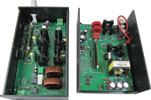
The C2000 Solar Developer’s Kit is TI’s first complete, high-voltage, string-ready, isolated MCU-controlled solar solution to help power designers create high-voltage solar applications. Comprised of two separate development boards, it provides a dual-controller design allowing developers to work with high-voltage power stages and inter-processor communications systems.

The primary board features a 300 V d.c. compatible input stage supporting up to 500 W with an interleaved boost stage for maximum power point tracking (MPPT) and a resonant LLC stage for isolation, with both stages controlled by a single Piccolo MCU. The secondary board features a full-bridge DC/AC inverter supporting 120/220 V a.c. output with grid-matching, and can be controlled by a Concerto or Piccolo MCU, offering both control and connectivity in one processor.

Supporting both Piccolo and Concerto C2000 MCUs, the Solar Explorer Kit provides a complete, non-isolated design and features multiple power stages controlled with a single low-cost digital controller, ideal for designing solar and renewable energy applications. The kit includes multiple DC/DC conversions, as well as a DC/AC stage that supports a 12 V d.c./100 W input stage for a safe, low-cost architecture that can be used in desktop or low-voltage benchtop experimentation lab situations for learning digitally controlled power stages or use in non-grid-tied applications. These stages are all controlled by a single Piccolo MCU.

Featuring a single-switch DC/DC boost for MPPT, DC/DC SEPIC for battery charging and a full-bridge DC/AC inverter capable of driving 24 V a.c., the Solar Explorer Kit enables flexibility for low-voltage solar designs. Also included is a secondary processor controlling a solar panel emulator circuit, featuring a photodiode for light sensing. Providing optional support for the C2000 Concerto MCU adds connectivity functions to the digital controller through an included Ethernet-connected graphical user interface (GUI).

Integral to making solar development easy, TI provides complete open source software and tools to ease development. As part of the C2000 family of MCU devices, both solar development boards are fully supported in the controlSUITE software offering. With controlSUITE, designers can quickly find all the necessary tools and documentation for the solar development kits, including general-purpose algorithm libraries as well as renewable energy-specific functions.

For more information contact EBV Electrolink, +27 (0)21 402 1940, [email protected], www.ebv.com


Credit(s)


Share this article:
Share via emailShare via LinkedInPrint this page

Further reading:

Advanced pressure monitoring sensor
EBV Electrolink Test & Measurement
The Infineon KP497 is an advanced, highly integrated digital pressure sensor designed for demanding automotive and industrial applications, with a particular focus on battery management systems.

Read more...
Quad-Apollo MxFE reference design
Design Automation
The Quad-Apollo MxFE reference design exemplifies a complete, high-performance platform for every-element direct-RF sampling digital beamforming using Analog Devices’ Apollo mixed-signal front-end technology.

Read more...
High-efficiency 600 V power MOSFET
EBV Electrolink Power Electronics / Power Management
The Infineon Technologies 600 V CoolMOS CFD7 is a high-voltage, super-junction N-channel MOSFET technology designed to deliver outstanding efficiency and robust switching performance.

Read more...
High-performance FPGA family
EBV Electrolink DSP, Micros & Memory
AMD’s Kintex UltraScale+ FPGA family delivers high-performance, mid-range field programmable gate arrays that balance price, performance, and power efficiency for demanding DSP applications.

Read more...
MIKROE signs multi-year deal with Renesas
Dizzy Enterprises Design Automation
MIKROE has signed a multi-year MCU development tool support deal with Renesas, which commits MIKROE to providing development tools for 500 of Renesas’ most popular MCUs.

Read more...
Future Electronics and SnapMagic announce CAD model integration to support faster design cycles
Future Electronics Design Automation
Engineers can now download verified symbols, footprints, and 3D models directly from supported product pages, enabling a smoother transition from component selection to PCB layout.

Read more...
Pulsonix 14.0 advances design
Design Automation
Pulsonix’s latest PCB design software platform further strengthens simulation and brings significant enhancements in mechanical-electrical 3D integration, smarter comparison tools, and enhanced usability features.

Read more...
KIOXIA pioneer new 3D Flash technology
EBV Electrolink DSP, Micros & Memory
KIOXIA Corporation and Sandisk Corporation pioneered a state-of-the-art 3D flash memory technology, setting the industry benchmark with a 4,8 Gb/s NAND interface speed, superior power efficiency, and heightened density.

Read more...
Silicon Labs’ Simplicity AI-enabled SDK
Design Automation
Silicon Labs recently unveiled a new way it is helping developers and their AI agents collaborate through its Simplicity AI SDK.

Read more...
Accelerate development of AI-enabled embedded systems
Design Automation
ADI’s CodeFusion Studio (CFS) is a modern embedded software development platform aimed at accelerating the creation of AI-enabled embedded systems.

Read more...


While every effort has been made to ensure the accuracy of the information contained herein, the publisher and its agents cannot be held responsible for any errors contained, or any loss incurred as a result. Articles published do not necessarily reflect the views of the publishers. The editor reserves the right to alter or cut copy. Articles submitted are deemed to have been cleared for publication. Advertisements and company contact details are published as provided by the advertiser. Technews Publishing (Pty) Ltd cannot be held responsible for the accuracy or veracity of supplied material.


© Technews Publishing (Pty) Ltd | All Rights Reserved

