


Since the approval by ICASA of satellite phones that operate via the Iridium Low Earth Orbit (LEO) satellite system, Jasco’s Webb Industries reports a definite increase in local interest in the Iridium network and related products.
“While there is no doubt that the industry is waking up to the Iridium system locally, the real interest for our Iridium products is coming from abroad,” says Webb MD Paul Richards.
Michael Kenny, MD of Webb’s European partner Multiband Technologies, concurs. “We are experiencing a surge in demand for Iridium antenna products, which could be partly as a result of the difficulty that ORBCOMM has had in expanding,” he says.
The Iridium satellite system is the world’s largest commercial constellation, with 66 active communication satellites and spares around the earth. Iridium Communications owns and operates the constellation and sells equipment and access to its services. The Iridium network allows worldwide voice and data communications using handheld devices.
New Jersey-based ORBCOMM is a global satellite data communications company with 27 current-generation and two second-generation satellites in orbit, and a further 16 second-generation satellites scheduled for launch starting this year.
ORBCOMM’s two-way data communication services track, monitor and control mobile and fixed assets in markets such as commercial transportation and industrial fixed assets, among others.
“ORBCOMM will still be a big player in Africa and especially when it offers OG2. VHF is excellent for developing areas as suitable modems and data are relatively inexpensive. While Iridium is more expensive, it has 66 satellites, pole-pole network and requires only one earth station,” Kenny asserts.
From a local perspective, Webb is focusing on the VENUS IR, ALPHA GSM IR and SatMaster Iridium combination antennas.
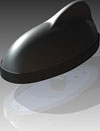
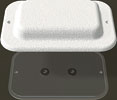
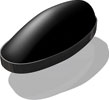
The Alpha antenna is a roof-mount Iridium/GSM/GPS combination antenna based on a dual ceramic patch design with PCB GSM or 2,4 GHz radiator. For the GPS, using a 24 dB patch and amplifier, this antenna has a time-to-first-fix (TTFF) of <45 seconds and, for the GSM or 2,4 GHz, an upright PCB radiator gives an omnidirectional signal with a maximum gain of 2 dBi. All certified Iridium antennas work for both data and voice.
SatMaster is essentially a rugged housing for the OEM IR combination antenna boards. It can be used to house the OEM IR 2, OEM IR 3 and OEM IR 4 boards which are combinations of Iridium, cellular, GPS and 2,4 GHz. The ‘indestructible’ casing is specially designed for external use where a hard-wearing rugged antenna is required. Operating temperature range is -30°C to +80°C.
Richards says that these antennas have a wide range of applications in line with the Iridium offering and include maritime, aviation, government/military, emergency/humanitarian services, mining, forestry, oil and gas, heavy equipment, transportation and utilities.
Kenny says that one of the important results of the Webb/Multiband partnership is the large choice offered to customers. “Not only do we offer a first class range of injection moulded housings for external installations but we are also getting noticed as a provider of embedded Iridium antenna solutions.
“By embedding the Iridium/GPS antenna into the electronic design, customers can control the overall top-to-toe aesthetic design of their product and are not confined by the standard shape and high cost of external helical antennas,” he says.
Kenny points out that in Europe and America there are a host of interesting Iridium applications and Multiband has a wide range of antennas on offer to suit them. “One such application is ocean buoys where the embedded principle is most apt.
“Another interesting application is in the mountain rescue and avalanche control sector where, for example, leading avalanche beacon company, PIEPS, has made use of Iridium technology to produce the PIEPS Globalfinder, which offers messaging (e-mail, sms and text and position messages) with full global coverage including the poles; special emergency button for search and rescue signal; permanent weather observation and others.
Kenny says that while there is a plethora of interesting applications made possible by Iridium, his top selling items remain the Alpha and Venus antennas. “These are superb machine-to-machine antennas. They are aesthetic, hard-wearing and have a very small footprint making them suitable for even the smartest vehicles,” he says.
| Tel: | +27 11 719 0000 |
| Email: | [email protected] |
| www: | www.webb.co.za |
| Articles: | More information and articles about Webb Industries |






© Technews Publishing (Pty) Ltd | All Rights Reserved
 printer friendly version