


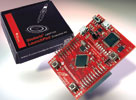
Expanding its LaunchPad portfolio to the ARM ecosystem, Texas Instruments announced a new low-price, easy-to-use Stellaris LM4F120 LaunchPad evaluation kit. The tool allows professional engineers, hobbyists and university students to begin exploring ARM Cortex-M4F microcontrollers and TI’s Stellaris family of microcontrollers.
The core of the new LaunchPad is a Stellaris LM4F120 MCU which features low power, integrated analog and floating-point performance and lends itself to the highly flexible and modular design environment of the LaunchPad with abundant peripherals for real-time digital signal control.
The Stellaris LaunchPad brings consumer electronics, human interface control, health and fitness and many more applications to a wider audience of developers. The kit includes all the hardware and software needed to get started in 10 minutes or less.
The Stellaris LaunchPad uses the BoosterPack XL connection standard that consists of two pairs of dual-gender 20-pin stackable headers. Those 40 easy-to-access pins allow interface with external components (BoosterPacks) or custom daughter boards.
Two sets of 20 pins on the outer rows of the board have similar functions to the primary header pins on existing MSP430 and C2000 LaunchPad kits, allowing developers to add greater functionality and speed design and exploration. Two inner rows offer an additional 20 pins of Stellaris-based expansion signals for BoosterPack development.
The kit includes a 32-bit LM4F120H5QR Cortex-M4 MCU with floating-point operating up to 80 MHz that provides targeted performance headroom for application differentiation, 64 KB Flash with 100 000 write/erase cycles and two 12-bit 1 MSps ADCs and up to 27 timers, some configurable up to 64 bits.
Licence- and royalty-free StellarisWare software is pre-loaded in ROM to conserve Flash memory. The kit incorporates USB connectivity and other peripherals including serial ports for UART, I²C, SSI/SPI and CAN controllers so developers can support the communication standard best suited for their application.
An out-of-the-box RGB LED example application lets developers start experimenting with the Stellaris LaunchPad in minutes. Planned BoosterPacks include capabilities for sensors, wireless connectivity and many more third-party BoosterPacks.
For more information contact EBV Electrolink, +27 (0)21 402 1940, [email protected], www.ebv.com
| Tel: | +27 11 236 1900 |
| Email: | [email protected] |
| www: | www.ebv.com |
| Articles: | More information and articles about EBV Electrolink |






© Technews Publishing (Pty) Ltd | All Rights Reserved
 printer friendly version