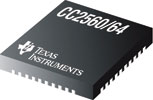
Texas Instruments announced that its Bluetooth v4.0 technology-based CC2560 and CC2564 wireless devices are now available in easy-to-integrate QFN packages. The company also announced the availability of additional production-ready modules based on the two devices, as well as software and tools.
The ROHS-compliant QFN packages of the CC2560 and CC2564 Bluetooth v4.0 devices are available together with a downloadable two-layer reference design (schematics, layout and bill of materials) that can be copied and pasted into end applications.
The CC2560 device offers Bluetooth v4.0 ‘classic’ support for audio and data applications requiring high throughput. The CC2564 device supports two options: dual-mode Bluetooth/Bluetooth low energy or dual-mode Bluetooth/ANT+.
Applications that benefit from the dual-mode solution include those that require wireless communication to Bluetooth ‘classic’ products and Bluetooth low energy or ANT+ devices such as sports and fitness aggregator gadgets or smart watches. The dual-mode Blue-tooth v4.0 solution can also be used as a sensor solution that delivers longer range to communicate with mobile devices that may or may not have Bluetooth low energy technology.
In addition to the two modules previously announced, four new complete, validated and certified modules are now available. The modules vary in size, temperature range and output power, and include Class 1 and Class 2 versions. One module also offers a pre-integrated MCU plus CC2564 solution for faster development.
Software development kits for Bluetooth and Bluetooth/Bluetooth low energy solutions are currently available. Customers can also access sample applications and demos provided in source code showing API usage. A royalty-free Bluetooth stack and various profiles are provided pre-integrated on MCUs such as TI’s ultra-low power MSP430 MCU and Stellaris ARM Cortex-M3/M4 MCUs.
TI will also release an updated Bluetooth stack near the end of 2012. The new stack will reportedly offer flexible software build options that will enable customers to select specific profiles to support. This capability allows for greater memory size optimisation and the ability to support a broader range of MCUs.
Accelerate development of physical AI deployments Altron Arrow
DSP, Micros & Memory
With Avocado OS now available on the HummingBoard RZ-V2N-
AIoT and SolidSense AIoT V2N from SolidRun, teams can move from prototype to deployed fleet in weeks.
Read more...Universal NFC device Altron Arrow
DSP, Micros & Memory
Delivering high-end performance in a compact 4 x 4 mm package, the multipurpose NFC reader from ST Microelectronics, enables the convenience of contactless interaction and features for various end applications.
Read more...Simplifying system design iCorp Technologies
Telecoms, Datacoms, Wireless, IoT
The FGMC63N tri-band MCU Wi-Fi 6E module from Quectel addresses offers integrated connectivity across 2,4 GHz, 5 GHz, and 6 GHz bands in a compact, highly optimised design.
Read more...Dragino’s connectivity catalogue Otto Wireless Solutions
Telecoms, Datacoms, Wireless, IoT
Where Wi-Fi demands frequent charging and covers tens of meters, and traditional cellular consumes too much power for battery-operated nodes, LoRaWAN threads the needle.
Read more...RF filters explained RFiber Solutions
Telecoms, Datacoms, Wireless, IoT
As RF environments become increasingly crowded, RF filters play a critical role in maintaining signal quality, improving system performance, and ensuring reliable operation.
Read more...Practical design strategies for 5G RF Design
Telecoms, Datacoms, Wireless, IoT
The Cavli CQM211 aims to provide a platform that combines strong 5G connectivity with onboard compute capability, as well as interface flexibility that suits both new designs and rapid migrations from earlier products.
Read more...Compact direct Time-of-Flight 3D LiDAR module Altron Arrow
AI & ML DSP, Micros & Memory
The VL53L9 from STMicroelectronics is the first direct Time-of-Flight (dToF) 3D LiDAR all-in-one module in ST’s portfolio, offering a resolution of 2,3K zones, wide field of view, on-chip processing, 100 frames per second, and sensing range from 5 centimeters to 9 meters.
Read more...SoC brings scalable edge AI to life Altron Arrow
AI & ML
The NXP i.MX 937 applications processor is optimised for performance without excessive power draw and bridges the gap between entry-level chips and high-end processors.
Read more...An industry-first Android 16 smart module solution RF Design
Computer/Embedded Technology Telecoms, Datacoms, Wireless, IoT
The MeiG Smart SLM580 4G Smart Module features native support for Android 16 and covers core frequency bands in major countries and regions worldwide.
While every effort has been made to ensure the accuracy of the information contained herein, the publisher and its agents cannot be held responsible for any errors contained, or any loss incurred as a result. Articles published do not necessarily reflect the views of the publishers. The editor reserves the right to alter or cut copy. Articles submitted are deemed to have been cleared for publication. Advertisements and company contact details are published as provided by the advertiser. Technews Publishing (Pty) Ltd cannot be held responsible for the accuracy or veracity of supplied material.









 printer friendly version