u-blox announced the launch of its newest core positioning platform, u-blox M8. The new chip forms the basis of the company’s upcoming line of positioning modules which are able to acquire and track different satellite systems concurrently to achieve higher accuracy and reliability.
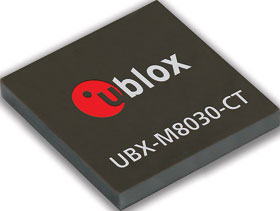
Supporting all deployed as well as upcoming global navigation satellite systems (GNSS), the platform is based on the UBX-M8030 concurrent multi-GNSS receiver IC which is able to track American GPS, European Galileo, Japanese QZSS, Russian GLONASS and Chinese BeiDou satellites. Concurrent tracking of GPS (QZSS) and GLONASS or BeiDou, or concurrent tracking of GLONASS and BeiDou satellites, increases performance for applications requiring maximum availability and accuracy.
The chip is prepared for the European Galileo system through a future firmware upgrade once the constellation is fully available. The new platform will ultimately support special functions such as automotive dead reckoning and precision timing to support a wide variety of vehicle, industrial and consumer applications.
To further improve acquisition performance, u-blox’ globally available AssistNow assisted-GNSS service for accelerated positioning has been extended for u-blox M8 products; the service supports both GPS and GLONASS, and the validity of downloaded assistance data is now able to support offline operation for up to 35 days.
The new M8 chip is at the heart of u-blox’ next generation of positioning modules based on the company’s popular MAX, NEO and LEA module form factors. The chips feature low power consumption in concurrent reception mode, thanks to an innovative single-die architecture combined with sophisticated software algorithms.
The extended supply voltage supply range and 1,8 V/3,0 V I/O compliance supports a wide variety of system architectures. Sophisticated radio architecture and interference suppression using active jamming detection ensure maximum performance even in GNSS hostile environments.
UBX-M8030 chips are available in miniature WL-CSP (2,99 x 3,21 x 0,36 mm) and QFN (5,00 x 5,00 x 0,59 mm) packages. The chip is also available in automotive quality grade according to AEC-Q100.
The new platform maintains backwards compatibility with u-blox 7 modules and QFP chip products which remain in the company’s portfolio as low-power standalone satellite positioning receivers.
Simplifying system design iCorp Technologies
Telecoms, Datacoms, Wireless, IoT
The FGMC63N tri-band MCU Wi-Fi 6E module from Quectel addresses offers integrated connectivity across 2,4 GHz, 5 GHz, and 6 GHz bands in a compact, highly optimised design.
Read more...Dragino’s connectivity catalogue Otto Wireless Solutions
Telecoms, Datacoms, Wireless, IoT
Where Wi-Fi demands frequent charging and covers tens of meters, and traditional cellular consumes too much power for battery-operated nodes, LoRaWAN threads the needle.
Read more...RF filters explained RFiber Solutions
Telecoms, Datacoms, Wireless, IoT
As RF environments become increasingly crowded, RF filters play a critical role in maintaining signal quality, improving system performance, and ensuring reliable operation.
Read more...Practical design strategies for 5G RF Design
Telecoms, Datacoms, Wireless, IoT
The Cavli CQM211 aims to provide a platform that combines strong 5G connectivity with onboard compute capability, as well as interface flexibility that suits both new designs and rapid migrations from earlier products.
Read more...Nordic expands nRF Cloud with firmware vulnerability scanning RF Design
Computer/Embedded Technology
nRF Cloud identifies vulnerabilities in firmware and shows exactly which deployed devices are affected, empowering device manufacturers to address EU Cyber Resilience Act requirements.
Read more...An industry-first Android 16 smart module solution RF Design
Computer/Embedded Technology Telecoms, Datacoms, Wireless, IoT
The MeiG Smart SLM580 4G Smart Module features native support for Android 16 and covers core frequency bands in major countries and regions worldwide.
Read more...High performance RF signal conditioning RFiber Solutions
Telecoms, Datacoms, Wireless, IoT
The AM3269 from Mercury Systems is a high-performance RF preselector module designed to improve receiver sensitivity and signal integrity in demanding electronic warfare, signals intelligence, test, and communications applications.
Read more...Nordic expands nRF Cloud with firmware vulnerability scanning RF Design
Computer/Embedded Technology
nRF Cloud identifies vulnerabilities in firmware and shows exactly which deployed devices are affected, empowering device manufacturers to address EU Cyber Resilience Act requirements.
Read more...RF filters explained RFiber Solutions
Telecoms, Datacoms, Wireless, IoT
As RF environments become increasingly crowded, RF filters play a critical role in maintaining signal quality, improving system performance, and ensuring reliable operation.
While every effort has been made to ensure the accuracy of the information contained herein, the publisher and its agents cannot be held responsible for any errors contained, or any loss incurred as a result. Articles published do not necessarily reflect the views of the publishers. The editor reserves the right to alter or cut copy. Articles submitted are deemed to have been cleared for publication. Advertisements and company contact details are published as provided by the advertiser. Technews Publishing (Pty) Ltd cannot be held responsible for the accuracy or veracity of supplied material.









 printer friendly version