


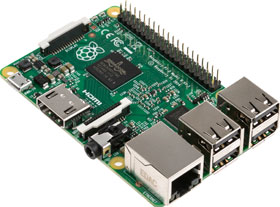
There are many sayings about small things, the packages they come in and the power they are capable of. This is no different when it comes to the Raspberry Pi.
Not the traditional slice of Pi but as easy as Pi, the Raspberry Pi is a credit card-sized computer board that can be connected to a TV or monitor, keyboard, mouse and power outlet, and runs off an SD card containing the operating system. It can do many of the things that a normal desktop PC can, such as spreadsheets, word processing, games and high-definition video playback.
The product was developed in the UK, at the University of Cambridge, by Eben Upton, Rob Mullins, Jack Lang and Alan Mycroft. The developers realised a year-on-year decline in the number of students entering the computer science field and that the interaction we have with computers these days has changed. The older computers, that still provided users with the opportunity to learn how to program, were being phased out, and it was clear that something like the Raspberry Pi could be a very powerful and important tool to make a difference.
The developers had the idea of designing a product that would provide children the opportunity to learn computer programming with an easy to use, low cost tool. The objective would be to pique interests from a young age with the hope of nurturing greater interest in the field later on when the young students would get to university level.
Raspberry Pi was thus developed and the Raspberry Pi Foundation (now a registered educational charity) was founded as a result. The product was never meant to be mass manufactured but the success and fame of the Pi meant that it was unavoidable not to continue with the dream of seeing affordable and programmable computers everywhere.
Once launched, the 10 000 units that were supposed to have been a once off production run sold like hot cakes. Many novel ideas and a broad number of uses came about, with many projects appearing at science fairs. Videos of children designing with the Raspberry Pi can be found on YouTube at http://bit.ly/1LU2YxY. Trial solar Pi labs also popped up in Africa, making computers available to the disadvantaged.
Things did however not stop at making programming and the use of cheap computers available to children and providing hobbyists with a new mini-computer board to play around with. Businesses also started to realise the opportunity and that the Pi could be designed into their professional applications. Many engineers that first started playing around with the product for fun are now using the Pi to build demo models amongst many other things.
As the number of use cases expanded, so did the demand for more power and memory. To meet this demand, RS Components has announced the next generation Raspberry Pi 2 from the Raspberry Pi Foundation.
The new Raspberry Pi 2 Model B offers six times more processing power and double the memory of previous models, increasing it to 1 GB. This new version incorporates the Broadcom BCM2836 application processor, containing a powerful ARM Cortex-A7 quad-core CPU running at 900 MHz.
The board layout, multimedia subsystem and peripherals remain fully compatible with the Raspberry Pi Model B+ and accessories such as the power supply, including the use of the extensive 40-pin GPIO (general purpose input/output) connector, four USB ports and an efficient switching power supply.
For more information contact RS Components, +27 (0)11 691 9300, sales.za@rs-components.com, www.rsonline.co.za
| Tel: | +27 11 691 9300 |
| Email: | sales.za@rs-components.com |
| www: | www.rs-online.co.za |
| Articles: | More information and articles about RS South Africa |






© Technews Publishing (Pty) Ltd | All Rights Reserved
 printer friendly version