Many of today’s products, such as implantable and wearable devices for the medical industry, demand miniaturisation along with high functionality and reliability.
Those requirements drive designers to find durable solutions to package more electronics into smaller spaces.
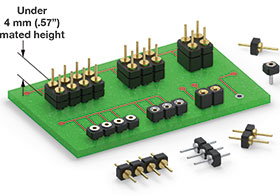
Addressing these needs, the new 315-43-1XX-41-004000 (single row) and 415-43-2XX-41-004000 (double row) sockets from Mill-Max have 2,54 mm pin spacing with a low profile of 2,11 mm. They are designed for through-hole mounting in boards up to 1,57 mm thick, providing a secure connection to the PCB.
These sockets are ideal for board stacking and wire-to-board applications where minimising package height is paramount. When mated with Mill-Max low-profile headers 335-10-1XX-00-160000 (single row) and 435-10-2XX-00-160000 (double row) the total between-boards height is only 3,94 mm. For wire-to-board connections the Mill-Max 380-10-1XX-00-002000 (single row) and 480-10-2XX-00-002000 (double row) solder cup headers combine with the low-profile sockets to achieve a total height of 6,81 mm.
Each receptacle is precision turned from brass alloy, has a highly reliable 4-finger, beryllium copper contact, accepts leads ranging from 0,38 to 0,56 mm, and is designed to withstand the rigors of rugged applications associated with portability. The insulator material is high-temperature PCT, compatible with most soldering processes. Connectors are available from 1 to 32 positions (single row) and 4 to 72 positions (double row). Standard plating options include tin or gold for the outer shell and gold for the internal contact, providing optimal interconnect reliability.
Connectivity solutions for hydrogen technologies Hiconnex
Interconnection
As the production distribution and utilisation of hydrogen continue to scale, connectivity becomes a key enabler for efficient energy transmission, data communication, and system control.
Read more...Mixed-density Combo-D connectors Hiconnex
Interconnection
Positronic’s SCBM connector series is a rugged, high-performance family of mixed-density D-sub connectors engineered for demanding environments.
Read more...Same Sky expands rectangular connector portfolio Future Electronics
Interconnection
The portfolio includes male pin headers, female pin headers, and box headers, giving engineers the flexibility to select the most appropriate connector style for their specific design requirements.
Read more...Rugged USB-C for modern designs
Interconnection
Same Sky has expanded its USB Type-C connector portfolio to meet the growing demand for faster data transfer and higher power delivery in modern electronic designs.
Read more...Designing with PCIe Spectrum Concepts
Editor's Choice Interconnection
PCI Express has become the backbone of modern high-performance systems with each new generation promising higher bandwidth, but that performance comes with a cost.
Read more...Robust single-pole power connectivity Hiconnex
Interconnection
Designed for cable-to-cable and cable-to-equipment use, Radiall’s single-pole power connector support current ratings from 250 A to 750 A and operating voltages up to 1000 V AC or DC.
Read more...M12 push-pull connectors IOT Electronics
Interconnection
Phoenix Contact’s M12 push-pull connectors with internal locking set a new benchmark for fast, secure, and space-saving connectivity in industrial automation.
Read more...Versatile outdoor waterproof connectors Vepac Electronics
Interconnection
The LP-20 outdoor waterproof connector series offers a versatile range of rugged, circular connectors with 2, 3, 4, 5, 7, 8, 9, 12 and 14-pin configurations.
Read more...Comprehensive range of data connectors IOT Electronics
Interconnection
Phoenix Contact’s comprehensive range of data connectors provides reliable connection solutions for modern networked applications across industrial, infrastructure, and commercial environments.
Read more...Compact inline connector for aerospace Hiconnex
Interconnection
Radiall’s Small Inline Connector series is a fully qualified wire-to-wire solution designed to simplify harness creation, installation, and modification in aerospace applications.
While every effort has been made to ensure the accuracy of the information contained herein, the publisher and its agents cannot be held responsible for any errors contained, or any loss incurred as a result. Articles published do not necessarily reflect the views of the publishers. The editor reserves the right to alter or cut copy. Articles submitted are deemed to have been cleared for publication. Advertisements and company contact details are published as provided by the advertiser. Technews Publishing (Pty) Ltd cannot be held responsible for the accuracy or veracity of supplied material.









 printer friendly version