


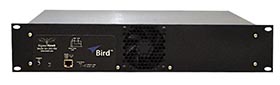
Troubleshooting RF interference can be a lengthy process. At the very least, it requires a spectrum analyser to identify what is occurring on or near your frequency. Using a conventional spectrum analyser, you have to be watching the screen when the interference occurs or you risk missing the event. Bird Technologies has solved this problem with its Advanced Spectrum Logging (ASL) system.
The rack-mount SignalHawk spectrum analyser with ASL is designed to be utilised in applications where constant monitoring of the spectrum over a long period of time is beneficial. This includes applications where one may be only interested in a small subset of the time (for example, during an interference event). The ASL software allows every analyser trace to be collected, and played back in real time.
Unlike basic trace logging, the system allows the user to monitor multiple sweeps covering any frequency span. In order to best utilise the ASL, a custom configuration can be created for each application. This allows the speed and resolution of the collection to be maximised.
Using multiple sweeps, rather than a single wideband sweep, the user can maintain sufficient resolution to identify events within a single channel. The SignalHawk monitors 705 data points per sweep but only 3 data points are required to define a single channel. This allows the system to monitor up to 235 individual channels per sweep. This high resolution permits the user to pinpoint specific channel activity.
Software
The ASL software stores all of the trace data in custom SQL databases, each of which can hold a maximum of 10 GB of data. Depending on the speed at which traces are collected (determined by the span, RBW and VBW) this will typically allow between 7 and 15 days of continuous data collection. If the database becomes full, it will delete the first 10 000 records (1-2 hours) and continue collecting data. To prevent the loss of data, the user can archive a database and create a new one before it reaches 10 GB.
During or after data collection, the user can play back the analyser traces. The playback utility allows the user to set the start and stop time and the playback speed. Playback speed is adjustable from single-step to significantly faster than real time. All of the various trace features such as maximum hold, minimum hold, markers and even waterfall modes are available during trace playback.
If the approximate time of an interference event is known, the user can jump to that time and use the single-step mode to slowly walk through the traces. If overall peak signal levels are of interest, the entire database can be run at maximum speed in maximum hold mode.
If an interference event occurs during data collection, the stored traces can be played back without interrupting the data capture by opening a second instance of the software and selecting ‘Playback only.’ By utilising this feature, the user can play back the data as soon as it’s collected without missing the next event.
Applications
The features in the ASL software make it ideal for use in a number of situations:
Intermittent interference
Troubleshooting intermittent interference is difficult because a lot of time is wasted waiting for an event to occur. When it does, that event might be missed on a conventional spectrum analyser if the user is momentarily distracted. The ASL software will permit the capture of multiple events, allowing the user to better evaluate the interference.
The ASL software allows the user to focus their efforts elsewhere while waiting for an interference event. In addition, the configurations can be set so that they give individual channel resolution, letting the user pinpoint the channel of interest after the event occurs.
Long-term analysis
Looking at data over a long period of time can give a better understanding of changing conditions over time. The ASL software can be used to collect large data sets and play them back in accelerated speed to view interference or noise phenomena, and determine any correlation between occurrences. The data can also be played back in waterfall mode to provide a 3-dimensional view of the spectrum over time.
Remote access
Some locations can only be accessed at certain times, require an escort, or have other access restrictions. This limits the amount of time one can spend analysing the RF environment, and limits the speed at which they can respond to interference events.
If an Internet connection is available, the rack-mounted SignalHawk ASL can be accessed remotely from anywhere. Full control of the unit is available including configuration setup, attaching or changing databases, recording and playback.
Permanent installation
Utilising a rack-mount SignalHawk spectrum analyser with ASL, a system operator can investigate interference events days after they occur. This is ideal for troubleshooting those reports of poor system performance that come in overnight, on the weekend or anytime no one is watching.
For more information contact Comtest, +27 10 595 1821, sales@comtest.co.za, www.comtest.co.za
| Tel: | +27 10 595 1821 |
| Email: | sales@comtest.co.za |
| www: | www.comtest.co.za |
| Articles: | More information and articles about Comtest |






© Technews Publishing (Pty) Ltd | All Rights Reserved
 printer friendly version