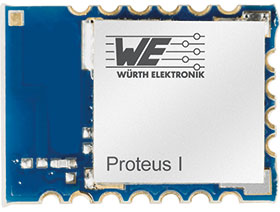
The Wireless Connectivity and Sensors division at Würth Elektronik eiSos has rolled out firmware version 3.4.0 of its Proteus I Bluetooth module. The most important improvement is the more than twofold increase in UART (universal asynchronous receiver transmitter) baud rate, with the maximum data throughput going from 36 Kbps to 80 Kbps.
The newly introduced UART flow control guarantees that no data packets get lost on the UART. This, and extensive possibilities for firmware individualisation, are further improvements on the product. With firmware version 3.4.0, the data throughput of 80 Kbps can be achieved with a single BLE (Bluetooth Low Energy) packet per connection interval, and is therefore compatible with all BLE 4.2 devices on the market.
Manufacturers that make their products Bluetooth-enabled using the Proteus I module can now also completely determine how it appears to the communication partner. This starts with its appearance, i.e. the device name and icon displayed to the user in the list of possible Bluetooth connections. A profile can also be added with the Device Information Service (DIS) to make more of the device’s information available with wireless technology, for example the name of the device manufacturer or the serial number.
The Proteus II 2,4 GHz BLE wireless module, with dimensions of 11 x 8 x 1,8 mm, has a feature that is actually no longer intended in the Bluetooth Low Energy standard (Bluetooth Smart): the serial port profile (SPP) for emulating a serial cable connection. Data transmission is enabled with the AMBER SPP-like profile, which is based on the optional Bluetooth 4.2 ‘data length extension’ feature and increases the data throughput.
Firms can make this BLE profile their own by assigning their own UUID, for example to register the profile with the Bluetooth Special Interest Group (SIG). Würth Elektronik eiSos also offers customers individualisation of the firmware, while guaranteeing adherence with the relevant guidelines in the wireless domain.
SMT flat-wire inductor for automotive electronics Würth Electronics South Africa
Passive Components
Würth Elektronik introduces its new WE-SFIA series of flat-wire inductors in 2010, 2013, and 2016 packages.
Read more...Nanocrystalline cores for cable assembly Würth Electronics South Africa
Passive Components
Conventional MnZn and NiZn ferrite cores for cable assembly are now complemented by nanocrystalline cable cores.
Read more...Simplifying system design iCorp Technologies
Telecoms, Datacoms, Wireless, IoT
The FGMC63N tri-band MCU Wi-Fi 6E module from Quectel addresses offers integrated connectivity across 2,4 GHz, 5 GHz, and 6 GHz bands in a compact, highly optimised design.
Read more...Dragino’s connectivity catalogue Otto Wireless Solutions
Telecoms, Datacoms, Wireless, IoT
Where Wi-Fi demands frequent charging and covers tens of meters, and traditional cellular consumes too much power for battery-operated nodes, LoRaWAN threads the needle.
Read more...RF filters explained RFiber Solutions
Telecoms, Datacoms, Wireless, IoT
As RF environments become increasingly crowded, RF filters play a critical role in maintaining signal quality, improving system performance, and ensuring reliable operation.
Read more...Practical design strategies for 5G RF Design
Telecoms, Datacoms, Wireless, IoT
The Cavli CQM211 aims to provide a platform that combines strong 5G connectivity with onboard compute capability, as well as interface flexibility that suits both new designs and rapid migrations from earlier products.
Read more...An industry-first Android 16 smart module solution RF Design
Computer/Embedded Technology Telecoms, Datacoms, Wireless, IoT
The MeiG Smart SLM580 4G Smart Module features native support for Android 16 and covers core frequency bands in major countries and regions worldwide.
Read more...High performance RF signal conditioning RFiber Solutions
Telecoms, Datacoms, Wireless, IoT
The AM3269 from Mercury Systems is a high-performance RF preselector module designed to improve receiver sensitivity and signal integrity in demanding electronic warfare, signals intelligence, test, and communications applications.
While every effort has been made to ensure the accuracy of the information contained herein, the publisher and its agents cannot be held responsible for any errors contained, or any loss incurred as a result. Articles published do not necessarily reflect the views of the publishers. The editor reserves the right to alter or cut copy. Articles submitted are deemed to have been cleared for publication. Advertisements and company contact details are published as provided by the advertiser. Technews Publishing (Pty) Ltd cannot be held responsible for the accuracy or veracity of supplied material.









 printer friendly version