23 October 2019
Manufacturing / Production Technology, Hardware & Services
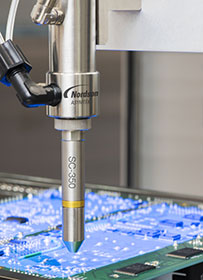
The Select Coat applicator series from Nordson Asymtek – which includes the SC-350 Select Spray and the SC-300 Multi-Mode – is a highly versatile conformal coating applicator that supports a wide range of fluid viscosities and is ideal for solvent or solvent-less fluid formulations. The series features fast system on/off times to optimise start and stop movements; and an optional four-position tilt accessory and dual-simultaneous bracket configuration that delivers improved throughput and reduced process time.
The SC-350 Select Spray is specifically optimised to atomise coating fluids – delivering enhanced edge definition and thin, uniform coating thicknesses at increased speeds. It offers additional flexibility within process parameters at the low and high end of the viscosity spectrum exclusively for atomised spray. It efficiently sprays solvent-based fluids while reducing solvent usage and the ‘cobwebbing’ effect that occurs when coating fluids cure in air. In the higher viscosity range, the applicator provides uniform pass coverage at faster speeds.
With the SC-350, the air assist function is optimised to deliver significant edge tolerance, fluid viscosity, and coating velocity improvements. The applicator applies less air pressure to achieve a tighter edge tolerance, providing increased selectivity and control near keep-out zones and reduced ‘cobwebbing’ of solvent-based fluids.
The versatile SC-300 Multi-Mode offers bead, monofilament, and swirl modes of operation that are ideal for applications that require spot coating, broad pattern widths, and thin film builds.
In bead mode, a stream of material is applied to the circuit board in areas where components are very close to non-coating or keep-out areas, or extra material is required for protection of high-impedance areas. The bead may also be used as a spot command for single coating of a single test point or component.
In monofilament mode, this pattern is created by controlling the fluid pressure and material flow passing through the nozzle. Auxiliary air circulating through the air passage strikes the material at a precise angle, causing it to spin on its axis and form a conical, looping pattern. The monofilament pattern is ideal for dispensing broad pattern widths while maintaining good edge definition, resulting in faster cycle times.
The swirl pattern is a coarse atomised spray achieved by increasing air pressure and lowering flow settings. Angled jets impinge air upon the pressurised material exiting the nozzle, creating a conical, swirling pattern. The mode is ideal for applications where moderate selective coating is required. The swirling action helps maintain pattern shape, resulting in excellent width control. Because the air jets cause slight atomisation of the material, extremely thin film builds are possible.
Delivering uniform thicknesses and consistent pattern widths for a wide range of fluid viscosities, Select Coat applicators can be configured to meet a variety of application requirements including spot, line, area-coat, and optimised atomisation.
High precision in-line conformal coating inspection system MyKay Tronics
Manufacturing / Production Technology, Hardware & Services
Conformal coating is widely used to protect electronics from moisture or other environmental hazards. It is critical to know if coatings are properly applied; covering what is meant to be covered and not covering what should be exposed.
Read more...Soldering day highlights
Manufacturing / Production Technology, Hardware & Services
JAPAN UNIX has published a new event report and highlight video from their UNIX SOLDERING DAY 2026 in Hungary. This event reflects on their commitment to supporting manufacturers not only through soldering automation systems, but also through technical education, live demonstrations, hands-on training, and practical engineering know-how.
Read more...Clearing the Static: Electrostatic Discharge Actum
Manufacturing / Production Technology, Hardware & Services
A cordless ESD (Electrostatic Discharge) wrist strap does not work by grounding the person in the same way as a traditional wired wrist strap. Instead, it works by reducing or balancing the static charge on your body so that you are less likely to discharge electricity into sensitive electronic components.
Read more...Engineering trust in South Africa’s SMT sector ZETECH ONE
Manufacturing / Production Technology, Hardware & Services
From a small Johannesburg start-up to a trusted SMT technology partner, Zetech One has spent four decades helping South African electronics manufacturers improve production quality, efficiency and reliability.
Read more...The new reality of PCB material supply Jemstech
Editor's Choice Manufacturing / Production Technology, Hardware & Services
How resilient manufacturing strategies are helping OEMs navigate a changing global supply chain.
Read more...Streamlining Device Programming with the AutoBee-D1 Vepac Electronics
Manufacturing / Production Technology, Hardware & Services
The AutoBee-D1 desktop automated programmer is designed to simplify the programming of devices, while delivering consistent accuracy, high throughput and reduced manual intervention.
Read more...Zero PFAS die attach paste Testerion
Manufacturing / Production Technology, Hardware & Services
With silver price volatility increasing and sustainability requirements accelerating across semiconductor assembly, MacDermid Alpha Electronics Solutions introduces ATROX CD 560-1, a zero per- and polyfluoroalkyl substance (PFAS) alternate silver filler die attach paste.
Read more...Precision jet printing for advanced PCB designs MyKay Tronics
Manufacturing / Production Technology, Hardware & Services
Mycronic’s BA 01 small dot ejector delivers unmatched precision in solder paste jet printing for advanced PCB designs.
Read more...Polypropylene pole-top boxes support smarter, more secure electricity networks
Manufacturing / Production Technology, Hardware & Services Enclosures, Racks, Cabinets & Panel Products
As South Africa accelerates the rollout of smart prepaid electricity metering, innovative enclosure technology from Power Process Systems (PPS) is helping utilities improve network security, reduce electricity theft and protect critical electrical infrastructure.
While every effort has been made to ensure the accuracy of the information contained herein, the publisher and its agents cannot be held responsible for any errors contained, or any loss incurred as a result. Articles published do not necessarily reflect the views of the publishers. The editor reserves the right to alter or cut copy. Articles submitted are deemed to have been cleared for publication. Advertisements and company contact details are published as provided by the advertiser. Technews Publishing (Pty) Ltd cannot be held responsible for the accuracy or veracity of supplied material.









 printer friendly version