A unique single sideband upconversion architecture
24 April 2002
Telecoms, Datacoms, Wireless, IoT
Information from Parsec Components
In traditional transmit applications, a two-step upconversion occurs in which a baseband signal is modulated by one carrier to an IF then modulated a second time to the transmit frequency. The single-sideband upconversion architecture eases the filtering requirements by suppressing one of the unused sidebands. Coupling this approach with a direct RF analog modulator eliminates one mixing stage and can realise significant cost savings while maintaining exceptional performance.
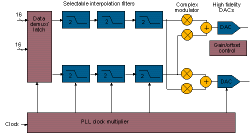
Analog Devices is the only chip manufacturer that offers a two-chip solution to realise this architecture, with its AD9777 family of TxDAC+ converters and AD8345/AD8346 Direct RF analog modulators.
AD9777 block diagram
How it works
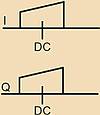
The idea behind image rejection or sideband suppression is to cancel out energy created in the sampling and mixing process.
Figure A
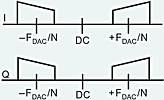
The signal starts as a baseband I and Q component signal with a finite bandwidth. This baseband I/Q signal is mixed in the AD977x TxDAC+ at a fraction of the sampling clock, placing the carrier at a low IF. Without doing a complex mix, the DAC output spectrum would look like that shown in Figure B.
Figure B
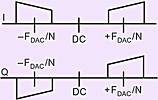
By engaging the complex mixer in the AD977x DAC, the orthogonal opposite sideband is produced in the selected channel (real or imaginary). When the complex signal is then mixed in an analog quadrature modulator, one of the sidebands is cancelled and the desired band is increased in power by 3 dB. The LO leakage can be minimised by calibrating the I/Q channel offset matching and filtering using a single SAW filter stage.
Figure C
Further reading:
RF filters explained
RFiber Solutions
Telecoms, Datacoms, Wireless, IoT
As RF environments become increasingly crowded, RF filters play a critical role in maintaining signal quality, improving system performance, and ensuring reliable operation.
Read more...
GigaDevice expands optical communication portfolio
NuVision Electronics
Telecoms, Datacoms, Wireless, IoT
GigaDevice has introduced the new GD32E512 and GD32E252 series MCUs specifically designed for optical module applications.
Read more...
Industrial connectivity without compromise
Telecoms, Datacoms, Wireless, IoT
The IR315 combines 4G LTE, Wi-Fi, Ethernet, and VPN technologies into a rugged, industrial-grade platform that enables seamless connectivity across a wide range of applications.
Read more...
Module provides 4G LTE Cat 1 bis connectivity
Dizzy Enterprises
Telecoms, Datacoms, Wireless, IoT
Mikroe adds 4G LTE Cat 1 bis connectivity where reliable data transmission and low power consumption are critical with the GC02S1-EU2 module.
Read more...
Enabling next-generation FPGA and SDR innovation
RFiber Solutions
Telecoms, Datacoms, Wireless, IoT
Puzhi Electronic Technology has established itself as a dynamic provider of advanced ARM and FPGA-based solutions, delivering a comprehensive ecosystem of products designed for modern embedded and high-performance computing applications.
Read more...
Magnetic mount antenna takes the hassle out of 4G installations
iCorp Technologies
Telecoms, Datacoms, Wireless, IoT
Designed for fast, tool-free installation, the YECN022CA 4G magnetic mount whip monopole antenna gives wireless devices a dependable cellular link in the field, where installation time and signal reliability both matters.
Read more...
Engineering for failure: why resilient telemetry matters more than perfect connectivity
Editor's Choice Telecoms, Datacoms, Wireless, IoT
One of the biggest assumptions in modern tracking systems is that connectivity will always be available. From an engineering perspective, this creates an interesting problem.
Read more...
Wi-Fi and Bluetooth smart module series integrates intelligence
iCorp Technologies
Telecoms, Datacoms, Wireless, IoT
Quectel Wireless Solutions has expanded its smart module portfolio with the SH503FM, a new-generation series of Wi-Fi and Bluetooth smart modules.
Read more...
Powering smart sensor networks
CST Electronics
Telecoms, Datacoms, Wireless, IoT
NeoCortec’s NeoMesh wireless mesh networking protocol and software stack is ideally suited for powering smart sensor networks where each device is required to send and receive small packets of data infrequently, but with high reliability.
Read more...
Lessons in long-distance telemetry
Omniflex Remote Monitoring Specialists
Telecoms, Datacoms, Wireless, IoT
Ian Loudon, international sales and marketing manager at Omniflex, reflects on some of the key engineering lessons learned from decades of deploying wireless telemetry systems in demanding industrial applications.
Read more...









 printer friendly version