Several years ago DIN 41612 plating specifications were changed from four performance levels (classes) to the now currently used three performance levels. Certain manufacturers immediately provided a new 4th class - the 200 mating class version (although DIN 41612 does not specify a performance level with 200 mating cycles).
Erni decided against the 200 mating cycle version because they would not be much more price competitive than with the 400 mating cycle version as many more piece parts have to be handled, plus about 25% more connector part numbers would have to be provided.
The test procedure differs and is as follows: After 200 mating cycles the corrosion test is carried out whereafter another 200 mating cycles are made. Then connectors, which have now made 400 mating cycles, are put through the final test procedure.
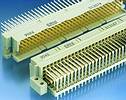
Erni strongly recommends that a minimum of class two connectors (400 mating cycles) are used for all severe environmental applications, eg in industry, salt air/atmosphere, etc. In these environments it is not only the number of insertions that is important but the connector's ability to withstand corrosion and continue to function in harsh environments that is vital.
This applies particularly in industries such as: mining - both on surface and underground; chemical - paper mills oil refineries and synthetic fuel plants; marine electronics; iron steel and ferrous metal plants; detergent and soap factories.
4 mm pitch power connectors Spectrum Concepts
Interconnection
Mill-Max has introduced a new line of high-reliability, 4 mm (.157”) pitch sockets and headers designed for power connections and rugged field applications.
Read more...56 G MezzaWave connectors and cable assemblies
Interconnection
Engineered to deliver notable signal integrity, TE Connectivity’s high-speed, high-density 56 G MezzaWave connector family is built on an open-pin-field array platform that supports data rates up to 56 Gbps PAM4 for next-generation modular system
Read more...Space SMPM and SMPM-Lock connectors Hiconnex
Interconnection
Radiall has released the Space SMPM and SMPM-Lock, miniature Space connectors for high-frequency performance and high-density applications.
Read more...Compact, high density, heavy duty, thermoplastic connectors TRX Electronics
Interconnection
Amphenol Sine Systems ATD series connectors, available from Mouser, are a compact, high density, heavy duty, thermoplastic solution with superior environmental seals and end caps for exceptional rear seal retention.
Read more...Samtec supports SGeT oHFM.c with high-performance interconnects Spectrum Concepts
Interconnection
Samtec has announced a new product portfolio designed for the SGeT oHFM.c standard. These connectors are based on Samtec’s proven AcceleRate HD and AcceleRate HP high-density, high-performance product families.
Read more...The effect of seasonal changes on ESD performance in South Africa Actum
Editor's Choice Circuit & System Protection Manufacturing / Production Technology, Hardware & Services
Electrostatic discharge performance is influenced by several environmental factors, with relative humidity being one of the most important. This is particularly relevant in South Africa, where seasonal changes can result in significant differences in humidity levels.
Read more...Clearing the Static: Electrostatic Discharge Actum
Manufacturing / Production Technology, Hardware & Services
A cordless ESD (Electrostatic Discharge) wrist strap does not work by grounding the person in the same way as a traditional wired wrist strap. Instead, it works by reducing or balancing the static charge on your body so that you are less likely to discharge electricity into sensitive electronic components.
Read more...Connectivity solutions for hydrogen technologies Hiconnex
Interconnection
As the production distribution and utilisation of hydrogen continue to scale, connectivity becomes a key enabler for efficient energy transmission, data communication, and system control.
Read more...Mixed-density Combo-D connectors Hiconnex
Interconnection
Positronic’s SCBM connector series is a rugged, high-performance family of mixed-density D-sub connectors engineered for demanding environments.
Read more...Same Sky expands rectangular connector portfolio Future Electronics
Interconnection
The portfolio includes male pin headers, female pin headers, and box headers, giving engineers the flexibility to select the most appropriate connector style for their specific design requirements.
While every effort has been made to ensure the accuracy of the information contained herein, the publisher and its agents cannot be held responsible for any errors contained, or any loss incurred as a result. Articles published do not necessarily reflect the views of the publishers. The editor reserves the right to alter or cut copy. Articles submitted are deemed to have been cleared for publication. Advertisements and company contact details are published as provided by the advertiser. Technews Publishing (Pty) Ltd cannot be held responsible for the accuracy or veracity of supplied material.









 printer friendly version