


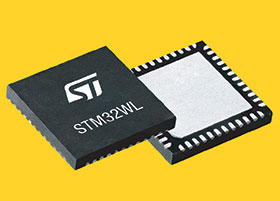
STMicroelectronics has expanded availability of its STM32WL long-range sub-GHz wireless system-on-chip (SoC) family, adding flexible configurations and package options for diverse mass-market applications.
By enabling devices to connect to LoRa-based low-power wide-area networks (LPWANs), the STM32WL series lets users create Internet-of-Things (IoT) devices that are extremely compact, energy efficient, and reliable. LPWANs provide cost-effective connectivity over large geographical areas and in remote locations, extending the IoT’s reach and enabling smart technologies to add greater value in industries from utilities and agriculture to shipping, transportation, and others.
The STM32WL series combines ST’s STM32 ultra-low-power microcontroller (MCU) architecture with a sub-GHz radio subsystem that supports multiple modulation schemes. These include LoRa, which allows high receiving sensitivity at low RF signal power, and (G)FSK, (G)MSK and BPSK modulation used by Sigfox and wireless Meter-Bus (wM-Bus) protocols, for instance, as well as other proprietary protocols or sub-GHz standards. The radio has a selectable dual-power output that helps customers comply with RF power restrictions for unlicensed frequency bands in all territories worldwide.
The new STM32WL models include the dual-core STM32WL55, based on an Arm Cortex-M4 core and a Cortex-M0+ MCU core which can both be used in a fully open and flexible way. The dual-core architecture effectively ensures hardware isolation that enhances cybersecurity, allows application updates without the need to recertify the device as a new radio product, and enhances real-time performance of both the radio and application.
The STM32WL55 joins the single-core STM32WLE5 introduced in January 2020 in BGA73 and QFN48 packages, which uses the main Cortex-M4 core to handle the radio and the application. The extended lineup also adds two non-LoRa variants, the single-core STM32WLE4 and dual-core STM32WL54, giving developers flexibility to leverage the unique SoC in new wireless IoT projects. All devices are supported by ST’s rolling ten-year longevity commitment for industrial products.
Monolithic integration of ST’s STM32 ultra-low-power architecture, and sub-GHz multi-modulation radio featuring LoRa modulation, makes the STM32WL series unique in the market.
The radio is based on proven Semtech SX126x transceiver IP, specially re-engineered by ST to fit market-proven power modes of STM32 platforms. It contains two internal power amplifiers with 15 dBm and 22 dBm maximum transmit power: The high-power and low-power transmitter modes, covering the global unlicensed frequency range from 150 MHz to 960 MHz, ensure compatibility with LPWANs in all territories and allow STM32WL SoCs to power end-products that are marketed worldwide.
The high level of RF integration enables single-crystal synchronisation of the high-speed external (HSE) clock and radio, and with no need for an external power amplifier (PA), which serves to minimise the overall bill of materials cost and solution footprint.
ST’s STM32WL architecture, leveraging the energy-efficient and powerful Arm Cortex-M4 core with DSP extensions, benefits from ultra-low-power technologies including dynamic voltage scaling and ST’s adaptive real-time ART Accelerator for zero-wait execution from Flash. MCU Flash options up to 256 KB let developers choose the optimal code and data storage density for the entire platform including application and radio.
Built-in cybersecurity features include hardware symmetric encryption and public key accelerators, true random number generator (TRNG), sector protection against read/write operation, dual-core secure areas isolation and support for state-of-the-art cryptographic algorithms including RSA, ECC and ECDSA.
Moreover, users can take advantage of the proven STM32Cube development ecosystem to simplify product creation and accelerate time to market. Such free resources include the STM32CubeMX project configuration and code generation tool, STM32CubeMonitor runtime monitoring and visualisation tool, and STM32CubeProgrammer.
The STM32CubeWL MCU package contains all the embedded software bricks needed to operate the STM32WL series, including peripheral drivers, ST’s LoRaWAN protocol stack, Sigfox stack, and example code for LoRaWAN firmware update over the air (FUOTA) leveraging ST’s Secure Boot and Secure Firmware Update (SBSFU) technology. Alternative stacks by authorised partners, such as the Stackforce W-MBus stack, are also available.
There are also two STM32WL-based Nucleo boards for fast prototyping: NUCLEO-WL55JC1 (868/915/923 MHz) and NUCLEO-WL55JC2 (433/470 MHz).
| Tel: | +27 11 923 9600 |
| Email: | info@arrow.altech.co.za |
| www: | www.altronarrow.com |
| Articles: | More information and articles about Altron Arrow |






© Technews Publishing (Pty) Ltd | All Rights Reserved
 printer friendly version