

Telecoms, Datacoms, Wireless, IoT


Otto Wireless Solutions welcomes new SIMCom family

26 May 2021 Telecoms, Datacoms, Wireless, IoT

SIMCom modules have created a reputation… no, it’s more than that… it’s a legacy, of releasing compatible modules when new product lines are launched. Nothing has changed, as we welcome the new A7600 family into the fold.

Imagine entering the realm of LTE compliance at half the cost of traditional modules. How would this be possible, considering the marketing rhetoric which has been put out there: “Oh no sir, the reason why LTE modules are so expensive is because they have much more circuitry, they need to cater for higher speeds, LTE frequencies, 3G frequencies, 2G frequencies and not to mention the costs of compliance and licencing for those various technologies… it will never change.” But it is this precise narrative which SIMcom has defeated with the launch of the A7600 family, because within that blurb lies a technology which the vast majority of telemetry applications have never used, mainly due to the ratio of cost to performance not being favourable and that near-redundant smokescreen is 3G technology.

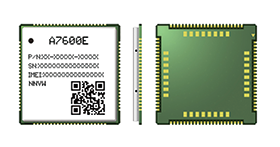
What makes the A7600 family unique is the total absence of 3G technology. The devices are 4G compliant and fall straight back to 2G (Edge), thus avoiding 3G technology entirely and avoiding all the associated costs of 3G in so doing. When one compares the A7600E against the similar SIM7600E (which, to be fair, also has a GPS), it is quite literally half the cost.

But why make the change? It’s no secret that the service providers have been intimating that the end of 2G is nigh for some time, but it is only recently that I have seen articles citing 2-3 year timelines. Practically, there are millions of 2G devices operational in South Africa and these are predominantly in the security environment, which makes it very unlikely that any service provider would throw the proverbial switch and shut down 2G anytime soon.

However, in my personal and humble opinion, what is potentially more likely to happen is the blocking of new, 2G-only devices from entering the market, similar to what happened elsewhere on the globe. It would not be inconceivable for 2G to be allowed only as an emergency fallback on new devices, provided such devices have a higher technology capability available as a primary connectivity medium. The time to consider 4G devices and future-proof products has, in my opinion, arrived.

With this in mind, Otto Wireless Solutions has taken the decision to go through ICASA approval of the A7600E family and the first product to be launched locally with ICASA approval is the A7600E. What we are doing to enable the market is providing starter kits consisting of a basic antenna, some connectors, common cables, a battery and of course, an A7600E module. This is supplied along with our full technical support to customers, in order to assist with the transition to 4G. A limited number of these kits are available free of charge.

Of course there is more to this than one module. It’s a family affair. The LTE Cat. 1 module (A7600E) is the first and following in its wake is a family with additional capabilities and reduced size (A7682E), including higher LTE Cat. 4 speed (A7600E-H), onboard GPS (A7600E-MNSE) and more. Plans are afoot to position this family as the next flagship family as the lowest cost and highest capability modules on the market.

An investment in the A7600E family is an investment in the inevitable future.


Share this article:
Share via emailShare via LinkedInPrint this page

Further reading:

Smart farming with LoRaWAN
Otto Wireless Solutions Telecoms, Datacoms, Wireless, IoT
Real-time visibility is transforming modern agriculture, and Otto Wireless Solutions, together with Dragino, deliver this capability through a comprehensive suite of long-range IoT sensors and gateways designed for smart farming.

Read more...
RTK-enhanced GNSS and INS solution
Dizzy Enterprises Telecoms, Datacoms, Wireless, IoT
This latest XSENS MTi-8 Click provides high-accuracy positioning (RTK-supported) and orientation tracking in demanding outdoor embedded applications.

Read more...
High-performance double balanced RF mixer
RFiber Solutions Telecoms, Datacoms, Wireless, IoT
The AM5008 from Mercury Systems is a high-performance, double-balanced MMIC mixer designed for wideband applications spanning 2 GHz to 24 GHz.

Read more...
Compact NFC antennas enable easy integration
Telecoms, Datacoms, Wireless, IoT
Leankon has expanded its 13,56 MHz NFC antenna portfolio with a comprehensive suite of nine off the shelf products designed for next generation IoT applications.

Read more...
Ultra-low jitter clocks
Altron Arrow Telecoms, Datacoms, Wireless, IoT
Skyworks has introduced a new family of ultra-low jitter programmable clocks designed to meet the increasing demands of next-gen connectivity.

Read more...
Efficient Bluetooth SoC
Altron Arrow Telecoms, Datacoms, Wireless, IoT
The EFR32BG29 wireless SoC from Silicon Labs is a highly efficient, high memory, low-power, and ultra compact SoC designed for secure and high-performance wireless networking for IoT devices.

Read more...
Minimal size, maximum flexibility
Würth Elektronik eiSos Telecoms, Datacoms, Wireless, IoT
Würth Elektronik has introduced two highly compact radio modules that give developers maximum freedom in designing proprietary wireless solutions that go beyond standard protocols.

Read more...
Super Wi-Fi extends industrial connectivity
NEC XON Telecoms, Datacoms, Wireless, IoT
Africa’s harshest mines, ports, and industrial parks are no longer bound by range, latency, and interference challenges.

Read more...
HackRF Pro advances Open SDR performance
IOT Electronics Telecoms, Datacoms, Wireless, IoT
Designed for engineers, researchers, and radio enthusiasts alike, the HackRF Pro can transmit and receive signals across a wide frequency range of 100 kHz to 6 GHz, making it a versatile tool for testing and developing modern and emerging radio technologies.

Read more...
Deterministic high-speed Ethernet
Telecoms, Datacoms, Wireless, IoT
The Fraunhofer Institute for Photonic Microsystems IPMS has developed a new 10G TSN endpoint IP Core, enabling deterministic real-time communication at data rates of up to 10 Gbit/s.

Read more...


While every effort has been made to ensure the accuracy of the information contained herein, the publisher and its agents cannot be held responsible for any errors contained, or any loss incurred as a result. Articles published do not necessarily reflect the views of the publishers. The editor reserves the right to alter or cut copy. Articles submitted are deemed to have been cleared for publication. Advertisements and company contact details are published as provided by the advertiser. Technews Publishing (Pty) Ltd cannot be held responsible for the accuracy or veracity of supplied material.


© Technews Publishing (Pty) Ltd | All Rights Reserved

