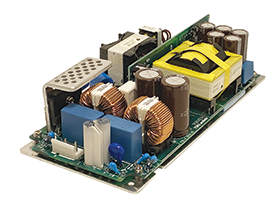
New TDK-Lambda CUS350MP-1000 AC-DC medical and industrial certified power supplies boast low audible noise for applications requiring occasional high peak power demands, medical equipment utilising DC motors, industrial printers and ticket dispensers.
Capable of providing 500 W with external airflow (1000W peak), the series is rated at 350 W when convection cooled and can deliver peaks of 800 W for up to 5 seconds. Power supplies with a peak capability can offer cost, size and audible noise reductions over fan cooled models rated for continuous operation at the peak power requirement.
The series is available with 24 V, 30 V, 36 V and 48 V outputs, a 5 V isolated standby and a remote on/off function. The CUS350MP-1000 has an 85 to 265 V a.c. input range and a leakage current of less than 300 µA. With efficiencies of up to 94%, operation in ambient temperatures of -20°C to +70°C is possible, derating linearly above 50°C to 30% load. Open-frame models measure 88 x 183 x 44 mm (W x L x H) with a weight of 770 g. Options include a perforated cover, double-sided board coating, single input fuse and screw terminations.
The CUS350MP-1000 has an input to output isolation of 4000 V a.c. (2 x MoPP), input to ground of 1500 V a.c. (1 x MoPP) and 1500 V a.c. (1 x MoPP) output to ground for suitability in B and BF rated medical equipment. It has a plethora of safety certifications and is compliant with conducted and radiated emission standards.
High-precision current transducer
Power Electronics / Power Management
Danisense announces its new high-precision DP12IP current transducer designed for isolated DC and AC current measurement in demanding PCB-mounted power electronics applications.
Read more...Secure holder for protected 18650 batteries
Power Electronics / Power Management
Designed for protected 18650 batteries up to 70 mm long, the holder offers secure retention for portable, industrial, and embedded applications.
Read more...More room to scale Altron Arrow
Power Electronics / Power Management
With the latest STM32H5 lines from STMicroelectronics, you can now scale within the same platform, from a compact 1 Mbyte device to higher-memory MCUs for graphics-rich and feature-heavy designs.
Read more...Surface mount power amplifier for high-power applications RF Design
Power Electronics / Power Management
The GNA-63-5W+, from Mini-Circuits, is a GaN MMIC Power Amplifier (PA) designed for demanding RF applications requiring high efficiency, excellent linearity, and a compact footprint.
Read more...1200 V QSiC modules
Power Electronics / Power Management
SemiQ Inc has launched the QSiC Dual3, a family of 1200 V half-bridge MOSFET modules for motor drives in data centre cooling systems, grid converters in energy storage systems, and industrial drivers.
Read more...Expanded range of high-thermal-performance QSiC modules
Power Electronics / Power Management
SemiQ’s half-bridge series for data centre power converters and industrial motor drives features low RDSON SiC MOSFETs and parallel SBD diodes for best-in-class power density and conversion efficiency.
Read more...Transporting lithium batteries and IoT devices
Power Electronics / Power Management
With billions of rechargeable and non-rechargeable lithium cells and batteries powering most of the world’s consumer and industrial electronic devices, shipping them to customers through vast global logistics chains is often an overlooked topic.
Read more...Setting a new benchmark for high-power DC load testing Conical Technologies
Test & Measurement Power Electronics / Power Management
The new ITECH IT8900G/L high-speed, high-power DC electronic load offers a powerful combination of speed, scalability, precision and high-power density.
Read more...Quality batteries are critical for IIoT Uniross Batteries
Power Electronics / Power Management
Batteries intended for use in industrial operations must indeed offer complete reliability under extreme environmental conditions, resistance to vibration and harsh environments.
While every effort has been made to ensure the accuracy of the information contained herein, the publisher and its agents cannot be held responsible for any errors contained, or any loss incurred as a result. Articles published do not necessarily reflect the views of the publishers. The editor reserves the right to alter or cut copy. Articles submitted are deemed to have been cleared for publication. Advertisements and company contact details are published as provided by the advertiser. Technews Publishing (Pty) Ltd cannot be held responsible for the accuracy or veracity of supplied material.









 printer friendly version