


For decades, the epicentre of entertainment, media and advertising was in the home – on television sets and eventually, computers and tablets. Now, however, with the emergence and growing maturity of technologies like 5G, edge computing, artificial intelligence (AI), precision positioning and extended reality (XR), robust content and multimedia services are becoming more common outside of the home in public venues and locations.
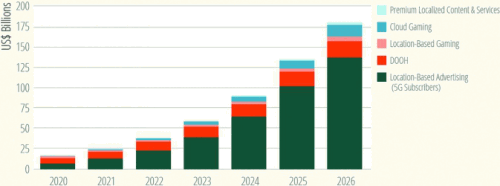
ABI Research has explored how this changing dynamic is shifting spending and investment habits, creating significant market value as well as tremendous opportunities for providers of enabling technologies.
Airports and air travel
Airports are intriguing locations for localised content and services because they have tremendous foot traffic and a flow of people with a high level of diversity. They also offer dining and shopping (and some offer recreational facilities), which makes these locations prime real estate for out-of-home (OOH) advertising and marketing.
There are two prime candidates for content and service localisation in airports: cloud gaming and streaming/downloadable video. While both types of streaming services could be accessed through personal subscriptions, there are still strong cases for in-venue services for both categories.
The cloud gaming market is still comparatively nascent within the context of the video game market, with cloud gamers totalling in the millions (estimated at around 15 million in 2020) versus the more than 2,7 billion worldwide gamers. For in-airport services, users could pay for blocks of playing time, with the potential to offer premium levels of service. The prices would likely exceed typical hourly rates for virtual PC/cloud gaming services, but a premium is assumed to account for the convenience and location of the service opportunity.
Video services could offer users the opportunity to download movies or TV shows with a one-day rental window. While a significant number of passengers may have access to subscription video on demand (SVOD) services, which support downloads, there are often cases when travellers may forget to download content ahead of time or may find exclusive content offered only in airport kiosks, mainly content targeting international travellers.
While passengers may be compelled to rent movies from a third party, airports could offer a premium connection to download content at a faster rate. Kiosks or download stations can also serve content in markets where cellular data connections are limited and/or expensive. For example, Migo, a digital distribution service, targets emerging economies by placing download stations/kiosks in public locations where users can quickly download content to their devices over local Wi-Fi.
Location-based gaming
Location-based gaming refers to mobile games that are designed to be played in public and outdoors. Revenue is typically generated through the sale of virtual goods and currencies, although some games like Pokémon Go create events around locations and support sponsored gathering points, so, for example, a store could sponsor a PokéStop, paying a fee per user who comes to the location.
Player longevity/engagement has been an issue for a number of new location-based games (some have already shut down), but longer-standing platforms keep the experience fresh by adding new content and most vitally, holding frequent public events for gamers. The Covid-19 pandemic changed the formula with a greater emphasis on in-home and in-building usage, but the same considerations around events will hold true.
Growth in the market is expected to continue, particularly as more individuals seek to return to a more normal life following the pandemic. The use of 5G and multi-access edge computing (MEC) will also have a critical role in bringing more advanced location-based services and experiences to market – this includes the use of hybrid and cloud XR (extended reality) platforms.
Advertising market outlook
One market that is already primed to take advantage of the location-based boom is location-based advertising (LBA). LBA covers a range of applications or techniques within the advertising landscape. In all cases, the target’s location plays a role in the types and content of ads received, but with varying degrees of specificity (regarding location) and intent or outcome. While not a requirement, most LBA and marketing is tied to mobile devices, which have the means to present location data and opportunities to target users in meaningful ways.
The use of location-based data will carry a premium, which often falls in the 25% to 30% range, but could go higher depending on the level of specificity and degree of targeting. A number of companies are offering location-based data and services for advertising and marketing.
Conclusion and recommendations
The near-term revenue potential for some of the opportunities discussed in this report is still viewed through a conservative lens. In this vein, market forecasts for in-venue premium content and services represent market potential, rather than projections based on historical precedent. 5G and MEC play key roles in enabling many of the most immersive and interactive experiences within these venues and they serve as key testbeds and showcases of these enabling technologies, but the larger market opportunity will come from more established markets.
For companies operating within these markets, it is important to view the opportunities as a series of milestones that will be reached over time. In addition, it is important to consider other forms of benefit and value beyond revenue alone; for example, marketing and user experiences. In the nearest term, location-based gaming and LBA hold the most opportunity. From the perspective of 5G and MEC, however, there is less immediate need for higher data rates and lower latencies, unless multiplayer location-based gaming (which will leverage some cloud compute) expands quickly out of trials. For advertising, the greatest impact for 5G and MEC will come with smart glasses.
Note: This is a condensed version of a free ABI Research white paper which can be downloaded at www.dataweek.co.za/*apr22-abi






© Technews Publishing (Pty) Ltd | All Rights Reserved
 printer friendly version