How does solder reflow affect RF connectors?
EMP 2023 Electronics Manufacturing & Production Handbook
Manufacturing / Production Technology, Hardware & Services
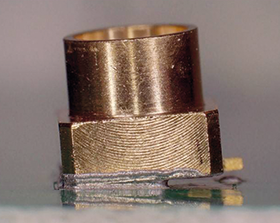
By Janine Love, Samtec.
Solder reflow plays an important role in the success and performance of high-bandwidth RF connectors. Sometimes, when a high-bandwidth RF connector
is soldered together with an optimised PCB launch, the results can be unpredictable. It is important to investigate the root causes of solder reflow variation and analyse what techniques can deliver consistent performance across frequencies.
In a new white paper from Samtec, ‘Impacts of Solder Reflow on High Bandwidth RF Connectors,’ authors Michael Griesi (RF design & simulation engineering manager) and Chris Shelly (retired senior RF/SI modelling engineer) analyse the impact of the design choices for a specific push-on connector, its PCB, and the process. Using simulations and measurements, the team steps through its detailed development process to achieve the optimal design and better solder flow control.
The design team began with an initial two-piece contact, traditional design shown in the image. The ‘tombstoning’ effect that was found on some of the sample connectors can be quite clearly seen, where the connectors were tilting on the PCB. Snap on connectors such as this need to stay firmly on the board, with the centre contacting the board. The initial connector design was targeting 40 GHz bandwidth when soldered onto a PCB; however, simulations showed performance of less than 25 GHz.
As a first design step, the team experimented with the thickness of the gold plating and the insulator’s coefficient of expansion. Other topics investigated include solder wicking and pooling, PCB pad design, and tuning the solder reflow process. At the end of the design process, the final design had thinner gold plating, higher temperature insulators, and a single-piece swept contact. To further address performance concerns, the team added a chamfer to the bottom of the connector, a solder control tail on the PCB pad, adjusted the thermal profile, and other process adjustments.
The performance challenges experienced with this connector design process are not unique to this type of connector. At high frequencies, every little detail matters. To achieve optimal performance, it is important to have robust simulation capabilities and multiple troubleshooting and analysis tools. The challenges of solder reflow and the impact it has on performance extends to all high-bandwidth RF connectors. At Samtec, work continues in simulation, manufacturing process, PCB and connector design to continue to optimise performance in the field of solder reflow.
Further reading:
Soldering day highlights
Manufacturing / Production Technology, Hardware & Services
JAPAN UNIX has published a new event report and highlight video from their UNIX SOLDERING DAY 2026 in Hungary. This event reflects on their commitment to supporting manufacturers not only through soldering automation systems, but also through technical education, live demonstrations, hands-on training, and practical engineering know-how.
Read more...
Clearing the Static: Electrostatic Discharge
Actum
Manufacturing / Production Technology, Hardware & Services
A cordless ESD (Electrostatic Discharge) wrist strap does not work by grounding the person in the same way as a traditional wired wrist strap. Instead, it works by reducing or balancing the static charge on your body so that you are less likely to discharge electricity into sensitive electronic components.
Read more...
Engineering trust in South Africa’s SMT sector
ZETECH ONE
Manufacturing / Production Technology, Hardware & Services
From a small Johannesburg start-up to a trusted SMT technology partner, Zetech One has spent four decades helping South African electronics manufacturers improve production quality, efficiency and reliability.
Read more...
The new reality of PCB material supply
Jemstech
Editor's Choice Manufacturing / Production Technology, Hardware & Services
How resilient manufacturing strategies are helping OEMs navigate a changing global supply chain.
Read more...
Streamlining Device Programming with the AutoBee-D1
Vepac Electronics
Manufacturing / Production Technology, Hardware & Services
The AutoBee-D1 desktop automated programmer is designed to simplify the programming of devices, while delivering consistent accuracy, high throughput and reduced manual intervention.
Read more...
Zero PFAS die attach paste
Testerion
Manufacturing / Production Technology, Hardware & Services
With silver price volatility increasing and sustainability requirements accelerating across semiconductor assembly, MacDermid Alpha Electronics Solutions introduces ATROX CD 560-1, a zero per- and polyfluoroalkyl substance (PFAS) alternate silver filler die attach paste.
Read more...
Precision jet printing for advanced PCB designs
MyKay Tronics
Manufacturing / Production Technology, Hardware & Services
Mycronic’s BA 01 small dot ejector delivers unmatched precision in solder paste jet printing for advanced PCB designs.
Read more...
Strengthening local electronics manufacturing through investment and innovation
Microtronix Manufacturing
Editor's Choice Manufacturing / Production Technology, Hardware & Services
Microtronix South Africa cements its commitment to local manufacturing with ongoing investments in production capacity, skills development, and job creation.
Read more...
Polypropylene pole-top boxes support smarter, more secure electricity networks
Manufacturing / Production Technology, Hardware & Services Enclosures, Racks, Cabinets & Panel Products
As South Africa accelerates the rollout of smart prepaid electricity metering, innovative enclosure technology from Power Process Systems (PPS) is helping utilities improve network security, reduce electricity theft and protect critical electrical infrastructure.
Read more...
200 W of power in a space-saving design
Vepac Electronics
Manufacturing / Production Technology, Hardware & Services
The Hakko FX-972 Soldering Station delivers high-performance soldering in a compact package, making it suitable for a wide range of soldering applications.
Read more...









 printer friendly version