


It is well known that the most sustainable and productive manufacturers in Africa will be those embracing the fourth industrial revolution (4IR). To not embrace these technologies would mean lagging behind global peers.
In an age when all that 4IR has to offer, like accelerated digitalisation, artificial intelligence, cloud computing, 3D printing and robotics, no manufacturing entity utilising automation can hope to compete without being abreast of advances in these spheres. It is important for a business to invest in equipment and processes that improve efficiencies to boost both its growth and bottom line.
To endorse this, Dennis Phillips, national sales manager at PFERD South Africa, said, “The most significant benefits of 4IR are around automation, including automating routine and repetitive tasks to allow for better productivity and efficiencies. The manufacturing sector is ideally placed to benefit from these advances.”
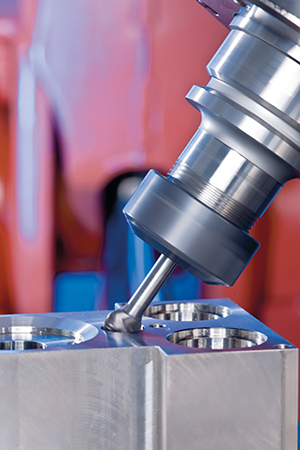
Abrasives in robotics
Robotic applications such as grinding, milling, and surface preparation and structuring, require a range of high-performance abrasives to have the desired impact on efficiency. PFERD can assist with the optimisation of automated processes by assessing the applications and advising on the correct tools.
Professional tools for automated processes
South Africa does, however, struggle with the infrastructure required to ensure that what 4IR has to offer, can be implemented to its fullest capabilities. These include:
• Being able to educate people to have the technical skills to employ the benefits of 4IR.
• Faster more streamlined internet connectivity and 5G mobile technology (which is being improved on).
However, having a reliable energy supply is vital and this is proving to be somewhat of a challenge.
SA manufacturers who implement robotics (probably the most meaningful addition to manufacturing operations) need to choose the most suitable consumables to maximise the efficiency, which in turn optimises the operations’ overall productivity:
• Milling, drilling and countersinking tools: Applications for these tools include chamfering, deburring, rounding edges, machining cast parts, together with trimming fibre-reinforced plastics. The milling tools’ precision design and dimensional stability allow for the easy programming of robots, while their performance and long tool life make them highly suitable for robotic applications because the frequency of tool changes is greatly reduced.
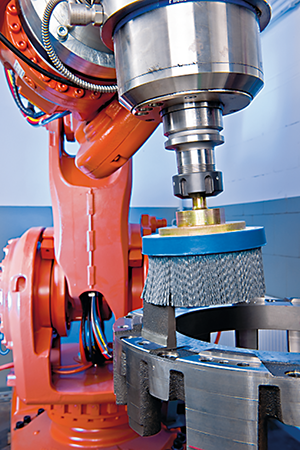
• Fine grinding and polishing tools: PFERD offers a wide range of high-performing coated and non-woven abrasives, suitable for numerous fine grinding and polishing jobs. Tasks such as automated stock removal, surface preparation and structuring can be done efficiently with consistent results.
• Diamond and CBN tools: Due to diamond and CBN tools’ constant tool geometry, they are highly suitable for robotic applications within the foundry industry. Their hardness and very long tool life reduces unproductive idle time attributed to tool changes, making them ideally suited for demanding applications within this industry.
• Composite filament brushes: High-quality technical brushes specifically developed for industrial, automated use. These brushes are particularly suitable for deburring complicated components such as cylinder heads and gear toothing.
Boosting the bottom line and gaining global recognition
The distinct advantage of robotic applications is that a workpiece can be produced and finished in fewer processing steps, resulting in less manual work, and with more consistent results.
Maximising the efficiency of business processes boosts local manufacturers’ bottom line and generates a better breed of SA manufacturers capable of competing on a global level.






© Technews Publishing (Pty) Ltd | All Rights Reserved
 printer friendly version