SA businesses need to encourage women in tech
28 February 2023
Editor's Choice
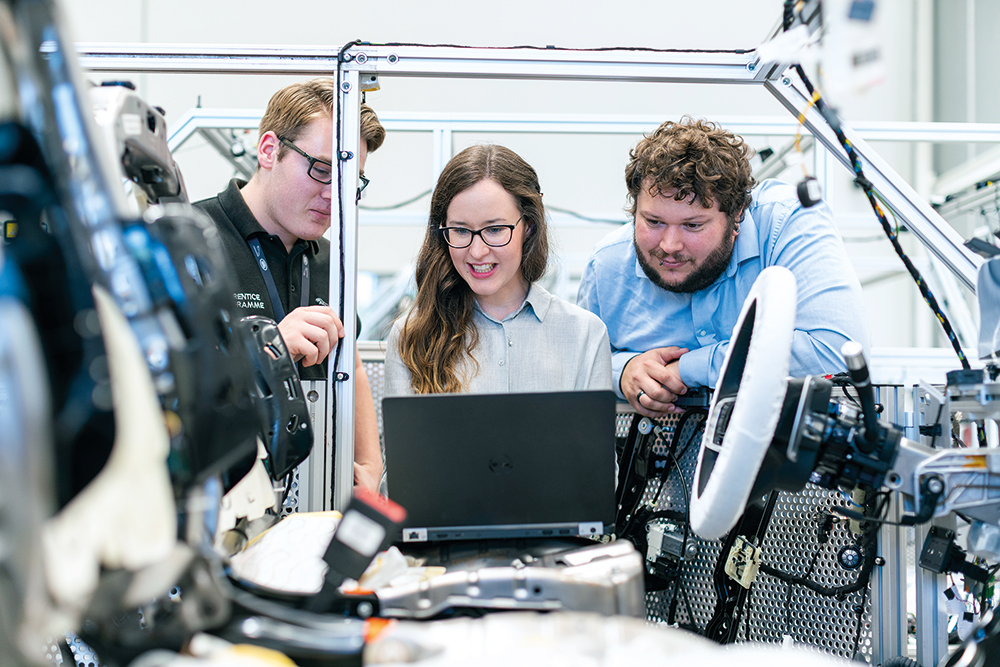
South Africa is known for its diversity and progressive society, yet in the field of technology, there is still a significant gender imbalance. Women are under-represented in the technology industry, both in terms of employment and leadership positions. This is not only a missed opportunity for women but also for South African businesses. To remain competitive in a rapidly changing technological landscape, businesses need to cultivate and support women in tech.
The Independent Communications Authority of South Africa (ICASA) reported in 2022 that the percentage of female employees in the telecommunications sector had decreased by as much as 32,9%. This decrease was based on the reported number of women employed which dropped from 12 820 in 2020 to merely 8603 in 2021.
The International Day of Women and Girls in Science is commemorated on 11 February, and is the ideal opportunity for businesses in the technology sector to show its support of young women and also to consider how to motivate them to work in this challenging, yet rewarding, field.
One of the main reasons for the lack of women in tech is a lack of representation in the education system. From a young age, girls are neither encouraged to pursue careers in technology nor given the opportunity to develop skills in this field. In most technology classes at school level – Information Technology, Physical Science, Coding and Robotics, and Engineering Graphics and Design – males far outnumber the females enrolled. This leads to a shortage of women in the pipeline for technology jobs.
Another reason for the low representation of women in tech is the prevalence of gender bias in the workplace. Women are often undervalued and not given equal opportunities to advance in their careers. This leads to a lack of women in senior positions, making it harder for them to serve as role models and mentors for the next generation of women in tech, which simply exacerbates the problem.
Businesses need to invest in education and training programmes to help women develop their technical skills. This can include offering paid internships, sponsoring technical certifications, or partnering with local schools and universities to provide mentorship opportunities.
Businesses also need to work with the wider community to raise awareness of the importance of women in tech. This can involve sponsoring events, hosting workshops, and collaborating with other organisations to promote the value of women in the technology industry.
Cultivating women in tech is necessary, as they often bring different perspectives, skills, and experiences to the workplace, which can drive innovation and hopefully lead to a better business outcome.
Further reading:
Women and the future of engineering in South Africa
Editor's Choice
With women making up just 16% of registered engineering professionals in South Africa, AvenirHoldings CEO, Tshidi Mndzebele, is calling on women engineers and graduates to pursue formal professional registration as a key step to unlocking career growth and industry leadership.
Read more...
The effect of seasonal changes on ESD performance in South Africa
Actum
Editor's Choice Circuit & System Protection Manufacturing / Production Technology, Hardware & Services
Electrostatic discharge performance is influenced by several environmental factors, with relative humidity being one of the most important. This is particularly relevant in South Africa, where seasonal changes can result in significant differences in humidity levels.
Read more...
Compact RTK design: More than just the receiver
iCorp Technologies
Editor's Choice Telecoms, Datacoms, Wireless, IoT
In practice, engineers building compact RTK products keep discovering the same thing: the hardest component in the system is no longer the receiver. It is the antenna.
Read more...
The signal-to-noise challenge in large-scale IIoT
Sigfox South Africa
Editor's Choice Telecoms, Datacoms, Wireless, IoT
For much of the last decade, the industrial IoT industry has been driven by a relatively simple assumption: if a little data is useful, more data must be better. That thinking shaped countless deployments.
Read more...
Women building South Africa’s power infrastructure
Editor's Choice
As South Africa celebrates Women’s Month in August, women are increasingly taking their place on the factory floor, in technical workshops and across engineering environments, helping manufacture the infrastructure that keeps the country’s electricity network running.
Read more...
More efficient production with optimised procurement
Editor's Choice
The smallest part on the BOM is usually the one that holds it up. Interconnect, passive and electromechanical components rarely get attention until they are missing. That is starting to change, and it is reshaping how procurement teams think about risk.
Read more...
Locate underground cable faults faster with the Fluke AF2082 A-Frame
Comtest
Editor's Choice Test & Measurement
Underground cable faults can lead to costly downtime, service disruptions, and extensive excavation if the fault location is uncertain. The AF2082 simplifies this process by guiding operators directly to the fault point.
Read more...
Here is what we learnt from three supply chain crises
Seven Labs Technology
Editor's Choice
Component crises are not random events. They follow a pattern. After fifteen years and three major disruptions, Seven Labs knows exactly what that pattern demands, and what it takes to keep production lines moving.
Read more...
The new reality of PCB material supply
Jemstech
Editor's Choice Manufacturing / Production Technology, Hardware & Services
How resilient manufacturing strategies are helping OEMs navigate a changing global supply chain.
Read more...
Strengthening local electronics manufacturing through investment and innovation
Microtronix Manufacturing
Editor's Choice Manufacturing / Production Technology, Hardware & Services
Microtronix South Africa cements its commitment to local manufacturing with ongoing investments in production capacity, skills development, and job creation.
Read more...









 printer friendly version