

Manufacturing / Production Technology, Hardware & Services


Boosting productivity with automated troubleshooting tools

25 October 2023 Manufacturing / Production Technology, Hardware & Services

Although surface-mount assembly involves great precision and reliability, things can go wrong when operating continuously at high speed. In the event of errors and exceptions, full-speed operation needs to be restored as quickly as possible.

Whenever the line is stopped, the business incurs costs that reduce profitability. These costs include not only the direct cost of lost production, but also labour costs while the line is stopped, the cost of overtime and rush orders to catch up after the line is restored, and the cost of any rework or items scrapped due to the problem that caused the stoppage. There are costs associate with inventory waiting, and the disruption to the normal flow of operations can cause inefficiencies. Moreover, there can be impact on customer commitments that can result in financial penalties.

Today’s assembly equipment is loaded with sensors to detect issues such as blocked nozzles or pickup misalignment. Automatic inspection can be performed at multiple points in the line, including after screen printing, component placement, and reflow, to assist troubleshooting in real time.

Software tools are relied upon to help manage production equipment, detect any exceptions and defects, and provide information to production supervisors. These include dashboard applications that provide an instant appraisal of equipment and production status. There are also value-added tools such as Yamaha’s QA Options and the closely related Mobile Judgement app. Mobile Judgement can send details of any detected defects, directly to the supervisor’s smartphone to help assess the severity of the problem.

The Human-Machine Interface

These applications represent the place where machines and humans interact to solve the problems that inevitably arise during the normal course of a shift. The team in charge must apply skills to deliver the required quantity of each batch, and ensure that production runs to schedule.

This approach can be dependent on the quality of the tools provided to visualise the data captured from the various locations throughout the line. Identifying the causes of faults and applying a fix, quickly, also depends on the skills and knowledge of the supervisor staff-members present in the factory.

The latest advancements in data science can help to eliminate dependence on individual judgement by automatically identifying the causes of any defects or other production problems. Guiding operators directly to these causes permits more consistent production performance. As an example of this emerging generation of software tools, the latest Yamaha YSUP Analytics Dashboard contains advanced tools that use statistical techniques to identify most likely causes of detected defects. It also recommends suitable corrective actions.
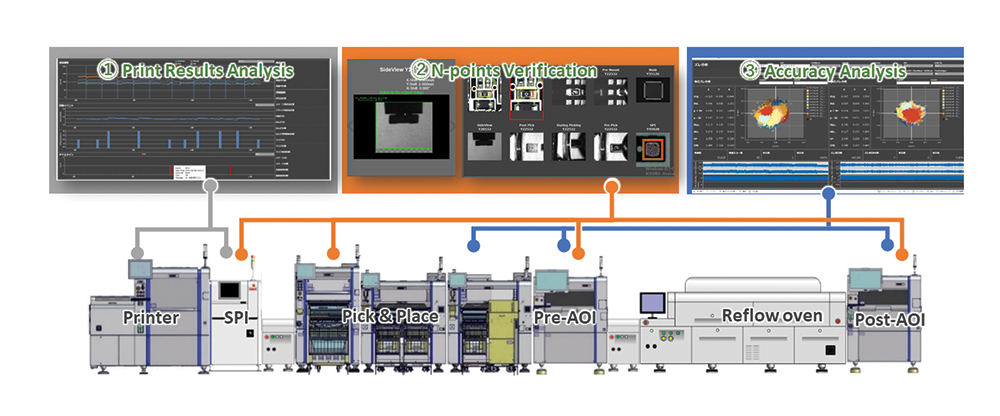
The new YSUP Analytics Dashboard presents information in an easy-to-read format that can be interpreted quickly. Ultimately, this enables every working shift to deliver consistently high production throughput.

Based on a relational database with built-in querying capabilities that analyse data in situ, the software identifies probable causes of recorded exceptions in near real-time using statistical techniques. The automatic analysis capabilities of the new dashboard application enable any authorised user to extract the information they need, analyse errors, and view corrective actions at any time.

Yamaha’s latest data-driven dashboard tools provide extra assistance to identify and fix the causes of errors, to help overcome the limitations of operators’ knowledge and shorten the time to restore operation, ultimately enabling further improvement of productivity.


Credit(s)


Share this article:
Share via emailShare via LinkedInPrint this page

Further reading:

Outscale your competition
Manufacturing / Production Technology, Hardware & Services
Attendees will be able to explore the benefits of AMD Kintex UltraScale+ Gen 2 FPGAs in high-performance Pro AV, test & measurement, industrial, and medical applications.

Read more...
MTN SA Foundation drives youth pathways into the digital economy
Manufacturing / Production Technology, Hardware & Services
The MTN SA Foundation, in partnership with Helios Towers and Datacomb Development Hub, has launched the MTN–Helios Towers 12-month ICT Learnership Programme, a pathway that takes young South Africans from digital training into real workplace experience.

Read more...
Downstream demand, system reliability, and the expanding role of engineering-led distribution
Manufacturing / Production Technology, Hardware & Services
[Sponsored] As South Africa’s semiconductor demand continues to be shaped by downstream system deployment rather than upstream fabrication, the importance of engineering-led distribution will continue to grow.

Read more...
The impact of harsh environments and ionic contamination on post-reflow circuit assemblies
MyKay Tronics Manufacturing / Production Technology, Hardware & Services
There is well documented historical proof that post-reflow circuit assemblies, when subjected to harsh environments, are particularly vulnerable to failure mechanisms, but modern electronic assemblies are far more susceptible to this phenomenon.

Read more...
Engineering copper grain structure for high-yield hybrid bonding in 3D packaging
Testerion Editor's Choice Manufacturing / Production Technology, Hardware & Services
The way copper grains are sized and distributed forms the metallurgical foundation of hybrid bonding, enabling lower bonding temperatures, greater reliability, and stable grain structures throughout integration.

Read more...
Understanding solder dross: causes and control strategies
Truth Electronic Manufacturing Editor's Choice Manufacturing / Production Technology, Hardware & Services
Dross formation is an inevitable consequence of wave soldering. It occurs when molten solder comes into contact with oxygen, forming metal oxides that float on the surface of the solder bath. Over time, this oxidation byproduct accumulates and must be removed to maintain solder quality and process consistency.

Read more...
Non-destructive techniques for identifying defects in BGA joints – TDR, 2DX, and cross-section-SEM comparison
MyKay Tronics Manufacturing / Production Technology, Hardware & Services
This whitepaper reports the results of a comparison of the following techniques: TDR, automatic X-ray inspection (AXI), transmission X-ray (2DX), cross-section/SEM, and Dye & Pry.

Read more...
Implications of using Pb-free solders on X-ray inspection of flip chips and BGAs
MyKay Tronics Manufacturing / Production Technology, Hardware & Services
With the move to Pb-free soldering, most of the attention has been paid to reflow temperatures, component compatibility, and reliability concerns, but the implications for inspection, particularly X-ray inspection, are equally important and often underestimated.

Read more...
The causes of solder balls in robotic soldering
Manufacturing / Production Technology, Hardware & Services
Solder balls (also known as solder splatter) are a major concern in many production sites as they may potentially cause shorts, leading to long-term impacts on product reliability.

Read more...
Material challenges for superconducting quantum chips
Manufacturing / Production Technology, Hardware & Services
To achieve the scalable and repeatable production of superconducting circuits for quantum technology products, players in the industry are leveraging semiconductor fabrication techniques.

Read more...


While every effort has been made to ensure the accuracy of the information contained herein, the publisher and its agents cannot be held responsible for any errors contained, or any loss incurred as a result. Articles published do not necessarily reflect the views of the publishers. The editor reserves the right to alter or cut copy. Articles submitted are deemed to have been cleared for publication. Advertisements and company contact details are published as provided by the advertiser. Technews Publishing (Pty) Ltd cannot be held responsible for the accuracy or veracity of supplied material.


© Technews Publishing (Pty) Ltd | All Rights Reserved

