Advanced graphite embedding capability for PCB thermal management
25 October 2023Editor's Choice
Manufacturing / Production Technology, Hardware & Services
Teledyne Labtech has announced a major new capability allowing the embedding of layers of synthetic graphite within RF and microwave PCBs. This provides weight savings for applications where size, weight, and power (SWaP) are key.
Heat management is a significant concern in many aerospace defence and space applications where SWaP are key attributes. Gallium nitride (GaN) solid state power amplifiers (SSPAs) are examples of increasingly common devices that benefit from careful heat management. This new technique allows efficient conduction of heat away from such devices, saving system weight and increasing their lifetime. Managing waste heat is a significant problem in today’s electronic systems, impacting reliability and requiring added expense and weight to control effectively. In the latest consumer mobile phones, it is common to employ sheets of self-adhesive synthetic graphite on top of critical semiconductor devices to conduct waste heat from small areas.
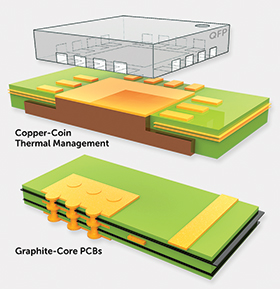
Aerospace, defence, and space applications require more precision, repeatability and area of coverage. To address this, Teledyne Labtech has developed a method of embedding thin layers of synthetic graphite inside the structure of the host PCB reliably, saving size and weight, while increasing the lifetime of active devices by permitting operation at cooler temperatures.
“Synthetic graphite is one quarter the mass of copper, and transfers heat four times more efficiently in the X-Y plane,” said John Priday, CTO of Teledyne Labtech. “Replacing PCB ground plane layers with graphite in critical applications such as T/R modules can cause devices to run up to 20°C cooler in our testing.”
Labtech has also demonstrated that thermal copper layers can be replaced with the new graphite technique, while experiencing minimal impact on the passage of microwave signals on grounding layers.
Setting a new benchmark for high-power DC load testing Conical Technologies
Test & Measurement Power Electronics / Power Management
The new ITECH IT8900G/L high-speed, high-power DC electronic load offers a powerful combination of speed, scalability, precision and high-power density.
Read more...Locate underground cable faults faster with the Fluke AF2082 A-Frame Comtest
Editor's Choice Test & Measurement
Underground cable faults can lead to costly downtime, service disruptions, and extensive excavation if the fault location is uncertain. The AF2082 simplifies this process by guiding operators directly to the fault point.
Read more...Here is what we learnt from three supply chain crises Seven Labs Technology
Editor's Choice
Component crises are not random events. They follow a pattern. After fifteen years and three major disruptions, Seven Labs knows exactly what that pattern demands, and what it takes to keep production lines moving.
Read more...The new reality of PCB material supply Jemstech
Editor's Choice Manufacturing / Production Technology, Hardware & Services
How resilient manufacturing strategies are helping OEMs navigate a changing global supply chain.
Read more...From the editor's desk: Local can be international Technews Publishing
Editor's Choice News
Welcome to the July 2026 issue of Dataweek. As you can see from this introduction, Dataweek’s regular editor, Peter Howells, is on extended leave and I am filling the void in his editor’s column – hopefully without being too boring.
Read more...Solving South African power problems with locally built intelligence
Editor's Choice Power Electronics / Power Management
Smart metering infrastructure in South Africa remains patchy. The rollout has been slow, coverage is inconsistent, and for the most part, granular per-unit measurement simply does not exist.
Read more...Lesley Havenga: Building partnerships for Africa’s electronics future
Editor's Choice News
As Würth Electronik expands its footprint across South Africa and the broader sub-Saharan region, Havenga’s blend of manufacturing expertise, supply chain knowledge, and people-centred leadership appears well suited to the task.
While every effort has been made to ensure the accuracy of the information contained herein, the publisher and its agents cannot be held responsible for any errors contained, or any loss incurred as a result. Articles published do not necessarily reflect the views of the publishers. The editor reserves the right to alter or cut copy. Articles submitted are deemed to have been cleared for publication. Advertisements and company contact details are published as provided by the advertiser. Technews Publishing (Pty) Ltd cannot be held responsible for the accuracy or veracity of supplied material.









 printer friendly version