


Transition-edge sensors, or TES devices, are among the most sensitive detectors available for measuring extremely weak electromagnetic radiation, including microwave photons. Originally developed for astrophysics and quantum measurement, these superconducting detectors exploit a sharp physical transition to convert tiny amounts of absorbed energy into measurable electrical signals.
Superconducting transition as an
amplifier
A TES operates at cryogenic temperatures, typically below 100 mK, where certain materials transition between superconducting and normal resistive states. This transition occurs over a very narrow temperature range. Within this region, even a minute temperature increase causes a disproportionately large change in electrical resistance.
The detector is voltage biased so that it self-regulates inside this transition edge. When microwave radiation is absorbed, its energy heats the sensing element slightly. Because the TES is biased in the steep transition region, this small temperature rise produces a measurable resistance change. Ohm’s law then translates this resistance change into a current variation, which is read out using an ultra-sensitive superconducting quantum interference device, or SQUID amplifier.
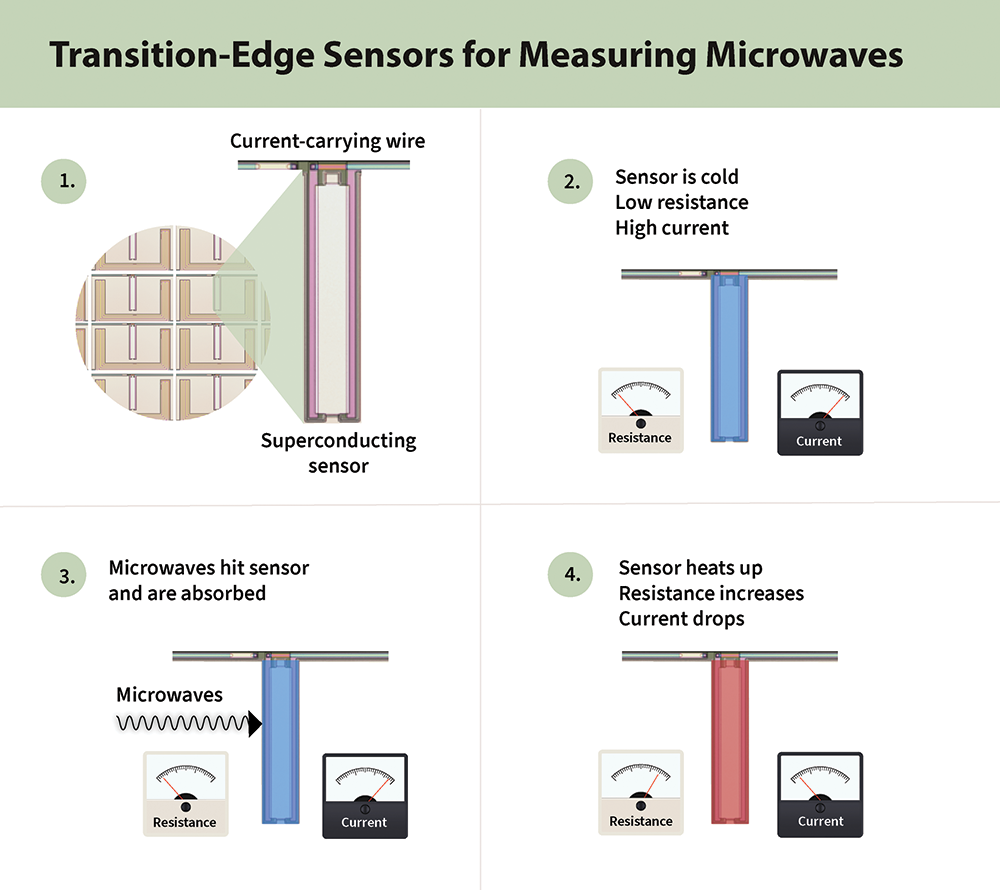
This steep transition effectively acts as a built-in amplifier. Tiny energy deposits that would otherwise be undetectable produce a large electrical response, enabling single-photon sensitivity in some implementations.
Coupling microwave energy into the sensor
Microwave radiation cannot simply be absorbed directly by the TES film. Instead, antennas or waveguide structures are integrated on-chip to couple incoming radiation efficiently. These structures convert the electromagnetic wave into localised currents that dissipate energy in a dedicated absorber thermally linked to the TES.
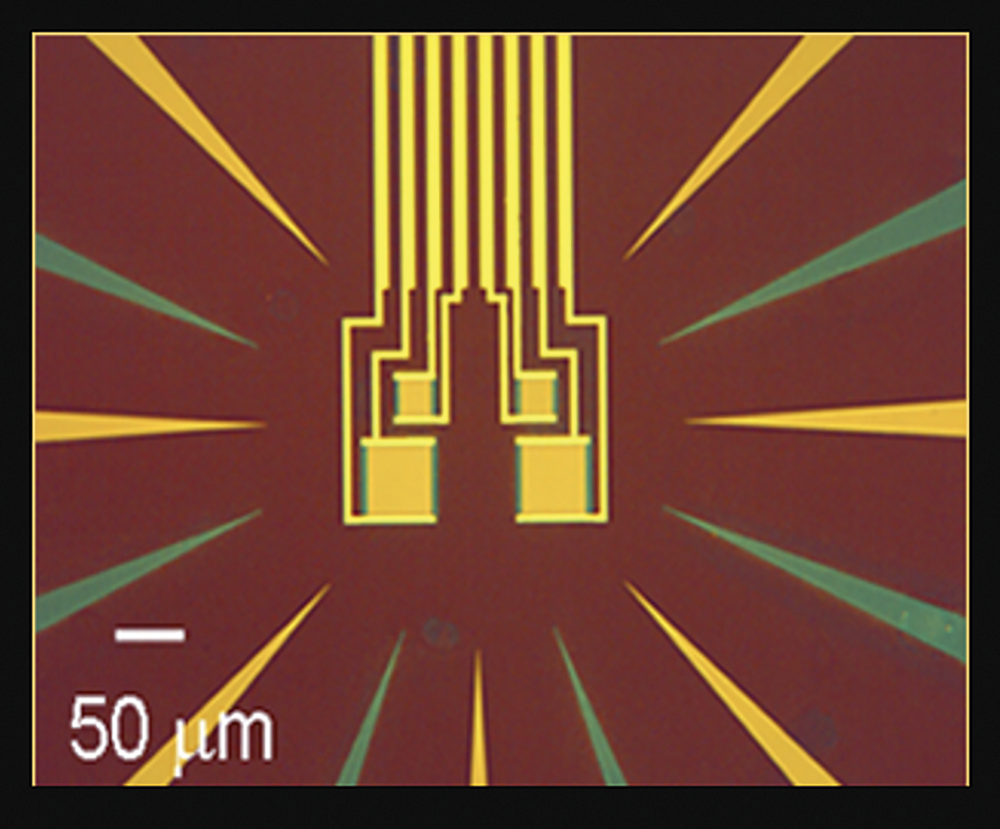
The absorber and TES are weakly connected to a cold thermal bath through engineered supports. This weak thermal link ensures that absorbed microwave energy produces a measurable temperature rise before the heat leaks away. The thermal design balances sensitivity with recovery speed, allowing the detector to reset for subsequent measurements.
Electrothermal feedback and stability
A defining feature of TES operation is strong negative electrothermal feedback. When absorbed radiation raises the TES temperature and resistance, electrical power dissipation decreases automatically due to the constant voltage bias. This cooling effect counteracts the initial temperature rise.
This feedback has desirable benefits. It stabilises the detector, improves linearity, speeds recovery time, and suppresses noise. As a result, TES detectors can achieve extremely high energy resolution and stable operation over long measurement periods.
Noise performance and sensitivity
TES microwave detectors approach fundamental noise limits set by thermal fluctuations and readout electronics. Careful material selection, cryogenic isolation, and SQUID-based amplification minimise excess noise. Because the resistance transition is so sharp, TES devices can resolve very small energy changes, making them ideal for cosmic microwave background experiments, spectroscopy, and quantum sensing.
Transition-edge sensors are widely used in astrophysical microwave observatories, where detecting faint radiation reveals information about the early universe. They are also increasingly relevant in quantum computing and precision metrology, where accurate measurement of microwave photons is essential.
Conclusion
Transition-edge sensors detect microwave radiation by converting absorbed photon energy into a temperature shift within a superconducting transition region. The steep resistance change, combined with electrothermal feedback and cryogenic operation, enables extraordinary sensitivity. This elegant interplay of superconductivity, thermal physics, and precision electronics makes TES technology a cornerstone of modern low-energy photon detection.






© Technews Publishing (Pty) Ltd | All Rights Reserved
 printer friendly version