



[Sponsored]
Breaking the Entry-Level Constraint
For decades, entry-level microcontrollers have traditionally been defined by constraint. Limited processing capability, reduced memory, minimal connectivity and little to no embedded security shaped the design envelope of cost-sensitive systems. These devices were typically confined to simple control tasks, basic sensing or low-complexity interfaces where functionality was intentionally restricted to meet aggressive price targets.
The introduction of STMicroelectronics’ STM32C5 series represents a significant shift from this model. Instead of incrementally improving legacy Cortex-M0+ architectures, STM32C5 introduces a Cortex-M33-based platform into the entry-level category. This changes not only performance expectations, but also how engineers approach system architecture, consolidation, and long-term scalability.
Architecture: From control logic to real processing
At the core of STM32C5 is the Arm Cortex-M33, built on the Armv8-M architecture. This immediately elevates the computational baseline of the device. Running at up to 144 MHz and delivering significantly higher CoreMark performance than Cortex-M0+ devices, the processor brings with it a fundamentally different execution environment.
The presence of a single-precision floating-point unit and DSP instruction support enables the device to handle workloads that were previously difficult to implement at this tier. Real-time filtering, signal conditioning, and control algorithms can now be executed locally without offloading or simplifying the model. In practical terms, this allows engineers to integrate sensing, processing, and actuation into a single device, rather than distributing functionality across multiple components or stepping up to a higher-cost MCU family.
This transition reflects a broader shift from control-oriented microcontrollers to devices capable of meaningful edge processing.
Memory and process technology: Removing a historical bottleneck
STM32C5 is manufactured using ST’s 40 nm embedded Flash process technology, which enables a substantial increase in memory density within a cost-sensitive device class. The family scales up to 1 MB of embedded Flash and 256 kB of SRAM, with additional protections such as error correction code (ECC) on selected variants.
Historically, memory - not compute - has been the limiting factor in entry-level designs, constraining firmware size, protocol integration, and secure update mechanisms.
The increased memory headroom allows designers to implement more complex communication stacks, integrate security frameworks, and support firmware partitioning strategies such as dual-bank updates. It also enables longer product lifecycles, as future features and updates can be accommodated without redesigning the hardware platform.
Connectivity and integration: Expanding the system boundary
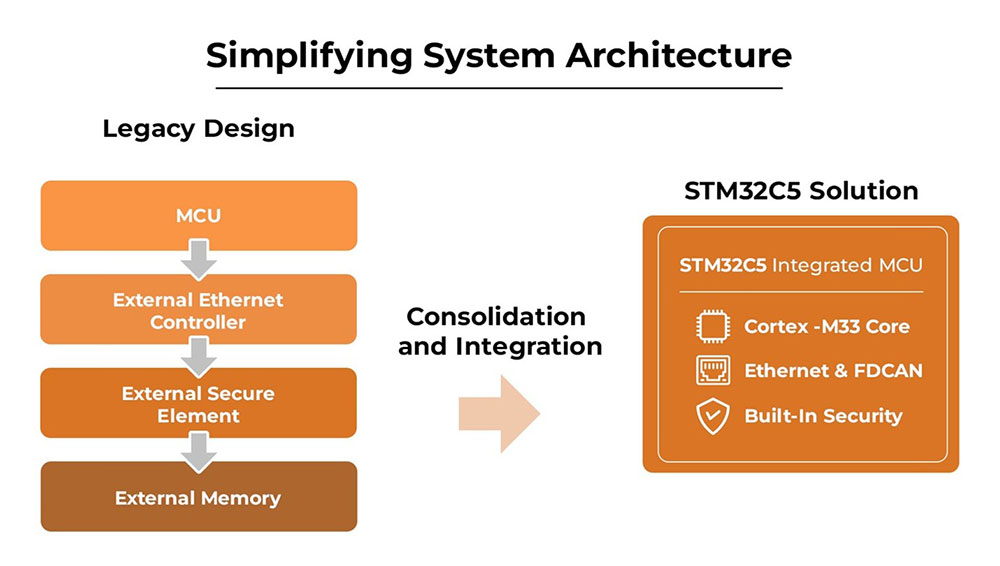
One of the most significant aspects of STM32C5 is the level of peripheral integration. Rather than pairing a higher-performance core with a minimal I/O set, ST has expanded connectivity to reflect real deployment requirements.
Ethernet integration, including IEEE 1588 precision time protocol (PTP) support, allows STM32C5 to participate directly in industrial and time-sensitive networks, expanding its role from peripheral controller to system-level integration point.
The implication is a reduction in system complexity. Some external components can be eliminated, board design simplified, and overall bill-of-materials optimised, and more importantly, the microcontroller becomes the central integration point.
Security: From add-on to foundational capability
Security in embedded systems has shifted from being optional to being a fundamental requirement. STM32C5 reflects this transition by integrating a comprehensive hardware security framework aligned with PSA Level 3 and SESIP Level 3 security architecture targets.
Rather than relying on external secure elements, the device incorporates cryptographic accelerators, secure boot mechanisms, hardware key storage, and a true random number generator. On higher-end variants, protection extends to resistance against side-channel attacks, enabling deployment in applications where trust and integrity are critical.
This integration changes the design approach. Security can now be considered a native feature of the platform rather than an additional layer that introduces complexity and cost. For connected industrial systems, this is particularly important, as it enables secure communication, authenticated updates, and device identity management from the outset.
Industrial readiness: Designed for deployment, not just development
STM32C5 is not positioned as a consumer-grade entry device. Its specifications reflect deployment in real industrial environments. With operation supported from -40°C to 125°C and stable performance across temperature variation, the device is suitable for applications where environmental conditions are non-negotiable.
The platform supports development, aligned with established safety standards, including IEC 61508 and IEC 60730/60335, enabling its use in regulated and safety-conscious systems. Internal oscillator calibration and robustness further support consistent operation without heavy reliance on external components.
This level of readiness allows STM32C5 to be deployed in industrial automation, energy infrastructure, and building systems without requiring a transition to higher-tier devices purely for environmental or compliance reasons.
System-level impact: A new design baseline
The significance of STM32C5 lies in the convergence of its features. Compute capability, memory density, connectivity, and security are combined within a single, cost-optimised platform.
This has immediate implications for system design. Architectures can be simplified, reducing the number of components required to achieve a given level of functionality. Development efforts can be consolidated around fewer MCU families, improving software reuse and reducing validation overhead. Products can be designed with greater flexibility, allowing for feature expansion and longer lifecycles without hardware changes.
Perhaps most importantly, security and connectivity become default capabilities rather than optional upgrades. This aligns with the reality of modern embedded systems, where even cost-sensitive devices are expected to operate within connected and increasingly regulated environments.
A structural shift
STM32C5 signals a shift in how the industry defines the category itself. By integrating Cortex-M33 performance, advanced connectivity, and embedded security into a cost-sensitive platform, STMicroelectronics has significantly reduced the traditional limitations associated with low-end devices.
The result is a new baseline for embedded systems design, where capability is no longer constrained by cost to the same extent. As system requirements continue to evolve, this redefinition of entry-level will have a lasting impact across industrial, infrastructure and IoT applications.
As an authorised distributor for STMicroelectronics, Dubai-based McKinsey Electronics supports engineering teams across South Africa with access to the STM32 portfolio and technical guidance throughout the design and deployment process. By combining component availability with engineering-led engagement, the company enables the integration of platforms such as STM32C5 into real-world systems where performance, reliability and long-term supply continuity are critical.
For more information visit McKinsey Electronics,






© Technews Publishing (Pty) Ltd | All Rights Reserved
 printer friendly version