

Power Electronics / Power Management


Complete design solution for energy efficient motor driving system

25 March 2020 Power Electronics / Power Management

Electric motors are a powerhouse user of electricity worldwide, accounting for about two-thirds of industrial electricity consumption. The International Energy Agency reports that electric motors account for around 45% of total global power usage.

Thus, improving the efficiency of electric motor-driven systems has a significant impact on costs for industrial and other electricity consumers. One way to improve efficiency is to move away from fixed speed motors driven by the AC line voltage to variable speed motor drives where a three-phase inverter is used to generate the sinusoidal currents to turn the motor.

ON Semiconductor enables variable speed motor drives for many applications through its comprehensive portfolio of MOSFETs, IGBTs, gate drivers, op-amps and power supplies. The core topology, the three-phase inverter, is also available as a power module, which incorporates the six power switches and the gate drive circuits into a single package. ON Semiconductor’s intelligent power modules (IPMs) are perfect for applications ranging from watts to kilowatts.

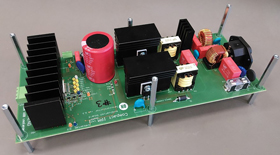
The company recently released a new evaluation board, Compact Intelligent Power Module (IPM) Motor Drive, featuring the NFAQ1060L36T IPM in a DIPS6 package.

Taking a 230 V a.c. input, the board can deliver 850 W output power to a three-phase motor. The complete system design is on this board, with EMC filtering, input rectification, two-phase interleaved PFC, auxiliary power supplies and of course, the three-phase inverter with feedback and protection circuits.

The NFAQ1060L36T intelligent power module is a fully integrated power stage for a three-phase motor drive consisting of six IGBTs with reverse diodes, a high-voltage gate driver and a thermistor. The low-side IGBTs have open emitter terminals to allow the designer flexibility in choosing the current feedback topology and resolution.

The gate driver provides protection functions including shoot-through protection, under-voltage lockout and external shutdown. An internal comparator and reference connected to the over-current protection circuit allow the designer to set the over-current protection level. This device is suitable for industrial automation as well as industrial fans and pumps and appliances.

The interleaved PFC stage utilises several ON Semiconductor components: NCP1632 power factor controller, FCPF125N65S3 650V super-junction MOSFET and FFSPF1065A 650V SiC diode. The interleaved approach has several advantages such as the ease of implementation, the use of smaller components or a better distribution of the heating. It also extends the power range of critical conduction mode that is an efficient and cost-effective technique.

The NCP1632, whose drivers are 180° phase shifted for a significantly reduced current ripple, incorporates all the features necessary for building robust and compact interleaved PFC stages, with a minimum of external components.

This complete evaluation kit is rounded out by the NCS2250 high-speed comparator, NCS2003 high slew rate operational amplifier and NCP1063 high-voltage switcher which provide protection, feedback and auxiliary power, respectively.

An Arduino Due compatible header is the interface for the user to supply PWM signals to the inverter and to receive sense and fault information. If using an Arduino Due, simple code for motor V/f control in an open loop using space vector modulation is available. It allows one to set the phase voltage amplitude and frequency via a graphical user interface (GUI).




Share this article:
Share via emailShare via LinkedInPrint this page

Further reading:

Powering the IoT
Uniross Batteries Power Electronics / Power Management
Choosing the right battery is not simply a technical detail, but a defining factor in the longevity and cost-effectiveness of any IoT deployment.

Read more...
The move to DC infrastructure
IOT Electronics Power Electronics / Power Management
The shift toward direct current infrastructure in data centres is accelerating as operators pursue higher efficiency, improved reliability, and stronger alignment with renewable energy goals.

Read more...
Power inductor for automotive applications
Würth Elektronik eiSos Power Electronics / Power Management
The WE-MXGA inductor features RDC values up to 25% lower and a saturation current up to 47% higher compared to other components currently available on the market.

Read more...
High-performance DC-DC converter
Conical Technologies Power Electronics / Power Management
With a wide 9 - 40 V DC input range, the Claf Power DWHB400-F24xxN series is a high-performance DC-DC converter family ideally suited for 12 V and 24 V battery-based systems including vehicles, off-grid installations, and distributed power architectures.

Read more...
DC-DC converters for next-generation IoT
iCorp Technologies Power Electronics / Power Management
AIPUPOWER’s K78XXJT-500R3 and K78XXJT-500R3-LB give designers a compact, high-efficiency power option for battery-powered and space-constrained systems, combining up to 96% efficiency with no-load input current as low as 0,2 mA.

Read more...
240 W in compact form factor
Brabek Power Electronics / Power Management
The cost-effective and reliable RECOM RACPRO1-S240E DIN-rail mount AC-DC series is only 125 x 139 mm and 39 mm wide, yet provides 240 W output.

Read more...
You cannot manage what you cannot measure
Power Electronics / Power Management
South African sites are generating solar energy. Most still have no idea what is consuming it… or when, or why. Intelligent load management hardware is changing that.

Read more...
Scalable and intelligent power solution
Power Electronics / Power Management
Designed for Africa’s rapidly evolving energy landscape, Bluetti’s ES125 offers a scalable, intelligent power solution that delivers reliable and cost-efficient electricity for uninterrupted operations.

Read more...
Simulating grid abnormalities
Conical Technologies Power Electronics / Power Management
Simulating grid abnormalities has become an essential part of validating systems such as inverters, UPS units, photovoltaic inverters, and EV charging infrastructure.

Read more...
Evaluation board for STPMIC25 PMIC
Power Electronics / Power Management
The STEVAL-PMIC25V1 is a power management IC evaluation board for the highly integrated STPMIC25, which is designed to manage the power requirements of the core, memory, and interfaces of the STM32MP2x series MPU.

Read more...


While every effort has been made to ensure the accuracy of the information contained herein, the publisher and its agents cannot be held responsible for any errors contained, or any loss incurred as a result. Articles published do not necessarily reflect the views of the publishers. The editor reserves the right to alter or cut copy. Articles submitted are deemed to have been cleared for publication. Advertisements and company contact details are published as provided by the advertiser. Technews Publishing (Pty) Ltd cannot be held responsible for the accuracy or veracity of supplied material.


© Technews Publishing (Pty) Ltd | All Rights Reserved