

Manufacturing / Production Technology, Hardware & Services


Automating material handling through robotics

28 October 2020 Manufacturing / Production Technology, Hardware & Services

Stock accuracy, traceability, and timely delivery of parts are key aspects of a material handling system. Today, most factories still rely on manual handling of electronic components, in the best case with the support of unique barcodes for parts and tight software integration to an MES (manufacturing execution system) or ERP (enterprise resource planning) system. To further increase factory productivity, improving the business, a higher degree of automation is required. This is a trend already ongoing among electronic manufacturers worldwide.

It is nothing new for factories to make use of robotics, however the industry is still expecting a greater focus on automation, and automating what, until now, have been manual process steps in manufacturing. This includes moving electronic components and PCBs efficiently to and from the SMT assembly line. This process improvement will require more novel storage systems and planning software for automatic inventory control and material tracking, together with an increased use of robotics, such as automated guided vehicles (AGVs) and collaborative robots.

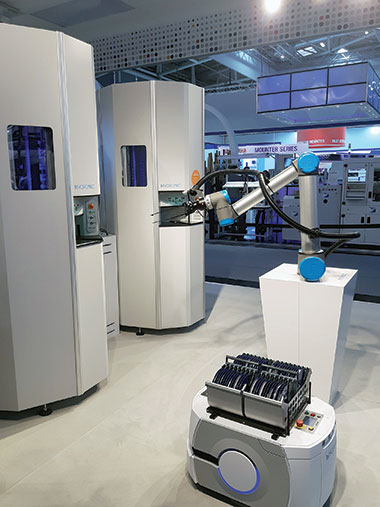
Last year at the tradeshow productronica, Mycronic showcased what a fully automated material handling system can look like. The solution encompassed the intelligent storage solution SMD Tower, AGVs known as ‘Leo’ from Omron, and a UR10 robotic arm from Universal Robots delivering higher efficiency with less human intervention.

Mycronic believes in a smarter material flow through intelligent material handling. In high-mix SMT assembly, the time in between jobs is significant and should be as short as possible. Having an automated material flow can greatly reduce the overall kitting time and thereby minimise changeover cost.

Through the integration of a robotic arm and an AGV, electronics manufacturers can load and unload reels from the SMD Tower, and distribute them to their respective kitting areas without human intervention.

The solution – how it works

A single carrier (reel) or a list of carriers for a complete job is requested from one or more SMD Towers. The towers start to unload reels and the robotic arm will pick reels from the tower terminals and place them into bins in the correct kitting order on the AGV. When the bins are fully kitted with reels, the AGV transports the bins to the kitting area. In the kitting area, the bins are placed into magazines and are then ready to be used on the SMT assembly line.

The robotic arm has a special gripper that allows it to pick all sizes of reels and the AGV has been programmed to always be waiting in the same location. A vision system on the robotic arm is used to accurately locate the position of the AGV relative to the robotic arm. This ensures that the reels are placed accurately in the bins at a high speed.

Reaping the benefits of automation

A key objective for manufacturers automating the PCB assembly process is to improve both productivity and equipment utilisation. As an example, automating material handling results in fewer operators required to manage the flow of electronic components and circuit boards to and from the SMT lines. This makes it possible for operators to focus their work on more value-adding tasks in the factory – a process improvement leading to a more optimised material flow as well as lower operational costs.

Another aspect of this process improvement is that it reduces bottlenecks, as this automated solution constantly loads reels into the SMD, preparing for upcoming jobs. This means material is ready on time when you need it at the kitting station. It also reduces material handling errors, such as misplaced reels or retrieving the incorrect reel from stock. In addition it greatly improves the retrieval time for reels when kitting. All in all, the benefits are manifold and cost savings great.

Automated material handling will help manufacturers capture and create more value in tomorrow’s demanding production environments.


Credit(s)


Share this article:
Share via emailShare via LinkedInPrint this page

Further reading:

Outscale your competition
Manufacturing / Production Technology, Hardware & Services
Attendees will be able to explore the benefits of AMD Kintex UltraScale+ Gen 2 FPGAs in high-performance Pro AV, test & measurement, industrial, and medical applications.

Read more...
MTN SA Foundation drives youth pathways into the digital economy
Manufacturing / Production Technology, Hardware & Services
The MTN SA Foundation, in partnership with Helios Towers and Datacomb Development Hub, has launched the MTN–Helios Towers 12-month ICT Learnership Programme, a pathway that takes young South Africans from digital training into real workplace experience.

Read more...
Downstream demand, system reliability, and the expanding role of engineering-led distribution
Manufacturing / Production Technology, Hardware & Services
[Sponsored] As South Africa’s semiconductor demand continues to be shaped by downstream system deployment rather than upstream fabrication, the importance of engineering-led distribution will continue to grow.

Read more...
The impact of harsh environments and ionic contamination on post-reflow circuit assemblies
MyKay Tronics Manufacturing / Production Technology, Hardware & Services
There is well documented historical proof that post-reflow circuit assemblies, when subjected to harsh environments, are particularly vulnerable to failure mechanisms, but modern electronic assemblies are far more susceptible to this phenomenon.

Read more...
Engineering copper grain structure for high-yield hybrid bonding in 3D packaging
Testerion Editor's Choice Manufacturing / Production Technology, Hardware & Services
The way copper grains are sized and distributed forms the metallurgical foundation of hybrid bonding, enabling lower bonding temperatures, greater reliability, and stable grain structures throughout integration.

Read more...
Understanding solder dross: causes and control strategies
Truth Electronic Manufacturing Editor's Choice Manufacturing / Production Technology, Hardware & Services
Dross formation is an inevitable consequence of wave soldering. It occurs when molten solder comes into contact with oxygen, forming metal oxides that float on the surface of the solder bath. Over time, this oxidation byproduct accumulates and must be removed to maintain solder quality and process consistency.

Read more...
Non-destructive techniques for identifying defects in BGA joints – TDR, 2DX, and cross-section-SEM comparison
MyKay Tronics Manufacturing / Production Technology, Hardware & Services
This whitepaper reports the results of a comparison of the following techniques: TDR, automatic X-ray inspection (AXI), transmission X-ray (2DX), cross-section/SEM, and Dye & Pry.

Read more...
Implications of using Pb-free solders on X-ray inspection of flip chips and BGAs
MyKay Tronics Manufacturing / Production Technology, Hardware & Services
With the move to Pb-free soldering, most of the attention has been paid to reflow temperatures, component compatibility, and reliability concerns, but the implications for inspection, particularly X-ray inspection, are equally important and often underestimated.

Read more...
The causes of solder balls in robotic soldering
Manufacturing / Production Technology, Hardware & Services
Solder balls (also known as solder splatter) are a major concern in many production sites as they may potentially cause shorts, leading to long-term impacts on product reliability.

Read more...
Material challenges for superconducting quantum chips
Manufacturing / Production Technology, Hardware & Services
To achieve the scalable and repeatable production of superconducting circuits for quantum technology products, players in the industry are leveraging semiconductor fabrication techniques.

Read more...


While every effort has been made to ensure the accuracy of the information contained herein, the publisher and its agents cannot be held responsible for any errors contained, or any loss incurred as a result. Articles published do not necessarily reflect the views of the publishers. The editor reserves the right to alter or cut copy. Articles submitted are deemed to have been cleared for publication. Advertisements and company contact details are published as provided by the advertiser. Technews Publishing (Pty) Ltd cannot be held responsible for the accuracy or veracity of supplied material.


© Technews Publishing (Pty) Ltd | All Rights Reserved

