

Manufacturing / Production Technology, Hardware & Services


Automated industrial dispensing for a rugged world

27 July 2022 Manufacturing / Production Technology, Hardware & Services

Life isn’t easy for industrial electronics. One day it’s the heat and vibration of an electric drivetrain. The next it’s dust, rain and freezing temperatures at a mountain-top 5G base station. Although the conditions vary, all these sensitive electronics share the need for long-lasting protection from the harshest operating environments.

Electronic sensors, battery assemblies and other complex electronics are vital to the functioning of our society. On the road, they protect against collisions. In our communications grid, they keep us connected. And in an increasingly electrified world, they ensure non-stop supply of everything from electricity to industrial production. Industrial dispensing is our necessary safeguard when electronics simply can’t afford to fail.

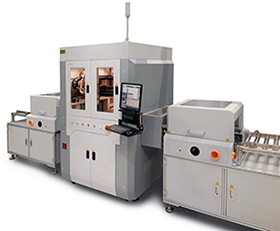
Fortunately, leading industrial manufacturers are already a step ahead, using the MYC60 industrial dispenser to solve their toughest structural, thermal, sealing, bonding and gasketing needs. Complete with precise, heavy-duty systems for one-component and two-component materials, the MYC60 can be tailored to process a wide variety of fluids for nearly any high-reliability application.

Thermal interfaces are just one example of a fast-growing dispensing application. Whether it’s odd-shaped components or dense battery arrays, the challenge is to dispense thermal interface materials in precise locations to maximise heat dissipation and prevent overheating. Thanks to the MYC60’s advanced dispensing processes, manufacturers can apply nearly any thermal conductive material to any assembly with total control.

For the ultimate protection of intellectual property and fragile components, many producers increasingly pot or encapsulate entire assemblies in opaque fluids. From advanced sensors to proprietary designs, the MYC60 makes it possible to fully cast and seal off electronics from curious competitors as well as protect from heat, moisture and vibration.

THT components can be particularly vulnerable to shocks and vibrations. By accommodating any variety of structural adhesives and dispensing angles, the MYC60 enables high-precision bonding that withstands the inevitable shocks of real-world environments.

Regardless of the electronics inside, the sheer variety of shapes, contours and gaps remains a challenge for any assembly. Whatever the pattern or line requirement, the MYC60 can be easily programmed to apply precise seals and gaskets of virtually any shape, with better consistency and less manual effort.

Of course, technical features only count when they can fit seamlessly into ongoing production which is why the complete MYC60 system is always customised by Mycronic’s process experts to meet the needs of the most demanding industrial operations.

In-line or trolley systems ensure a seamless flow for assemblies with novel formats and dimensions. In-line pre- and post-weight conveyors guarantee precise material dispensing, and all process controls are managed through an intuitive point-and-click graphic interface, allowing operators of any skill level to program online or offline.

The result is a versatile all-in-one solution for 24/7 automated dispensing, bringing new levels of protection to the world of ruggedised electronics.


Credit(s)


Share this article:
Share via emailShare via LinkedInPrint this page

Further reading:

Downstream demand, system reliability, and the expanding role of engineering-led distribution
Manufacturing / Production Technology, Hardware & Services
[Sponsored] As South Africa’s semiconductor demand continues to be shaped by downstream system deployment rather than upstream fabrication, the importance of engineering-led distribution will continue to grow.

Read more...
The impact of harsh environments and ionic contamination on post-reflow circuit assemblies
MyKay Tronics Manufacturing / Production Technology, Hardware & Services
There is well documented historical proof that post-reflow circuit assemblies, when subjected to harsh environments, are particularly vulnerable to failure mechanisms, but modern electronic assemblies are far more susceptible to this phenomenon.

Read more...
Engineering copper grain structure for high-yield hybrid bonding in 3D packaging
Testerion Editor's Choice Manufacturing / Production Technology, Hardware & Services
The way copper grains are sized and distributed forms the metallurgical foundation of hybrid bonding, enabling lower bonding temperatures, greater reliability, and stable grain structures throughout integration.

Read more...
Understanding solder dross: causes and control strategies
Truth Electronic Manufacturing Editor's Choice Manufacturing / Production Technology, Hardware & Services
Dross formation is an inevitable consequence of wave soldering. It occurs when molten solder comes into contact with oxygen, forming metal oxides that float on the surface of the solder bath. Over time, this oxidation byproduct accumulates and must be removed to maintain solder quality and process consistency.

Read more...
Non-destructive techniques for identifying defects in BGA joints – TDR, 2DX, and cross-section-SEM comparison
MyKay Tronics Manufacturing / Production Technology, Hardware & Services
This whitepaper reports the results of a comparison of the following techniques: TDR, automatic X-ray inspection (AXI), transmission X-ray (2DX), cross-section/SEM, and Dye & Pry.

Read more...
Implications of using Pb-free solders on X-ray inspection of flip chips and BGAs
MyKay Tronics Manufacturing / Production Technology, Hardware & Services
With the move to Pb-free soldering, most of the attention has been paid to reflow temperatures, component compatibility, and reliability concerns, but the implications for inspection, particularly X-ray inspection, are equally important and often underestimated.

Read more...
The causes of solder balls in robotic soldering
Manufacturing / Production Technology, Hardware & Services
Solder balls (also known as solder splatter) are a major concern in many production sites as they may potentially cause shorts, leading to long-term impacts on product reliability.

Read more...
Material challenges for superconducting quantum chips
Manufacturing / Production Technology, Hardware & Services
To achieve the scalable and repeatable production of superconducting circuits for quantum technology products, players in the industry are leveraging semiconductor fabrication techniques.

Read more...
UV curing oven for high-efficiency PCB production
Techmet Manufacturing / Production Technology, Hardware & Services
The jCURE-2UV+ from JTU is a cutting-edge ultraviolet curing oven engineered for fast, reliable curing of UV-sensitive coatings in SMT production environments.

Read more...
Automatic stencil cleaning
ZETECH ONE Manufacturing / Production Technology, Hardware & Services
The MBtech N29 series delivers high-precision stencil cleaning with a focus on efficiency, economy and the environment, and is ideal for SMT adhesive and solder paste stencil maintenance.

Read more...


While every effort has been made to ensure the accuracy of the information contained herein, the publisher and its agents cannot be held responsible for any errors contained, or any loss incurred as a result. Articles published do not necessarily reflect the views of the publishers. The editor reserves the right to alter or cut copy. Articles submitted are deemed to have been cleared for publication. Advertisements and company contact details are published as provided by the advertiser. Technews Publishing (Pty) Ltd cannot be held responsible for the accuracy or veracity of supplied material.


© Technews Publishing (Pty) Ltd | All Rights Reserved

