Lead-free reflow puts new demands on rework equipment
5 May 2004Manufacturing / Production Technology, Hardware & Services
Security Services & Risk Management
Lead-free solder is a subject that must be addressed today because it will be a requirement soon. The process parameters required for high reliability solder joints put new and tougher demands on reflow and rework equipment. The hot air rework systems that are currently used for BGA rework will have a difficult time trying to achieve a proper lead free profile. However, Ersa's IR technology is perfectly suited to meet these lead-free demands.
Forced convection
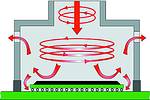
Forced convection reflow systems are the standard in the industry for production. Quality lead-free BGA reflow can be achieved in the enclosed environment of a reflow oven. Rework, however, cannot be done in a completely enclosed environment. The heating conditions required for lead free BGA reflow are difficult to achieve when blowing hot air through a nozzle (Figures 1 and 2).
Figure 1. The air flow dynamics in a hot air rework nozzle are difficult to control and, depending on the nozzle construction, can lead to hot and cold spots on the package
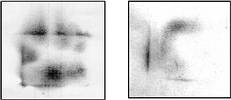
Figure 2. Two separate hot air rework nozzles were lowered down to a heat sensitive surface and the reflow program was started. The burn patterns shown here indicate how the heated air molecules move in the nozzle and transfer heat to the component. Dark areas are hotter
The process
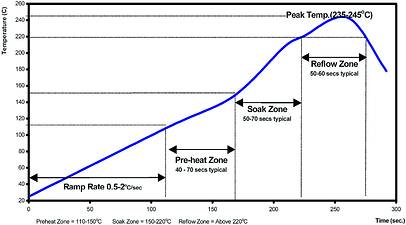
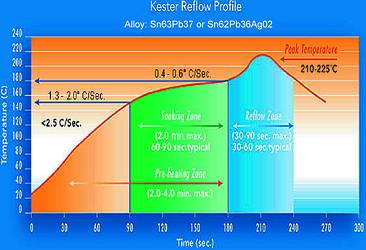
The process window for lead-free solder paste reflow is much tighter than for eutectic or low melt alloys (Graphs 1 and 2). The activation time is sacrificed in order to reduce the oxidation which takes place much faster in the absence of lead. The reflow or rework heating system must be able to achieve the optimal soak from 150 to 220°C in 50 seconds also on heavy thermal mass PCBs. Slow heat rework systems, like hot air, can take too long in this critical phase, causing oxidation to form during soak.
Graph 1. Kester reflow profile for lead-free alloy (SnAgCu)
Graph 2. Typical eutectic paste profile
Due to the increase in temperature range and the tight process window, controlling the DT across the entire PCB in reflow and across the complete area array package in rework will be the ultimate challenge. Most hot air rework systems are poorly suited to meet these tougher demands. Ersa's 2nd generation proprietary IR technology was specifically designed for lead-free BGA rework.
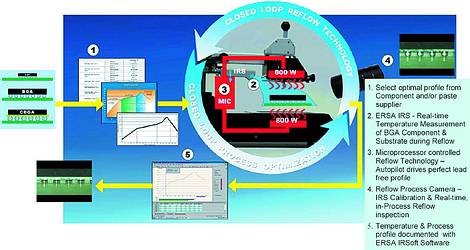
By using the closed-loop reflow technology (Figure 5) of Ersa's 1600 W IR 550 A a perfect process window can be guaranteed, with uniform heat distribution with minimum DT, and proper peak temperature for high reliability lead-free solder joints.
Figure 3. The dark areas are hotter, revealing nonuniform heat distribution across the package. This DT is unacceptable for lead-free solders and will cause oxidation to form in the lighter areas
Figure 4. The ERSA IR technology guarantees minimum DT across the entire BGA package
Weller limited Black Edition soldering station Testerion
Manufacturing / Production Technology, Hardware & Services
Weller’s WE1010 Black Edition Soldering Station is a premium limited-edition soldering station.
Read more...Quick and easy shielding Würth Electronics South Africa
Electronics Technology Manufacturing / Production Technology, Hardware & Services
Würth Elektronik expands its EMC product portfolio with nanocrystalline WE-FNCS sheets.
Read more...Smarter local buying could reboot South Africa’s manufacturing sector
Manufacturing / Production Technology, Hardware & Services
With smarter localisation, clearer procurement rules and a more deliberate industrial strategy, public spending could again become a powerful engine for rebuilding factories, expanding supply chains and restoring confidence in South Africa as a place that makes things.
Read more...The effect of seasonal changes on ESD performance in South Africa Actum
Editor's Choice Circuit & System Protection Manufacturing / Production Technology, Hardware & Services
Electrostatic discharge performance is influenced by several environmental factors, with relative humidity being one of the most important. This is particularly relevant in South Africa, where seasonal changes can result in significant differences in humidity levels.
Read more...High precision in-line conformal coating inspection system MyKay Tronics
Manufacturing / Production Technology, Hardware & Services
Conformal coating is widely used to protect electronics from moisture or other environmental hazards. It is critical to know if coatings are properly applied; covering what is meant to be covered and not covering what should be exposed.
Read more...The line between locking residents out and restricting their access
News & Events Security Services & Risk Management Residential Estate (Industry)
A June 2026 High Court judgment has clarified one of the most contested issues in modern estate governance: when an HOA's digital access restrictions amount to unlawful self-help or spoliation, and when they do not.
Read more...Modernise field communications with Push-to-Talk over Cellular
Products & Solutions Security Services & Risk Management
Sentiv is bringing Hytera’s Push-to-Talk over Cellular (PTToC) portfolio to organisations that need a more structured and controlled way to coordinate field teams, without extending a full private radio model to every team, site, or function.
Read more...Soldering day highlights
Manufacturing / Production Technology, Hardware & Services
JAPAN UNIX has published a new event report and highlight video from their UNIX SOLDERING DAY 2026 in Hungary. This event reflects on their commitment to supporting manufacturers not only through soldering automation systems, but also through technical education, live demonstrations, hands-on training, and practical engineering know-how.
Read more...Clearing the Static: Electrostatic Discharge Actum
Manufacturing / Production Technology, Hardware & Services
A cordless ESD (Electrostatic Discharge) wrist strap does not work by grounding the person in the same way as a traditional wired wrist strap. Instead, it works by reducing or balancing the static charge on your body so that you are less likely to discharge electricity into sensitive electronic components.
Read more...Engineering trust in South Africa’s SMT sector ZETECH ONE
Manufacturing / Production Technology, Hardware & Services
From a small Johannesburg start-up to a trusted SMT technology partner, Zetech One has spent four decades helping South African electronics manufacturers improve production quality, efficiency and reliability.
While every effort has been made to ensure the accuracy of the information contained herein, the publisher and its agents cannot be held responsible for any errors contained, or any loss incurred as a result. Articles published do not necessarily reflect the views of the publishers. The editor reserves the right to alter or cut copy. Articles submitted are deemed to have been cleared for publication. Advertisements and company contact details are published as provided by the advertiser. Technews Publishing (Pty) Ltd cannot be held responsible for the accuracy or veracity of supplied material.











 printer friendly version