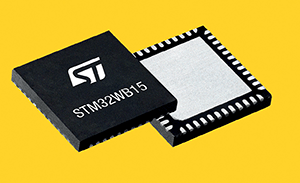
STMicroelectronics has extended its STM32WB Bluetooth LE microcontroller (MCU) offering with new devices that combine entry-level features with extra power savings for longer-lasting performance.
The dual-core STM32WB15 and STM32WB10 Value Line pair an Arm Cortex-M4 processor to run the main application and a Cortex-M0+ to handle Bluetooth 5.2 connectivity, ensuring real-time performance from each. The radio stage has a 102 dBm link budget to ensure reliable connections over long distances and integrates balun circuitry to save board space and reduce the bill of materials.
With a new ultra-power-saving mode that allows the radio to remain operational, and carefully tailored peripherals and memory, the new devices are suited to cost-sensitive, power-conscious embedded applications including wearables, beacons, smart circuit breakers, trackers, IoT endpoints, and equipment for industrial automation.
The software development kit (SDK) for each MCU includes standardised radio protocol stacks and openness to proprietary protocols with a set of security mechanisms that ensure safe software updates for brand protection and device integrity, with Proprietary Code Read-Out Protection (PCROP) to guard intellectual property.
With these new devices, the STM32WB series scales across package variants, offering options including extended GPIOs and pin-to-pin compatibility between similar packages of the portfolio. Customers can easily migrate designs between devices to take advantage of different features and memory densities, leveraging pin-compatibility across packages.
The development ecosystem includes STM32Cube certified radio stacks that support various profiles, software expansion packs and sample code, the STM32CubeMX configurator and initialisation code generator, the STM32CubeIDE development environment, a powerful STM32CubeMonitor-RF evaluation tool, and associated Nucleo hardware tools.
Compact low-power 32-bit platform EBV Electrolink
DSP, Micros & Memory
Microchip’s PIC32CM PL10 microcontroller family expands the company’s Arm Cortex-M0+ portfolio, delivering a compact, low-power 32-bit platform designed for cost-sensitive embedded applications.
Read more...Simplifying system design iCorp Technologies
Telecoms, Datacoms, Wireless, IoT
The FGMC63N tri-band MCU Wi-Fi 6E module from Quectel addresses offers integrated connectivity across 2,4 GHz, 5 GHz, and 6 GHz bands in a compact, highly optimised design.
Read more...Dragino’s connectivity catalogue Otto Wireless Solutions
Telecoms, Datacoms, Wireless, IoT
Where Wi-Fi demands frequent charging and covers tens of meters, and traditional cellular consumes too much power for battery-operated nodes, LoRaWAN threads the needle.
Read more...RF filters explained RFiber Solutions
Telecoms, Datacoms, Wireless, IoT
As RF environments become increasingly crowded, RF filters play a critical role in maintaining signal quality, improving system performance, and ensuring reliable operation.
Read more...Practical design strategies for 5G RF Design
Telecoms, Datacoms, Wireless, IoT
The Cavli CQM211 aims to provide a platform that combines strong 5G connectivity with onboard compute capability, as well as interface flexibility that suits both new designs and rapid migrations from earlier products.
Read more...An industry-first Android 16 smart module solution RF Design
Computer/Embedded Technology Telecoms, Datacoms, Wireless, IoT
The MeiG Smart SLM580 4G Smart Module features native support for Android 16 and covers core frequency bands in major countries and regions worldwide.
Read more...High performance RF signal conditioning RFiber Solutions
Telecoms, Datacoms, Wireless, IoT
The AM3269 from Mercury Systems is a high-performance RF preselector module designed to improve receiver sensitivity and signal integrity in demanding electronic warfare, signals intelligence, test, and communications applications.
Read more...RF filters explained RFiber Solutions
Telecoms, Datacoms, Wireless, IoT
As RF environments become increasingly crowded, RF filters play a critical role in maintaining signal quality, improving system performance, and ensuring reliable operation.
While every effort has been made to ensure the accuracy of the information contained herein, the publisher and its agents cannot be held responsible for any errors contained, or any loss incurred as a result. Articles published do not necessarily reflect the views of the publishers. The editor reserves the right to alter or cut copy. Articles submitted are deemed to have been cleared for publication. Advertisements and company contact details are published as provided by the advertiser. Technews Publishing (Pty) Ltd cannot be held responsible for the accuracy or veracity of supplied material.









 printer friendly version