


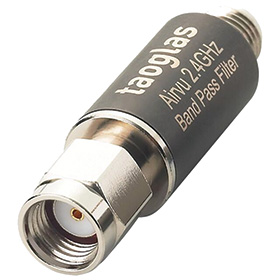
RF filters are essential components in modern communication and electronic systems. They help manage frequencies by allowing desired signals to pass, while reducing unwanted signals and interference. As RF environments become increasingly crowded, RF filters play a critical role in maintaining signal quality, improving system performance, and ensuring reliable operation.
From cellular networks and satellite communications to radar and defence applications, RF filters help engineers control how signals move through a system. Understanding the different types of RF filters and their applications is an important part of RF system design.
What are RF filters?
RF filters are frequency-selective components designed to pass certain frequency ranges, while attenuating others. Their primary purpose is to remove unwanted signals that could interfere with system performance.
In a typical RF signal chain, filters are used to isolate desired frequencies, suppress noise, and prevent interference from neighbouring channels or external sources. By controlling the frequencies that enter or leave a device, RF filters help maintain signal integrity and improve overall system efficiency.
Without effective filtering, RF systems may experience reduced sensitivity, degraded performance, and increased susceptibility to interference.
Why RF filters matter
Modern RF systems often operate in environments where multiple signals coexist across a wide range of frequencies.
Cellular networks, satellite systems, wireless infrastructure, and military communications all rely on effective frequency management. RF filters help ensure that receivers process only the signals they are intended to receive, while preventing unwanted frequencies from affecting performance.
Proper filtering can provide several benefits:
• Improved signal quality.
• Reduced interference.
• Better receiver sensitivity.
• Enhanced transmitter performance.
• Compliance with regulatory requirements.
As operating frequencies increase and spectrum becomes more crowded, filtering becomes even more important.
Common types of RF filters
Different filter types are used depending on the application and the frequencies that need to be controlled.
Low-Pass filters
Low-pass filters allow signals below a specific cutoff frequency to pass, while attenuating higher frequencies. These filters are commonly used to suppress harmonics and remove unwanted high-frequency content generated by transmitters or electronic circuits. Low-pass filters are frequently found in wireless communication systems, power amplifiers, and test equipment.
High-Pass filters
High-pass filters perform the opposite function by allowing frequencies above a selected cutoff point to pass, while reducing lower frequencies. They are often used to eliminate low-frequency noise or unwanted signals that could affect system performance. High-pass filters are commonly used in receiver front ends and signal conditioning circuits.
Band-Pass filters
Band-pass filters allow a specific range of frequencies to pass, while attenuating signals above and below that range. This is one of the most widely used filter types in RF systems because it helps isolate the desired communication channel. Applications include cellular infrastructure, satellite communications, radar systems, and wireless networks.
Band-Stop filters
Band-stop filters, sometimes called notch filters, reject a specific range of frequencies, while allowing frequencies outside that range to pass. These filters are often used to suppress known sources of interference without affecting the desired signal. They can be particularly useful in environments where strong unwanted signals exist within a narrow frequency range.
RF filter technologies
Several technologies are used to manufacture RF filters, each offering different performance characteristics.
Cavity filters
Cavity filters provide excellent selectivity and power handling capability. They are commonly used in base stations, defence systems, and satellite communications where high performance is required. Although larger than some alternatives, cavity filters offer low insertion loss and excellent frequency discrimination.
Ceramic filters
Ceramic filters provide a compact solution for applications requiring good performance within limited space. These filters are widely used in wireless communication equipment and commercial electronics.
SAW filters
Surface Acoustic Wave (SAW) filters are commonly used in mobile devices and wireless systems operating at lower microwave frequencies. They offer compact size and strong filtering characteristics, making them suitable for high-volume applications.
BAW filters
Bulk Acoustic Wave (BAW) filters are often selected for higher-frequency applications where greater performance is required. They are commonly used in modern cellular networks and advanced wireless communication systems.
Applications of RF Filters
RF filters are used across numerous industries and technologies.
Cellular and wireless infrastructure
Modern wireless networks depend on RF filters to separate frequency bands, reduce interference, and improve network performance. As technologies continue to evolve beyond 5G, filtering remains a key part of managing increasingly complex RF environments.
Satellite communications
Satellite systems require highly selective filtering to ensure reliable communication links. RF filters help isolate desired signals, while minimising interference from adjacent channels and external sources.
Defence and electronic warfare
Military and defence applications often operate across wide frequency ranges, while facing challenging signal environments. RF filters help improve receiver protection, signal selection, and overall system reliability.
Test and measurement equipment
RF filters are frequently used in laboratory instruments and field-testing equipment to ensure accurate signal analysis and measurement. Proper filtering helps eliminate unwanted signals that could affect measurement accuracy.
Key design considerations
Selecting the appropriate RF filter requires evaluating several performance characteristics.
Frequency range is often the starting point, as the filter must operate effectively within the desired band.
Insertion loss is another important factor. Lower insertion loss helps preserve signal strength throughout the system.
Engineers must also consider parameters such as bandwidth, selectivity, power handling capability, and environmental requirements.
In many applications, achieving the right balance between performance, size, and cost is an important part of the design process.
Conclusion
RF filters are fundamental components that help modern RF systems operate efficiently and reliably. By controlling which frequencies pass through a signal chain, they improve signal quality, reduce interference, and support overall system performance.
Whether used in wireless infrastructure, satellite communications, defence systems, or test equipment, RF filters play an essential role in managing increasingly complex RF environments. Understanding the different filter types and their applications helps engineers make informed decisions when designing high-performance RF systems.
| Tel: | +27 12 667 5212 |
| Email: | sales@rfibersolutions.com |
| www: | www.rfibersolutions.com |
| Articles: | More information and articles about RFiber Solutions |






© Technews Publishing (Pty) Ltd | All Rights Reserved
 printer friendly version