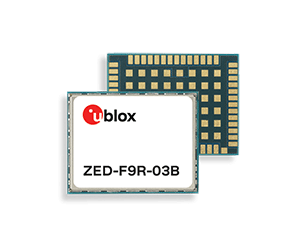
u-blox has released a new firmware update which extends the range of positioning augmentation services supported by its ZED-F9R high-precision GNSS dead reckoning modules. Thanks to a firmware update, the u-blox ZED-F9R-03B adds support for SPARTN 2.0 and QZSS CLAS correction services, extending the geographical market reach of the module and increasing the scalability of applications using it.
The RTK (real-time kinematic) capable ZED-F9R module was designed for use in autonomous automotive and industrial applications that require simple and efficient implementation and where rapid access to highly accurate positioning data is key, even in challenging signal environments as found in dense cities. Typical applications include slow-moving use cases such as robotic lawnmowers and shared e-scooters.
The module has an integrated inertial measurement unit (IMU) for RTK positioning and employs sophisticated algorithms to fuse the IMU data with GNSS measurements, wheel ticks, correction service data, and a vehicle dynamics model to provide centimetre-level positioning accuracy even in situations where GNSS alone would fail. It is based on the u-blox F9 multi-band GNSS receiver platform, which concurrently tracks up to four GNSS constellations, providing high-quality positioning accuracy.
“As our new ZED-F9R-03B high-precision GNSS module also supports SPARTN 2.0 and QZSS CLAS, it enables designers to bring products that need dead reckoning technology to wider geographical markets, increasing economies of scale,” says Alex Ngi, product manager, industrial navigation and robotics, product centre positioning at u-blox.
Simplifying system design iCorp Technologies
Telecoms, Datacoms, Wireless, IoT
The FGMC63N tri-band MCU Wi-Fi 6E module from Quectel addresses offers integrated connectivity across 2,4 GHz, 5 GHz, and 6 GHz bands in a compact, highly optimised design.
Read more...Dragino’s connectivity catalogue Otto Wireless Solutions
Telecoms, Datacoms, Wireless, IoT
Where Wi-Fi demands frequent charging and covers tens of meters, and traditional cellular consumes too much power for battery-operated nodes, LoRaWAN threads the needle.
Read more...RF filters explained RFiber Solutions
Telecoms, Datacoms, Wireless, IoT
As RF environments become increasingly crowded, RF filters play a critical role in maintaining signal quality, improving system performance, and ensuring reliable operation.
Read more...Practical design strategies for 5G RF Design
Telecoms, Datacoms, Wireless, IoT
The Cavli CQM211 aims to provide a platform that combines strong 5G connectivity with onboard compute capability, as well as interface flexibility that suits both new designs and rapid migrations from earlier products.
Read more...Nordic expands nRF Cloud with firmware vulnerability scanning RF Design
Computer/Embedded Technology
nRF Cloud identifies vulnerabilities in firmware and shows exactly which deployed devices are affected, empowering device manufacturers to address EU Cyber Resilience Act requirements.
Read more...An industry-first Android 16 smart module solution RF Design
Computer/Embedded Technology Telecoms, Datacoms, Wireless, IoT
The MeiG Smart SLM580 4G Smart Module features native support for Android 16 and covers core frequency bands in major countries and regions worldwide.
Read more...High performance RF signal conditioning RFiber Solutions
Telecoms, Datacoms, Wireless, IoT
The AM3269 from Mercury Systems is a high-performance RF preselector module designed to improve receiver sensitivity and signal integrity in demanding electronic warfare, signals intelligence, test, and communications applications.
Read more...Nordic expands nRF Cloud with firmware vulnerability scanning RF Design
Computer/Embedded Technology
nRF Cloud identifies vulnerabilities in firmware and shows exactly which deployed devices are affected, empowering device manufacturers to address EU Cyber Resilience Act requirements.
Read more...RF filters explained RFiber Solutions
Telecoms, Datacoms, Wireless, IoT
As RF environments become increasingly crowded, RF filters play a critical role in maintaining signal quality, improving system performance, and ensuring reliable operation.
While every effort has been made to ensure the accuracy of the information contained herein, the publisher and its agents cannot be held responsible for any errors contained, or any loss incurred as a result. Articles published do not necessarily reflect the views of the publishers. The editor reserves the right to alter or cut copy. Articles submitted are deemed to have been cleared for publication. Advertisements and company contact details are published as provided by the advertiser. Technews Publishing (Pty) Ltd cannot be held responsible for the accuracy or veracity of supplied material.









 printer friendly version