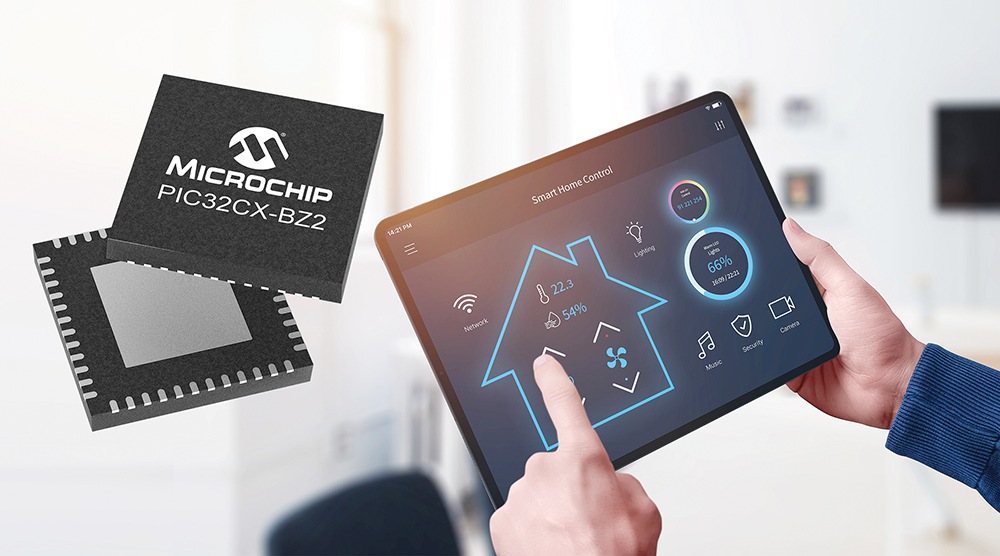
Wireless connectivity has become a mandatory feature for many products, but often increases the cost and complexity of system design since it generally must be added as part of the larger application. Microchip Technology has introduced its first Arm Cortex-M4F-based PIC microcontroller family that solves this wireless connectivity design challenge. It accomplishes this by integrating Bluetooth Low Energy functionality directly into one of a system’s most basic components.
“Our PIC32CX-BZ2 MCU family removes barriers that have made it difficult to bring wireless applications to market, from availability problems and complexity challenges to regulatory certification hurdles and long-term support concerns,” said Steve Caldwell, vice president of Microchip’s wireless solutions business unit. “Our family tightly integrates wireless connectivity with an MCU that is built on our decades of specialised experience and backed by a vertical manufacturing approach that encompasses ICs, Microchip’s highly integrated software stacks, in-house module manufacturing and a customer-driven obsolescence practice.”
Microchip’s PIC32CX-BZ2 family includes system-on-chip (SoC) devices as well as global regulatory-certified, RF-ready modules. In addition to Bluetooth Low Energy functionality, the family includes Zigbee stacks and over-the-air (OTA) update capabilities.
The MCU family hardware features include a 12-bit analog to digital converter, multiple timer/counters channels, an on-board encryption engine, and a broad set of interfaces for touch, CAN, sensor, display and other peripherals. The family’s 1 MB of Flash memory supports large application codes, multiprotocol wireless stacks, and OTA updates.
AEC-Q100 Grade 1 qualified packages provide an operating temperature up to 125°C and further simplify wireless connectivity integration where highly robust solutions are required.
Flash memory devices for high-capacity mobile storage
DSP, Micros & Memory
KIOXIA has begun sampling new Universal Flash Storage Ver. 4.1 embedded memory devices with 4-bit-per-cell, quadruple-level cell technology.
Read more...Microchip expands maXTouch M1 touchscreen controller Altron Arrow
DSP, Micros & Memory
Microchip Technology has again expanded its maXTouch M1 family of touchscreen controllers, now covering free-form widescreen format displays up to 42 inches down to small compact screens in the 2 to 5 inch range.
Read more...SoC with improved processing and efficiency Future Electronics
DSP, Micros & Memory
The nRF54L Series of 2,4 GHz SoCs from Nordic Semiconductor is an upgrade on the previous nRF52 Series and offers advanced Bluetooth connectivity, improved processing power and efficiency, and high security capabilities.
Read more...Low power liquid detection for smart systems Future Electronics
Test & Measurement
Microchip Technology’s MTCH9010 Liquid Detection Turnkey Device is a compact, low power sensing solution designed to simplify reliable liquid detection in modern electronic systems.
Read more...Microchip expands its Arm Cortex-M0+ portfolio Altron Arrow
DSP, Micros & Memory
PIC32CM PL10 MCUs feature a rich set of Core Independent Peripherals, 5 V operation, touch capabilities, integrated toolsets, and safety compliance.
Read more...1 GHz crossover MCU with Arm Cortex Cores Future Electronics
DSP, Micros & Memory
i.MX RT1170 Crossover MCUs, from NXP Semiconductor, are dual-core devices featuring an Arm Cortex-M7 and Arm Cortex-M4 for real-time microcontroller (MCU) performance and high integration for automotive, industrial and IoT applications.
Read more...NECTO studio update 7.5.0
DSP, Micros & Memory
MIKROE have continued their collaboration with Renesas by introducing support for the RL78 architecture in NECTO Studio, expanding the IDE beyond its existing MCU platforms.
Read more...UFS 5.0 flash for on-device AI EBV Electrolink
DSP, Micros & Memory
UFS 5.0 embedded flash memory solutions, designed to deliver the performance, efficiency and capacity required for the next generation of AI-enabled mobile and edge devices.
Read more...Accelerate development of physical AI deployments Altron Arrow
DSP, Micros & Memory
With Avocado OS now available on the HummingBoard RZ-V2N-
AIoT and SolidSense AIoT V2N from SolidRun, teams can move from prototype to deployed fleet in weeks.
Read more...AI-ready edge MPU for HMIs Future Electronics
DSP, Micros & Memory
The Renesas RZ/G3E MPU is a high-performance microprocessor designed to enable advanced HMI systems with integrated artificial intelligence capabilities at the edge.
While every effort has been made to ensure the accuracy of the information contained herein, the publisher and its agents cannot be held responsible for any errors contained, or any loss incurred as a result. Articles published do not necessarily reflect the views of the publishers. The editor reserves the right to alter or cut copy. Articles submitted are deemed to have been cleared for publication. Advertisements and company contact details are published as provided by the advertiser. Technews Publishing (Pty) Ltd cannot be held responsible for the accuracy or veracity of supplied material.









 printer friendly version