A balanced amplifier is the proper term for a pair of devices operated in quadrature phase and combined to amplify a signal. Quadrature simply means that signals incident upon the devices are 90° out-of-phase with one another. The term ‘quadrature-combined pair’ (often shortened to ‘quad-combined pair’) is just as common as ‘balanced amplifier’, which is an equivalent term.
Quadrature hybrids: splitting RF signal with 90⁰ phase shifts
Quadrature hybrids have inherent -90° phase shifts for each leg traversed by a signal, whether used as a power splitter or as a combiner. An ideal quadrature hybrid will split the power of the RF input signal equally, applying half to each of two output ports, and delivering exactly zero power to the fourth, isolated port. Figure 1 shows a pair of amplifier devices nested between an input quadrature hybrid splitter and an output quadrature hybrid combiner. This entire circuit from RF In to RF Out is referred to as a balanced amplifier, or a quad-combined pair.
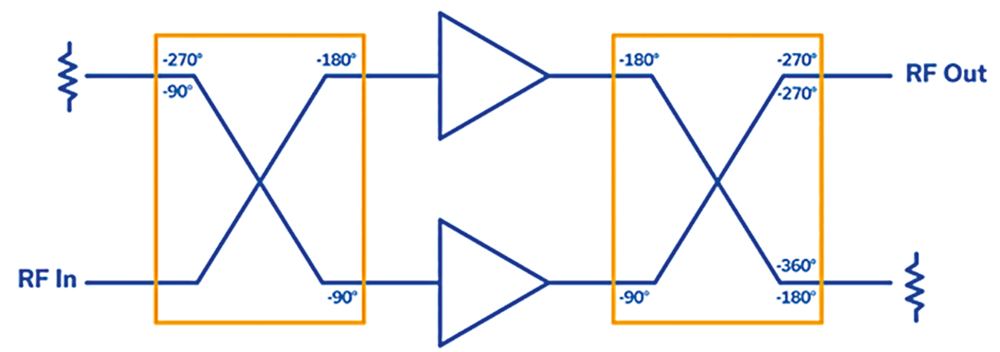 Figure 1. Generic block diagram of a balanced amplifier showing total signal phase shifts.
Looking at the quadrature hybrid schematic, each of the horizontal and vertical lengths between ports is referred to as a leg. Moving counter-clockwise, the signal shifts -90° for each leg traversed to arrive at a given port. Therefore, the lower output signal is shifted -90° (one leg counter-clockwise from the input port), and the upper output signal is shifted -180° (two legs counter-clockwise). Therefore, in the ideal, theoretical case, the signal incident on each amplifier is equal in magnitude and 90° out-of-phase with its counterpart. Notice what happens at the isolated port: The counter-clockwise-travelling signal experiences a phase shift of -270°, or three legs to get there, whereas the clockwise-travelling signal needs only a single -90° leg. The two signals are exactly 180° out-of-phase, and perfectly cancel, such that no power is dissipated in the 50 Ω termination resistor at the isolated port.
Recombining balanced RF output signals
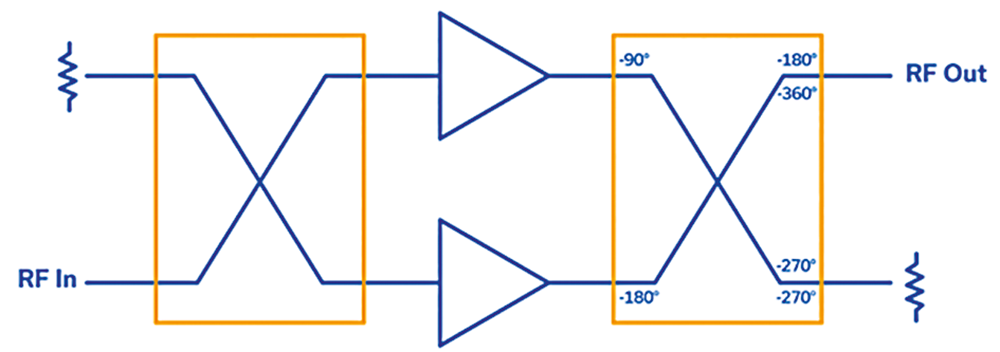
To recombine two amplifier devices operated 90° out-of-phase, the process that was performed when splitting the signal by orienting the hybrid in the opposite direction is essentially inverted. To show this, the associated phase shifts can be examined.
The lower device operates at -90°, the inversion of the phase shift from the input signal, and its output takes the long way back to the combined port, travelling another two legs counter-clockwise (-180°) for a total phase shift of -270°. The output signal of the upper device, already operating at -180° of phase shift, takes the short way home, just a single -90° leg, also becoming incident on the combined port at -270°. The two signals combine perfectly in phase, and the quad-combined pair operates at double the power output and double the IP3 (+3 dB) of either amplifier on its own. Once again, the signals incident at the isolated port are exactly 180° out-of-phase and perfectly cancel, so no power is dissipated in the 50 Ω termination resistor.
Low-power balanced amplifier application and the input port advantage
One common application for the balanced amplifier is in the low noise amplifier (LNA) of a receiver front end. In addition to high linearity/OIP3 requirements, designers are intent on squeezing every tenth of a dB of noise figure out of the LNA. The trade-off for the desired combination of linearity and noise figure performance, however, is degradation of the input return loss and VSWR of the device. It is not uncommon to find broadband, sub -1 dB noise figure, > 40 dBm OIP3 LNA MMICs with input VSWRs in the neighbourhood of 2:1.
This problem becomes even more significant when LNAs are designed with discrete devices such as GaN MESFETs, for which the input impedance is inordinately low. Utilising a quad-combined pair of low-noise, high-IP3 amplifiers is a common technique for improving VSWR in LNA designs.
The assumption, however, is that the amplifiers are ideal, lossless quads, perfectly matched to 50 Ω and identical in insertion phase. These conditions are impossible and some signal reflection between stages is expected.
Starting at the bottom, the -90° input of the lower device bounces straight back to the RF input. The reflected signal traverses one leg in the clockwise direction and therefore experiences another -90° of phase shift for a total of -180° at the RF input port. Likewise, the upper device reflects its input signal back to the RF input with an additional -180° of phase shift, for a total phase angle of -360°. The two reflected wavefronts are 180° out-of-phase at the RF input and cancel, effectively eliminating the effects of impedance mismatch at the amplifier inputs. The reflected signals are fully in-phase and combine at the isolated port, but the combined power is dissipated in the 50 Ω termination resistor with no effect upstream.
This means that the balanced amplifier not only doubles the total power output and IP3 of either amplifier alone, but also buffers the rest of the circuit from reflective elements commonly seen in discrete amplifiers with low noise and high IP3 performance. There are many other practical considerations such as whether the insertion loss of the hybrid is low enough to have only a modest impact on noise figure and whether the mismatch loss of running a 50 Ω hybrid into a poorly matched device is worth the input VSWR stabilisation. Overall, however, the high-linearity, low-noise, quad-combined pair is a proven technique for designing high-performance LNAs that have been widely used by circuit designers for decades.
Buffering output mismatch and load impedance variations
The emphasis up to this point has been on the -90° phase shifts that occur in the hybrid, enabling phase cancellation or in-phase combination, and the benefits these attributes offer for LNA design. But beyond the improvements in noise figure, IP3, and output power, quad-combined-pairs are remarkably effective at improving system performance anywhere a system connects to an imperfect load.
Figure 2 shows the phase shifts that a wavefront fully reflected from the output would experience, assuming an initial phase shift at the RF input port of 0°. Initially, the reflected signal traverses the quad and is incident upon the amplifier outputs at -90° for the through path (upper device) and -180° for the coupled path (lower device). The upper phase shifts correspond to the upper device and the lower phase shifts correspond to the lower device in the figure.
Once the respective reflected signals hit the associated amplifier, they will reflect once again towards the output. The signals reflected off the internal devices are exactly 180° out-of-phase at the RF output port, the upper device’s reflection at 180° and the lower device’s reflection at 360°. This cancelling of the reflected signals is very similar to the input VSWR effect discussed previously. Finally, the signal first reflected off the load, and then the internal devices, combines in-phase at the termination resistor.
In essence, the RF output port of the quad-combined amplifier exhibits an excellent output VSWR because, looking back into the RF output from the load, there is theoretically no power reflected off the devices (VSWR = 1:1). Practically it is known that this is not possible for many reasons, but the effect of quadrature combining is pronounced, and the output VSWR of a quad-combined pair can be improved over that of a single device and stabilised against load impedance variations.
Summary
Because balanced amplifiers can be complex to analyse mathematically, this application note focused on providing a conceptual overview to make the basic theory of the operation accessible. The advantages of configuring a pair of amplifiers in quadrature and recombining them are many. This article discussed only the theoretically ideal case, and while practical considerations may often limit the performance of this quadrature-combined configuration, it is still a valuable tool.
Mini-Circuits’ wide selection of LTCC and MMIC 90° hybrids are popular for balanced amplifier configurations. A series of dual-matched MMIC amplifiers for both 50 and 75 Ω impedance environments, which combine two matched amplifier dies in a single, tiny QFN package, are also available. Combined with the aforementioned quads, these devices are a great solution to save space and simplify board layouts for balanced amplifier implementations.
| Tel: | +27 87 265 2544 |
| Email: | [email protected] |
| www: | www.conical.co.za |
| Articles: | More information and articles about Conical Technologies |






© Technews Publishing (Pty) Ltd | All Rights Reserved
 printer friendly version