Mobile operators have started shutting down 2G networks to free up frequency bands for the newer 4G and 5G communication signals. Module manufacturers have, therefore, made their 2G modules end-of-life, and are now moving their low-cost 4G modules to Cat 1 bis only and doing away with the 2G Fallback. Cat 1 bis requires only one antenna instead of the two required by Cat 1 networks, allowing for a more compact and simpler design.
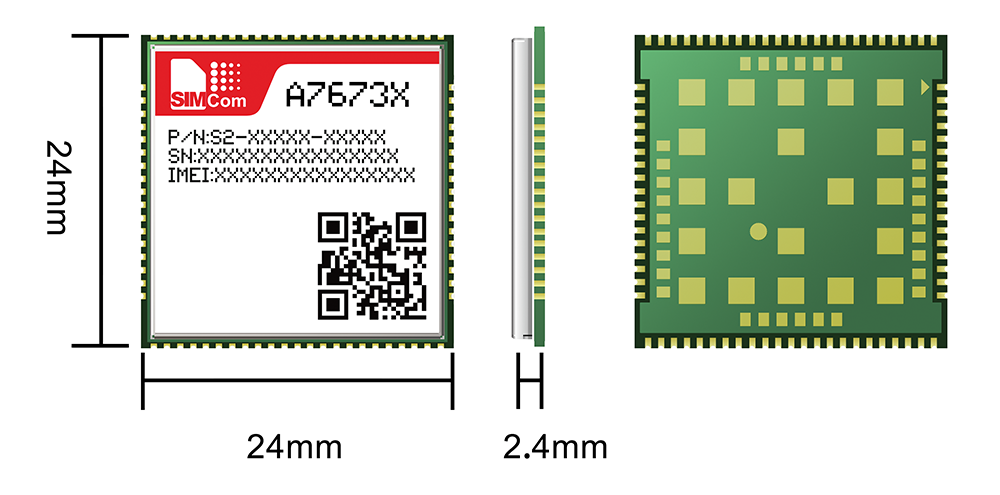
The SIMCom strategy is no different, and the company recently released the A7673X series, a Cat 1 bis module based on the ASR1606 chipset. The module supports LTE-FDD, with a maximum downlink rate of 10 Mbps, and an uplink rate of 5 Mbps.
The A7673X series adopts the LCC+LGA form factor, and is AT command compatible with the A7670 R2 series, the SIM7000/SIM7070 series, and the SIM800/SIM800F series. This enables smooth migration from 2G/NB/CATM products to LTE Cat 1 products, and facilitates more compatible product design for customer needs.
A7673X series supports both multiple built-in network protocols and the drivers for three main operation systems – Windows, Linux and Android. The software functions and AT commands are compatible with the SIM800 Industrial standard. The modules feature interfaces for expandability such as UART, USB, I2C, and GPIO, making them suitable for IoT applications such telematics, metering, surveillance devices, and industrial routers.
Simplifying system design iCorp Technologies
Telecoms, Datacoms, Wireless, IoT
The FGMC63N tri-band MCU Wi-Fi 6E module from Quectel addresses offers integrated connectivity across 2,4 GHz, 5 GHz, and 6 GHz bands in a compact, highly optimised design.
Read more...Dragino’s connectivity catalogue Otto Wireless Solutions
Telecoms, Datacoms, Wireless, IoT
Where Wi-Fi demands frequent charging and covers tens of meters, and traditional cellular consumes too much power for battery-operated nodes, LoRaWAN threads the needle.
Read more...RF filters explained RFiber Solutions
Telecoms, Datacoms, Wireless, IoT
As RF environments become increasingly crowded, RF filters play a critical role in maintaining signal quality, improving system performance, and ensuring reliable operation.
Read more...Practical design strategies for 5G RF Design
Telecoms, Datacoms, Wireless, IoT
The Cavli CQM211 aims to provide a platform that combines strong 5G connectivity with onboard compute capability, as well as interface flexibility that suits both new designs and rapid migrations from earlier products.
Read more...An industry-first Android 16 smart module solution RF Design
Computer/Embedded Technology Telecoms, Datacoms, Wireless, IoT
The MeiG Smart SLM580 4G Smart Module features native support for Android 16 and covers core frequency bands in major countries and regions worldwide.
Read more...High performance RF signal conditioning RFiber Solutions
Telecoms, Datacoms, Wireless, IoT
The AM3269 from Mercury Systems is a high-performance RF preselector module designed to improve receiver sensitivity and signal integrity in demanding electronic warfare, signals intelligence, test, and communications applications.
Read more...RF filters explained RFiber Solutions
Telecoms, Datacoms, Wireless, IoT
As RF environments become increasingly crowded, RF filters play a critical role in maintaining signal quality, improving system performance, and ensuring reliable operation.
Read more...Industrial connectivity without compromise
Telecoms, Datacoms, Wireless, IoT
The IR315 combines 4G LTE, Wi-Fi, Ethernet, and VPN technologies into a rugged, industrial-grade platform that enables seamless connectivity across a wide range of applications.
While every effort has been made to ensure the accuracy of the information contained herein, the publisher and its agents cannot be held responsible for any errors contained, or any loss incurred as a result. Articles published do not necessarily reflect the views of the publishers. The editor reserves the right to alter or cut copy. Articles submitted are deemed to have been cleared for publication. Advertisements and company contact details are published as provided by the advertiser. Technews Publishing (Pty) Ltd cannot be held responsible for the accuracy or veracity of supplied material.









 printer friendly version