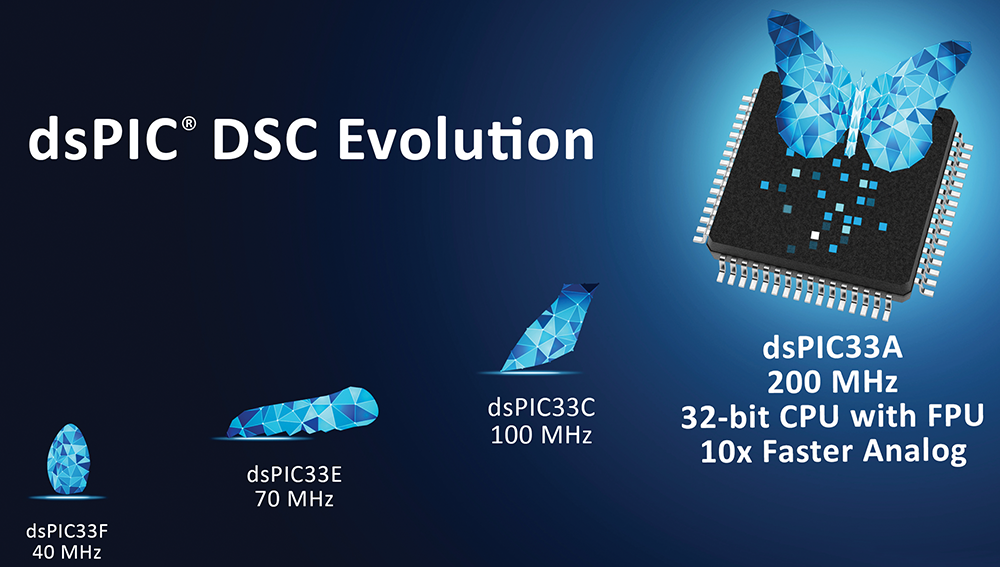
As embedded systems become more complex, and the need for enhanced performance increases, Microchip Technology has launched its dsPIC33A Core family of digital signal controllers (DSCs). The ability for engineers to create sophisticated, computationally intensive embedded control algorithms is crucial for achieving superior operational efficiency in motor control, power supply, charging and sensing systems.
Built around a 32-bit CPU architecture with a 200 MHz operating speed, the dsPIC33A family’s advanced core includes a Double-Precision Floating-Point Unit (DP FPU) and DSP instructions for numerically intensive tasks in many closed-loop control algorithms. The dsPIC33A architecture offers high-performance and precise real-time control, coupled with a comprehensive development tool ecosystem to streamline and accelerate the design process.
The dsPIC33A device families are outfitted with Flash security capabilities, including an immutable Root of Trust, secure debugging and restricted memory access. The DSCs’ instruction set architecture enables the adoption of software code generated by model-based designs to simplify code generation. The combined features make dsPIC33A DSCs well suited for applications that require efficient motor control for fans, pumps and compressors; they also manage digital power conversion for applications like AI servers and on-board chargers in electric vehicles, and enable sensor interfacing for industrial and automotive applications.
The first family of dsPIC33AK128MC1xx DSCs includes 128 kB Flash and an extensive peripheral set, offered in various packages, including SSOP, VQFN and TQFP options ranging from 28 to 64 pins, with package dimensions as small as 4 x 4 mm.
Flash memory devices for high-capacity mobile storage
DSP, Micros & Memory
KIOXIA has begun sampling new Universal Flash Storage Ver. 4.1 embedded memory devices with 4-bit-per-cell, quadruple-level cell technology.
Read more...Microchip expands maXTouch M1 touchscreen controller Altron Arrow
DSP, Micros & Memory
Microchip Technology has again expanded its maXTouch M1 family of touchscreen controllers, now covering free-form widescreen format displays up to 42 inches down to small compact screens in the 2 to 5 inch range.
Read more...ToF sensor with 6 m range Altron Arrow
Test & Measurement
Specifically designed for long-range, multitarget measurements, the VL53L4CX from ST Microelectronics provides very accurate distance measurements up to 6 m with excellent results over short distances.
Read more...SoC with improved processing and efficiency Future Electronics
DSP, Micros & Memory
The nRF54L Series of 2,4 GHz SoCs from Nordic Semiconductor is an upgrade on the previous nRF52 Series and offers advanced Bluetooth connectivity, improved processing power and efficiency, and high security capabilities.
Read more...Microchip expands its Arm Cortex-M0+ portfolio Altron Arrow
DSP, Micros & Memory
PIC32CM PL10 MCUs feature a rich set of Core Independent Peripherals, 5 V operation, touch capabilities, integrated toolsets, and safety compliance.
Read more...More room to scale Altron Arrow
Power Electronics / Power Management
With the latest STM32H5 lines from STMicroelectronics, you can now scale within the same platform, from a compact 1 Mbyte device to higher-memory MCUs for graphics-rich and feature-heavy designs.
Read more...1 GHz crossover MCU with Arm Cortex Cores Future Electronics
DSP, Micros & Memory
i.MX RT1170 Crossover MCUs, from NXP Semiconductor, are dual-core devices featuring an Arm Cortex-M7 and Arm Cortex-M4 for real-time microcontroller (MCU) performance and high integration for automotive, industrial and IoT applications.
Read more...NECTO studio update 7.5.0
DSP, Micros & Memory
MIKROE have continued their collaboration with Renesas by introducing support for the RL78 architecture in NECTO Studio, expanding the IDE beyond its existing MCU platforms.
Read more...Multi-constellation GNSS module in a legacy-compatible footprint Altron Arrow
Telecoms, Datacoms, Wireless, IoT
Telit Cinterion has announced the SE869eK2L, a single-frequency L1 GNSS module designed to help device manufacturers upgrade legacy positioning designs with improved performance and cost efficiency, while preserving design continuity.
Read more...Compact SSI family for industrial automation Altron Arrow
Passive Components
Infineon Technologies has introduced the ISSI20BxxF Solid State Isolator (SSI) family, bringing solid-state isolation technology into high-volume applications traditionally served by photovoltaic isolators (PVIs), photovoltaic relays (PVRs), and electromechanical relays (EMRs).
While every effort has been made to ensure the accuracy of the information contained herein, the publisher and its agents cannot be held responsible for any errors contained, or any loss incurred as a result. Articles published do not necessarily reflect the views of the publishers. The editor reserves the right to alter or cut copy. Articles submitted are deemed to have been cleared for publication. Advertisements and company contact details are published as provided by the advertiser. Technews Publishing (Pty) Ltd cannot be held responsible for the accuracy or veracity of supplied material.









 printer friendly version