Quectel’s RG255C-NA and RM255C-GL accelerate 5G RedCap adoption
28 February 2026Editor's Choice
Telecoms, Datacoms, Wireless, IoT
The evolution of 5G is entering a new phase. While early deployments focused on enhanced mobile broadband (eMBB) for high-speed consumer applications, the next wave of growth is being driven by industrial IoT, smart infrastructure and connected devices that require balanced performance, efficiency, and scalability. At the centre of this shift is 5G Reduced Capability (RedCap) technology, defined under 3GPP Release 17, which is designed to bridge the gap between high-end 5G modules and lower-speed LTE solutions.
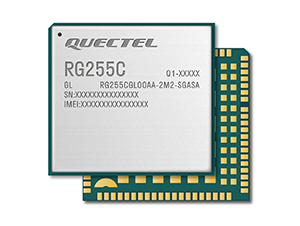
Figure 1. RG255C-NA.
Quectel’s RG255C-NA and RM255C-GL modules represent a strategic move into this fast-growing segment, delivering Sub-6 GHz 5G connectivity optimised for mid-tier IoT applications. By combining reliable throughput, reduced complexity and improved power efficiency, these modules provide an ideal solution for industrial and commercial deployments transitioning to 5G.
Understanding the role of 5G RedCap
RedCap technology is engineered for devices that do not require the extremely high data rates or antenna complexity of traditional 5G eMBB modules, but still benefit from 5G’s lower latency, network slicing, and long-term scalability. Typical applications include smart meters, industrial automation systems, telematics units, asset trackers, gateways, and fixed wireless access (FWA) devices.
With theoretical peak data rates of up to 223 Mbps downlink and 123 Mbps uplink, the RG255C-NA and RM255C-GL deliver more than sufficient bandwidth for these use cases. At the same time, RedCap reduces hardware complexity by lowering bandwidth requirements and RF design overhead, resulting in more cost-effective and power-efficient deployments.
Both modules support 5G Standalone networks and maintain backward compatibility with LTE, ensuring seamless operation in areas where 5G coverage is still expanding.
Two form factors for diverse integration needs
Although the RG255C-NA and RM255C-GL share a common technology platform, they are designed for different integration strategies.
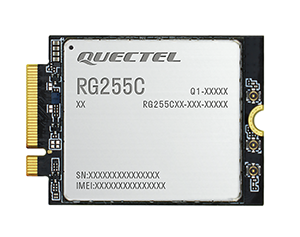
Figure 2. RM255C-GL in M.2 form factor.
The RG255C-NA comes in a compact LGA package measuring 29,0 x 32,0 x 2,4 mm, making it well suited for space-constrained embedded systems. This variant is tailored specifically for North American frequency bands, enabling OEMs targeting the US and Canadian markets to streamline certification and deployment.
The RM255C-GL, in contrast, adopts a widely used M.2 form factor (30,0 x 42,0 x 2,3 mm). This design makes it particularly attractive for industrial PCs, routers, and gateways equipped with M.2 slots. One of its key advantages is pin-to-pin compatibility with several existing Quectel LTE and 5G modules, allowing manufacturers to upgrade product lines to 5G RedCap with minimal hardware redesign.
Industrial-grade performance
Designed with demanding environments in mind, both modules support an operating temperature range of -30°C to 75°C, with extended temperature options available for harsher industrial settings. This makes them suitable for outdoor installations, utility infrastructure, and transportation systems.
The modules incorporate advanced 5G features including:
• Ultra-Reliable Low Latency Communication for time-sensitive applications.
• Network slicing, enabling dedicated logical networks for specific services.
• 5G LAN support, allowing 5G to function as a virtual local area network.
• Device Firmware Over-the-Air for remote updates and lifecycle management.
Optional multi-constellation GNSS support – including GPS, GLONASS, Galileo, BeiDou, QZSS and NavIC – adds precise positioning capability, expanding their suitability for fleet management, logistics, and tracking solutions.
The RG255C-NA and RM255C-GL provide a comprehensive range of interfaces, including USB 2.0, PCIe 2.0, UART, (U)SIM, SPI, and PCM. Driver support is available for Windows, Linux, and Android platforms, complemented by Quectel’s enhanced AT command set. This ensures flexibility across development environments and simplifies system design.
The RG255C-NA and RM255C-GL provide OEMs with flexible hardware options and a future-proof migration path toward 5G. Whether integrated directly onto embedded boards via LGA or deployed in modular gateway designs via M.2, these modules offer a scalable, standards-compliant solution aligned with the next generation of connected infrastructure.
Wireless connectivity expanded iCorp Technologies
Telecoms, Datacoms, Wireless, IoT
Espressif Systems has introduced two new members of its ESP32 wireless SoC family: the ESP32-E22, the company’s first Wi-Fi 6E connectivity chip, and the ESP32-H21, an ultra-low-power Bluetooth LE microcontroller aimed at coin-cell and battery-powered devices.
Read more...Women and the future of engineering in South Africa
Editor's Choice
With women making up just 16% of registered engineering professionals in South Africa, AvenirHoldings CEO, Tshidi Mndzebele, is calling on women engineers and graduates to pursue formal professional registration as a key step to unlocking career growth and industry leadership.
Read more...Quectel expands 5G portfolio iCorp Technologies
Telecoms, Datacoms, Wireless, IoT
Quectel expands 5G portfolio with new Qualcomm- and UNISOC-based modules.
Read more...The effect of seasonal changes on ESD performance in South Africa Actum
Editor's Choice Circuit & System Protection Manufacturing / Production Technology, Hardware & Services
Electrostatic discharge performance is influenced by several environmental factors, with relative humidity being one of the most important. This is particularly relevant in South Africa, where seasonal changes can result in significant differences in humidity levels.
Read more...Compact RTK design: More than just the receiver iCorp Technologies
Editor's Choice Telecoms, Datacoms, Wireless, IoT
In practice, engineers building compact RTK products keep discovering the same thing: the hardest component in the system is no longer the receiver. It is the antenna.
Read more...The signal-to-noise challenge in large-scale IIoT Sigfox South Africa
Editor's Choice Telecoms, Datacoms, Wireless, IoT
For much of the last decade, the industrial IoT industry has been driven by a relatively simple assumption: if a little data is useful, more data must be better. That thinking shaped countless deployments.
Read more...Simplifying RS485 network design iCorp Technologies
Telecoms, Datacoms, Wireless, IoT
Aipu Power has added the RS485-XXXSAV to its transceiver module range, a single-channel isolated RS485 transceiver that bundles power isolation, signal isolation, RS485 interface and bus protection into one drop-in module, aimed at simplifying RS485 network design in industrial equipment.
Read more...Women building South Africa’s power infrastructure
Editor's Choice
As South Africa celebrates Women’s Month in August, women are increasingly taking their place on the factory floor, in technical workshops and across engineering environments, helping manufacture the infrastructure that keeps the country’s electricity network running.
Read more...More efficient production with optimised procurement
Editor's Choice
The smallest part on the BOM is usually the one that holds it up. Interconnect, passive and electromechanical components rarely get attention until they are missing. That is starting to change, and it is reshaping how procurement teams think about risk.
Read more...SGMICRO expands analogue IC portfolio iCorp Technologies
Passive Components Telecoms, Datacoms, Wireless, IoT
SGMICRO continues to add to its analogue IC portfolio at a steady pace, with new devices released across power protection, power conversion, current sensing and RF signal-chain categories.
While every effort has been made to ensure the accuracy of the information contained herein, the publisher and its agents cannot be held responsible for any errors contained, or any loss incurred as a result. Articles published do not necessarily reflect the views of the publishers. The editor reserves the right to alter or cut copy. Articles submitted are deemed to have been cleared for publication. Advertisements and company contact details are published as provided by the advertiser. Technews Publishing (Pty) Ltd cannot be held responsible for the accuracy or veracity of supplied material.









 printer friendly version