OEM teams working on high throughput 5G IoT devices often encounter the same set of engineering hurdles. Designing for full 5G performance can place pressure on the rest of the hardware layout, and development teams are usually forced to choose between deep optimisation and the need to meet tight delivery timelines. The result is familiar: repeated PCB revisions, interface compromises, and upgrade paths that become more complex with every product cycle.
Three issues appear consistently in these projects. First, engineers must extract 5G level throughput without allowing the module to dominate or restrict the overall system architecture. Second, teams need to balance customisation with time to market, particularly when several SKUs or regional variants are required. Third, companies must plan a smooth path from LTE or transitional designs to full 5G NR without having to rebuild their hardware approach each time.
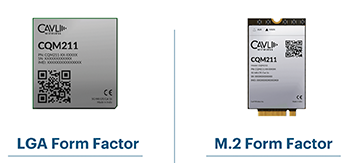
The Cavli CQM211 was developed to address exactly this tension. It aims to provide a platform that combines strong 5G connectivity with onboard compute capability, as well as interface flexibility that suits both new designs and rapid migrations from earlier products.
The CQM211 is a 5G NR and LTE Cat 16 cellular IoT module built as a complete connectivity and compute platform. It is powered by the Qualcomm SDX61 chipset, which supports modern 5G architectures where processing, networking, and security functions share the workload.
The module includes an Arm Cortex A7 CPU that operates up to 1,8 GHz, supported by a Hexagon DSP that reaches up to 1,5 GHz in Turbo mode. It runs the OpenWrt operating system and offers an extensive SDK, giving developers a familiar Linux environment for networking tasks, device management, and security tooling. With 1 GB LPDDR4X memory and 4 GB NAND storage, the module has sufficient capacity for logs, certificates, containers, and update systems. Support for three carrier aggregation ensures stable throughput for data intensive IoT applications.
Wireless connectivity expanded iCorp Technologies
Telecoms, Datacoms, Wireless, IoT
Espressif Systems has introduced two new members of its ESP32 wireless SoC family: the ESP32-E22, the company’s first Wi-Fi 6E connectivity chip, and the ESP32-H21, an ultra-low-power Bluetooth LE microcontroller aimed at coin-cell and battery-powered devices.
Read more...Integrated X-band radar front-end module RF Design
Telecoms, Datacoms, Wireless, IoT
Qorvo has introduced an X-band radar front-end solution that enables defence system designers to achieve higher performance without increasing size, weight or prime power.
Read more...Introducing Aurata CST Electronics
Telecoms, Datacoms, Wireless, IoT
Antenova has launched Aurata SR4L112: a compact, high efficiency embedded 4G/LTE antenna engineered for long, narrow PCB designs.
Read more...Multi-constellation GNSS module in a legacy-compatible footprint Altron Arrow
Telecoms, Datacoms, Wireless, IoT
Telit Cinterion has announced the SE869eK2L, a single-frequency L1 GNSS module designed to help device manufacturers upgrade legacy positioning designs with improved performance and cost efficiency, while preserving design continuity.
Read more...Quectel expands 5G portfolio iCorp Technologies
Telecoms, Datacoms, Wireless, IoT
Quectel expands 5G portfolio with new Qualcomm- and UNISOC-based modules.
Read more...Surface mount power amplifier for high-power applications RF Design
Power Electronics / Power Management
The GNA-63-5W+, from Mini-Circuits, is a GaN MMIC Power Amplifier (PA) designed for demanding RF applications requiring high efficiency, excellent linearity, and a compact footprint.
Read more...Compact RTK design: More than just the receiver iCorp Technologies
Editor's Choice Telecoms, Datacoms, Wireless, IoT
In practice, engineers building compact RTK products keep discovering the same thing: the hardest component in the system is no longer the receiver. It is the antenna.
Read more...Microchip advances Space-Grade timing performance ASIC Design Services
Telecoms, Datacoms, Wireless, IoT
Microchip Technology has expanded its atomic clock portfolio with the radiation-tolerant Space CSAC-SA65, a Chip Scale Atomic Clock designed to deliver precise timing for space systems.
Read more...Channel emulator for 6 G and Wi-Fi 7/8 Concilium Technologies
Telecoms, Datacoms, Wireless, IoT
With 400 MHz instantaneous bandwidth and support for carrier frequencies up to 23,6 GHz, Vertex 6.0 is the industry’s first channel emulator designed for next generation 6 G and Wi-Fi 7/8 testing.
Read more...Secure, low-power Bluetooth LE SoC NuVision Electronics
Telecoms, Datacoms, Wireless, IoT
Silicon Labs unveils BG2B, its lowest-power Bluetooth LE SoC with industry-leading power efficiency, security, and integration.
While every effort has been made to ensure the accuracy of the information contained herein, the publisher and its agents cannot be held responsible for any errors contained, or any loss incurred as a result. Articles published do not necessarily reflect the views of the publishers. The editor reserves the right to alter or cut copy. Articles submitted are deemed to have been cleared for publication. Advertisements and company contact details are published as provided by the advertiser. Technews Publishing (Pty) Ltd cannot be held responsible for the accuracy or veracity of supplied material.









 printer friendly version